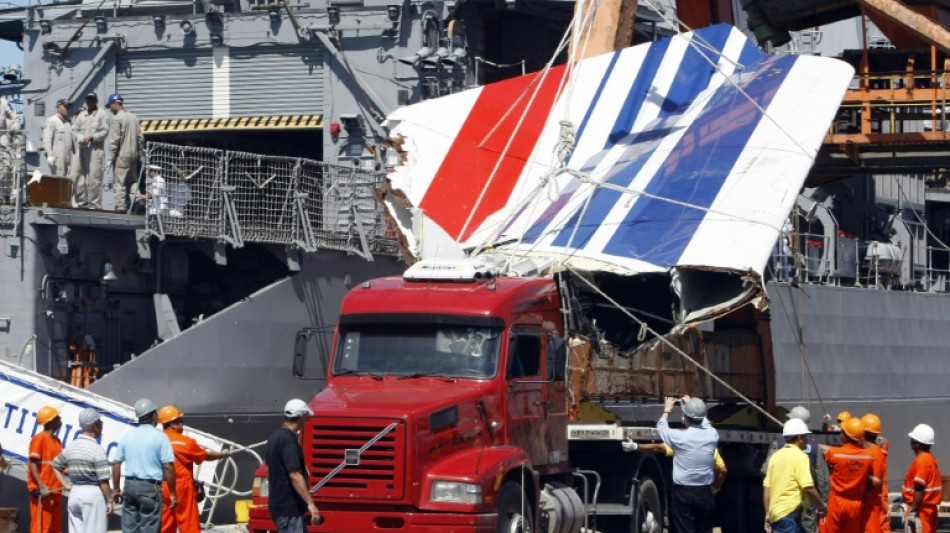
No convictions sought in French court over 2009 Rio-Paris crash / Photo: Evaristo SA - AFP/File
 Trump names Stephen Miller as White House chief of staff after midterm losses

 Restored Albanian tower houses anchor new rural tourism trail

 Sonia Gandhi reflects on family tragedy and reluctant political career

 Pope Leo begins three-country South American tour in Uruguay

 Khawaja says entire Australia camp knew of 2018 ball-tampering plan

 November Foraging Guide: Edible Mushrooms and Critical Safety Protocols

 Microsoft Updates Xbox PC App with 60% Faster Startup and Redesigned Interface

 Early Polar Vortex Disruption Creates Uncertain Winter Outlook for Pennsylvania

 How to Enjoy Luxury Experiences on a Budget

 Pakistan Demands Grant-Based Climate Finance at COP31 to Avoid Debt Trap
French prosecutors said Wednesday it was "impossible" to convict Air France and plane maker Airbus over the 2009 crash of a Rio-Paris flight, enraging victims' families after an eight-week trial.
In an unusual conclusion to proceedings, prosecutors said they could not recommend a guilty verdict for the two companies which have been charged with involuntary manslaughter over the air disaster.
Their guilt "appears to us to be impossible to prove," prosecutor Pierre Arnaudin told the court in Paris.
"We know that this view will most likely be difficult to hear for the civil plaintiffs, but we are not in a position to demand the conviction of Air France and Airbus," he added.
The decision not to seek a conviction by prosecutors does not mean that the three-person team of judges overseeing the trial has to follow their advice.
The two France-based companies went on trial in October to determine their responsibility for the worst aviation disaster in Air France's history, which left 228 dead on board flight AF447.
Both denied the involuntary manslaughter charges that carry a maximum fine of 225,000 euros ($236,000).
Prosecutors initially dropped charges against the companies in 2019 in a decision that also infuriated victims' families.
A Paris appeals court overturned this decision in 2021 and ordered the trial to go ahead.
"We have a prosecutor who is supposed to defend the people who in the end is defending the multinational Airbus," Daniele Lamy, the head of the Entraide et Solidarite AF447 association, told reporters on Wednesday.
She denounced a "trial skewed against the pilots".
"I'm ashamed to be French," one furious civil plaintiff said as they left the court on Wednesday. "What's the justice system for?" asked another.
- Pilot error -
At the heart of hearings in Paris has been the role of defective so-called Pitot tubes, which are used to measure the flight speed of aircraft.
The court heard how a malfunction with the tubes, which became blocked with ice crystals during a mid-Atlantic storm, caused alarms to sound in the cockpit of the Airbus A330 and the autopilot system to switch off.
Representatives from Airbus and Air France as well as technical experts have highlighted how the pilots put the plane into a climb after the instrument failure, causing the engines to stall.
"For us, what led the crew to react in the way they did remains a mystery in most respects," Air France representative Pascal Weil, a former test pilot, told the court on November 10.
Airbus has also blamed pilot error as the main cause for the crash during proceedings.
But lawyers for victims' families have emphasised how both companies were aware of the Pitot tube problem before the crash, and that the pilots were not trained to deal with a high-altitude emergency of this nature.
The court heard how 17 different incidents of defective Pitot tubes on Airbus aircraft were reported in the year before the crash, with Airbus and Air France previously warning their clients and pilots about the issue.
Air France's reaction was "too slow and insufficient," Thibault de Montbrial, a lawyer representing German victims, told the court on December 1.
He said at the time that the association he represented -- HIOP -- "feared for a long time ... that there was a form of state interest in putting a lid over this case."
- 'Stall, stall' -
Chief prosecutor Marie Duffourc acknowledged on Wednesday that the legal proceedings had been "far too long", meaning the "suffering has been endlessly rekindled over these last 13 years."
The model of Pitot tube used on the doomed Airbus plane, manufactured by French company Thales, was replaced on aircraft worldwide after the accident.
The crash also prompted an overhaul of training protocols across the industry, in particular to prepare pilots to handle the intense stress of unforeseen circumstances.
On October 17, lawyers and victims' families were allowed to listen to the chilling in-flight voice recording of the pilots' final minutes for the first time.
"We've lost our speeds," one pilot is heard before a recorded warning sounds -- "stall, stall, stall" -- and the aircraft begins to plunge towards the Atlantic Ocean.
It took nearly two years to recover the "black box" flight recorders which were found nearly 4,000 metres below sea level.
J.Oliveira--AMWN

