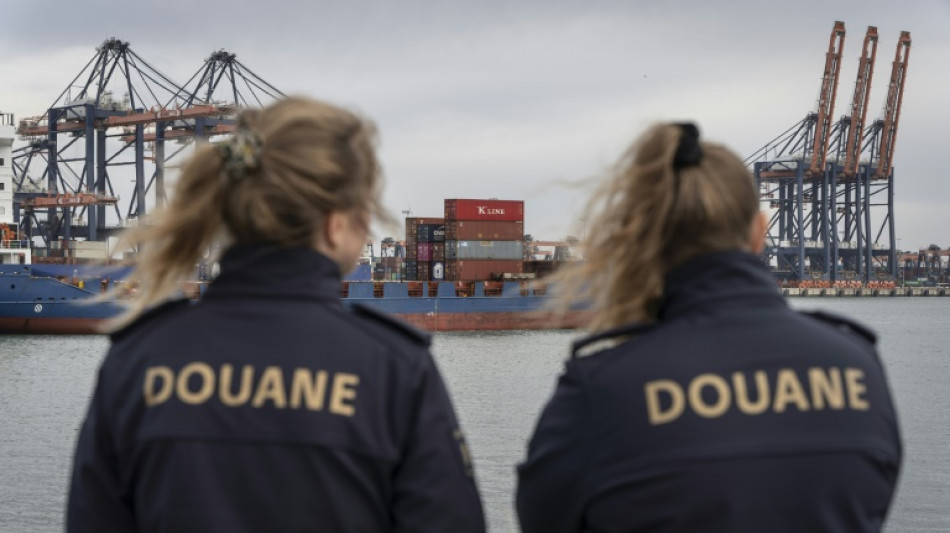
Europe's biggest port 'drowning in cocaine' / Photo: Simon Wohlfahrt - AFP
 ChatGPT interactive interface feature tested across six custom tools

 Freshways milk-price cut deepens pressure on UK dairy farms

 Labour and National remain virtually tied as New Zealand vote count advances

 The Good Daughter adapts Karin Slaughter thriller with Rose Byrne and Meghann Fahy

 Heavy-lift drone evacuates wounded Ukrainian soldier from frontline kill zone

 Morrison says West Brom recovered after pressure from successive derby losses

 Britain considers 2027 state visit for Ukraine’s Zelensky

 Anna Miltina Confronted with Racism Allegations on ProSieben Show

 German Auto Giants Face Existential Crisis as China Sales Plummet

 Cause of Death Revealed for 'Ellen' Producer Matthew Wright

 DEA Marijuana Rescheduling Hearing Closes With Government Not Meeting Its Burden Of Proof?

 Edmund Richardson Wins Baillie Gifford Prize for 'Alexander' Biography

The millions of containers unloaded by Rotterdam's giant cranes make it Europe's largest port, but the Dutch city is also dealing with ever larger amounts of a less welcome cargo: cocaine.
A record of nearly 70 tonnes of the drug was intercepted in 2021, up 74 percent from a year before, said Ger Scheringa, who leads a team of armed customs officers at the port.
Rotterdam and Antwerp in neighbouring Belgium were the two main entry points used by a Dubai-based "super cartel" supplying a third of Europe's cocaine, which Europol said it busted last month.
The cocaine is usually hidden in containers, or sometimes underneath ships in openings below the water line where they are then recovered by divers.
Pinpointing the reason for this jump in cocaine seizures is a "delicate question", Scheringa told AFP.
"It seems there are lots of buyers" in Europe, he said dryly.
"And if there is demand, it is supplied."
Rotterdam has taken major steps to stop the white powder making its way into Europe, particularly by stepping up customs checks, the Dutchman said.
But he doesn't expect Rotterdam's record for seizures to be beaten in 2022, and admitted that he "doesn't know if there is really a solution to the problem" as long as people keep taking cocaine.
- 'Needle in a haystack' -
Rotterdam mayor Ahmed Aboutaleb has deplored the fact that the port city is "drowning in cocaine", and condemns the violence that accompanies the drug trade.
Aboutaleb wants port authorities to scan all containers arriving from Latin America.
But customs official Scheringa said the "biggest challenge is to find a good balance between the speed of logistics for the port, and checking everything you want."
Gangs use sophisticated methods to send the cocaine through Rotterdam and then recover it afterwards, often relying on inside information, said Romilda Schaaf, a drugs specialist for the port police.
Maps on her computer show the dizzying scale of her patch, with tens of thousands of containers piling up at multiple terminals, meaning investigators need precise details to find smuggled drugs.
"It really is a question of finding a needle in a haystack," she told AFP.
Young men, often from the deprived south of Rotterdam according to prosecutors, sometimes spend several nights in "container hotels" equipped with food and blankets, close to where a container with cocaine is expected.
They then move the drugs to different containers so there is less chance of them being checked, particularly if they come from South America.
More than 70 people have been arrested so far this year for trafficking-related offences in the port, said Scheringa, including gang members and even port employees.
As recently as December 6, Dutch police said a 43-year-old female officer from Rotterdam was arrested over allegations of corruption and involvement in drug trafficking.
Gangs pay dockers and officials up to 100,000 euros to help get big batches through, Scheringa said.
It's easy money, said police official Schaaf, "but it leads to nothing. If you say yes once, you can't say no... (so) don't start in the first place!"
- Assassinations -
Dutch customs officers insist that good contacts with "source" countries are important to stem the flood of cocaine, along with tackling efforts to corrupt port employees -- and more checks.
A key part of the checks is risk assessment. Containers are singled out as suspect, often because of information from abroad, then scanned, unpacked and searched with sniffer dogs.
Some ships are also inspected by diving teams.
The automation of some parts of the port, and therefore the elimination of the human factor, has also helped to curb corruption, according to two officials.
Violence linked to the cocaine trade has deeply touched Dutch society.
A famous Dutch journalist and a lawyer who were involved in the trial of an alleged drug lord were assassinated in 2019 and 2021, shocking the country and convincing authorities to allocate more resources to a crackdown.
"The aim is really to assure people that they can live in safety, and that no politician, lawyer or crime reporter should have to be under protection because this junk is coming into our country," said Schaaf.
A.Rodriguezv--AMWN

