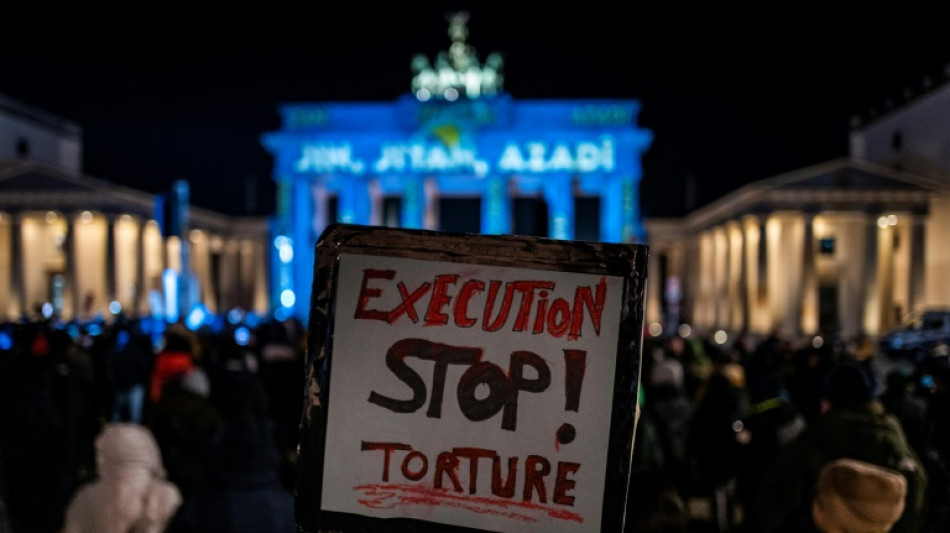
The young Iranians facing death penalty over protests / Photo: John MACDOUGALL - AFP
 ChatGPT interactive interface feature tested across six custom tools

 Freshways milk-price cut deepens pressure on UK dairy farms

 Labour and National remain virtually tied as New Zealand vote count advances

 The Good Daughter adapts Karin Slaughter thriller with Rose Byrne and Meghann Fahy

 Heavy-lift drone evacuates wounded Ukrainian soldier from frontline kill zone

 Morrison says West Brom recovered after pressure from successive derby losses

 Britain considers 2027 state visit for Ukraine’s Zelensky

 Anna Miltina Confronted with Racism Allegations on ProSieben Show

 German Auto Giants Face Existential Crisis as China Sales Plummet

 Cause of Death Revealed for 'Ellen' Producer Matthew Wright

 DEA Marijuana Rescheduling Hearing Closes With Government Not Meeting Its Burden Of Proof?

 Edmund Richardson Wins Baillie Gifford Prize for 'Alexander' Biography

A doctor, rap artists and a footballer are among around two dozen Iranians who risk being hanged as Tehran uses capital punishment as an intimidation tactic to quell protests, rights groups say.
The executions in the past week of Mohsen Shekari and Majidreza Rahnavard, both 23 and the first people put to death over the protests, sparked an outcry, especially as Rahnavard was hanged from a crane in public rather than in prison.
But campaigners warn that more executions will inevitably follow without tougher international action, with a dozen more people already sentenced to death over the protests and a similar number charged with crimes that could see them hanged.
"Unless the political cost of the executions is increased significantly, we will be facing mass executions," said Mahmood Amiry-Moghaddam, director of the Norway-based Iran Human Rights group.
He accused Iran's leaders of using executions to "spread fear among people and save the regime from the nationwide protests".
The largely peaceful protests sparked by the death in September of Mahsa Amini, who had been arrested for allegedly violating Iran's strict dress code for women, are posing the biggest challenge to the Islamic republic since the 1979 revolution.
There have been no reports of a slackening in protest activity in recent days, including after the executions, but the movement has been marked by phases of more and less intense demonstrations.
Authorities describe those facing death sentences as "rioters" who are being judged in full accordance with the country's sharia law.
But activists express alarm over the use of vaguely worded sharia legal charges against protesters, such as "enmity against God," "corruption on earth" and "armed rebellion", all of which are capital crimes in Iran.
- 'Unfair trial, torture' -
Amnesty International currently confirms 11 cases of death sentences issued against individuals over the protests, and another nine cases where individuals have been charged with crimes that could see them given the death penalty.
One young protester, Sahand Nourmohammad-Zadeh, was sentenced to death over charges -- which he denied -- that he did no more than tear down highway railings and set fire to rubbish bins and tyres, Amnesty said.
The group said it was concerned another young man, Mahan Sadrat, 22, could be executed "imminently" after being sentenced to death in a "grossly unfair trial" over accusations of using a knife to attack an individual.
Mohammad Ghobadlou, aged 22, was sentenced to death on charges of running over police officials with a car, killing one and injuring several others, Amnesty said, adding it had "serious concerns" he was subjected to torture and other abuse in jail.
Saman Seydi, a young Kurdish rapper, was sentenced to death on charges of firing a pistol three times into the air during protests, adding it had received information he had also been subjected to torture to extract forced confessions.
Before his arrest, Seydi had posted material on Instagram in support of the protests, while his rap songs had also been critical of the authorities.
Hamid Ghare-Hasanlou, a doctor, and his wife Farzaneh Ghare-Hasanlou were on their way to the funeral of a killed protester when they were "caught up in the chaos" of a fatal assault on a member of the Basij militia, Amnesty said.
Hamid Ghare-Hasanlou was sentenced to death and his wife to 25 years in prison, with the court relying on incriminating statements from his wife which Amnesty said were coerced and later retracted by her in court.
Her husband was tortured in custody and hospitalised with broken ribs, it said.
Those who face the death penalty after being charged with capital crimes include Toomaj Salehi, 32, a prominent rapper who was charged "solely in connection with critical music and social media posts," Amnesty said, adding that he had been tortured in detention.
The professional footballer Amir Nasr-Azadani, 26, is in a similar position after being charged over the deaths of three security officials in November in the city of Isfahan, it said.
The world union of professional footballers FIFPRO said it was "shocked and sickened" by the reports he faces death.
- Executed 'at any moment' -
Campaigners are seeking to highlight all individuals facing the death penalty in the hope that increased scrutiny on specific cases can help spare lives.
But they warn the executions are often sudden.
Rahnavard was hanged just 23 days after his arrest and shortly after a last meeting with his mother, who was given no inkling her son was about to be put to death.
Activists were also unaware of Shekari's case until his execution was announced by state media.
Amnesty said Iranian authorities are issuing, upholding and carrying out death sentences in a "speedy manner" and there is a "serious risk" that people whose death sentences have not been made public could be executed "at any moment."
"The executions of two people connected to the protests in Iran are appalling, and we are extremely worried for the lives of others who have been similarly sentenced to death," the office of the UN high commissioner for human rights told AFP.
It added that Iran had "ignored" its pleas not to carry out the executions.
B.Finley--AMWN

