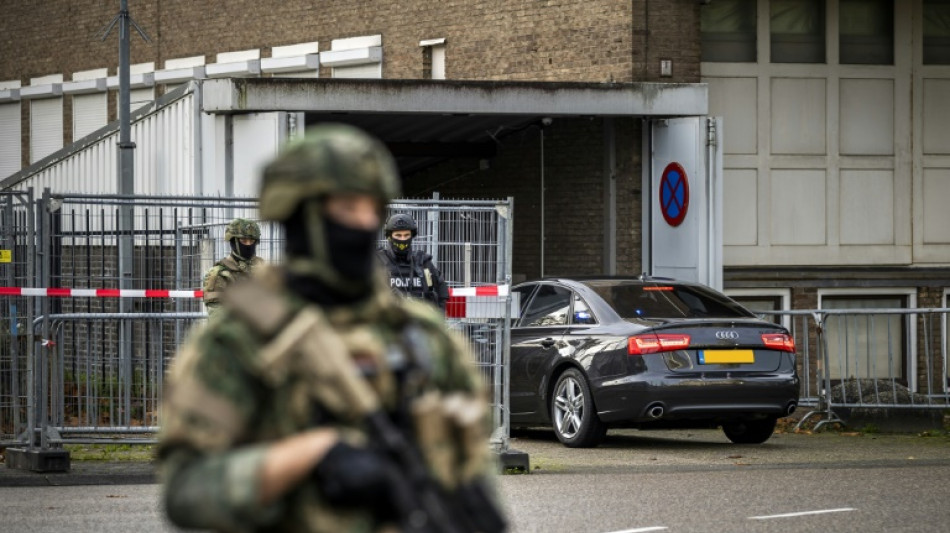
Drug kingpin trial 'ultimate test' for Dutch rule of law / Photo: Remko de Waal - ANP/AFP
 ChatGPT interactive interface feature tested across six custom tools

 Freshways milk-price cut deepens pressure on UK dairy farms

 Labour and National remain virtually tied as New Zealand vote count advances

 The Good Daughter adapts Karin Slaughter thriller with Rose Byrne and Meghann Fahy

 Heavy-lift drone evacuates wounded Ukrainian soldier from frontline kill zone

 Morrison says West Brom recovered after pressure from successive derby losses

 Britain considers 2027 state visit for Ukraine’s Zelensky

 Anna Miltina Confronted with Racism Allegations on ProSieben Show

 German Auto Giants Face Existential Crisis as China Sales Plummet

 Cause of Death Revealed for 'Ellen' Producer Matthew Wright

 DEA Marijuana Rescheduling Hearing Closes With Government Not Meeting Its Burden Of Proof?

 Edmund Richardson Wins Baillie Gifford Prize for 'Alexander' Biography

With shootings and threats against a princess and the prime minister it sounds like a crime drama, but for the Dutch the growing menace from drug cartels is all too real.
The top-security trial of one alleged cocaine cartel leader, Ridouan Taghi, has captivated the Netherlands in recent months and shone a light on the shadowy "Mocro Maffia".
The busting of a Dubai-based "super cartel" linked to Taghi, which used the Dutch port of Rotterdam as a hub, has further reinforced fears the liberal country could become a so-called narco-state.
Despite being behind bars in an ultra-secure prison, Taghi has been accused of pulling the strings of what prosecutors call his "killing machine" with secret messages to henchmen outside.
Commentators say the "Marengo" trial, named after a judicial codeword for the operation that saw Taghi charged with 16 others, is unprecedented for the Netherlands.
"The consequence of the Marengo trial, and the violence that was committed afterwards, that has simply caused a huge shock", Jan Meeus, a Dutch journalist specialising in criminal matters, told AFP.
Speaking after a recent hearing, he described it as "the ultimate test of the Dutch judicial system of the rule of law".
- 'Extreme violence' -
Three people linked to a key prosecution witness in the trial, Nabil B., have already been killed in scenes that shocked the Netherlands.
His brother was murdered in 2018, his lawyer Derk Wiersum was shot dead outside his house in 2019, and the prominent Dutch crime journalist Peter R. de Vries was killed in 2021.
Shot dead in broad daylight in central Amsterdam as he left a television studio, de Vries had said he was on the hit-list of Taghi, who was arrested in Dubai in 2019.
The army is guarding the "Bunker" in Amsterdam, where Taghi is on trial, in a first for the Netherlands. Judges and prosecutors arrive for hearings inside armoured cars.
Plans to spring Taghi from prison using "extreme violence" were uncovered, said Meeus. Taghi's cousin and one of his lawyers are accused of helping him communicate with the outside world.
"The democratic rule of law is shaken and under pressure from organised crime," Wim de Bruin, a spokesman for the national prosecutor's office, told AFP.
The threat has touched top levels of Dutch society.
Crown Princess Amalia, the daughter of King Willem-Alexander, was recently forced to give up plans to live in student accommodation for security reasons.
Both the 19-year-old royal and Prime Minister Mark Rutte were mentioned in messages by organised crime groups, raising fears of plans to kidnap or attack them, Dutch media reported.
- 'Dogs' -
Prosecutors say the gangsters have "no respect for human life", with members calling their victims "dogs" who must "sleep".
Nicknamed "Mocro Maffia" because many are of Moroccan descent, the gang is notorious for both the youth and the merciless violence of its members.
The violence has forced Dutch authorities to confront their own naivety about the level of organised crime in the country, a parallel economy worth several billion dollars.
The main Dutch police union, the NPB, has sounded the alarm for several years, with its president Jan Struijs warning some years ago it was slowly becoming a narco-state.
Struijs told AFP that the Netherlands' lenient policy on soft drugs was to blame.
The consumption and sale of cannabis have been decriminalised in the country but the rest of the supply chain that stocks famed Dutch "coffeeshops" remains illegal, with gangs muscling in on them.
- 'Tax paradise' -
But Marijn Schrijver, co-author of the bestselling book "Mocro Maffia", said that while the Netherlands' neighbours like to blame its lax soft drug policies, "that is not the reason".
"What we are is a tax paradise. We want to import as much as possible into the ports to transport it again, and that makes the Netherlands the perfect place logistically," Schrijver told AFP.
The recent dismantling in Dubai of the "super-cartel", which allegedly provided around one third of Europe's cocaine, indicates that the kingpins may be moving out of the Netherlands.
A Taghi-linked Dutch "big fish" arrested in the Gulf emirate had reportedly formed an alliance with the leaders of Irish and Italian drug gangs.
Europol spokesman Jan Op Gen Oorth said the "fluid and creative" networks now collaborate and have their "kingpins sitting outside of the EU jurisdiction".
"It's not one group against the other anymore, which makes it extremely dangerous," he told AFP.
Y.Kobayashi--AMWN

