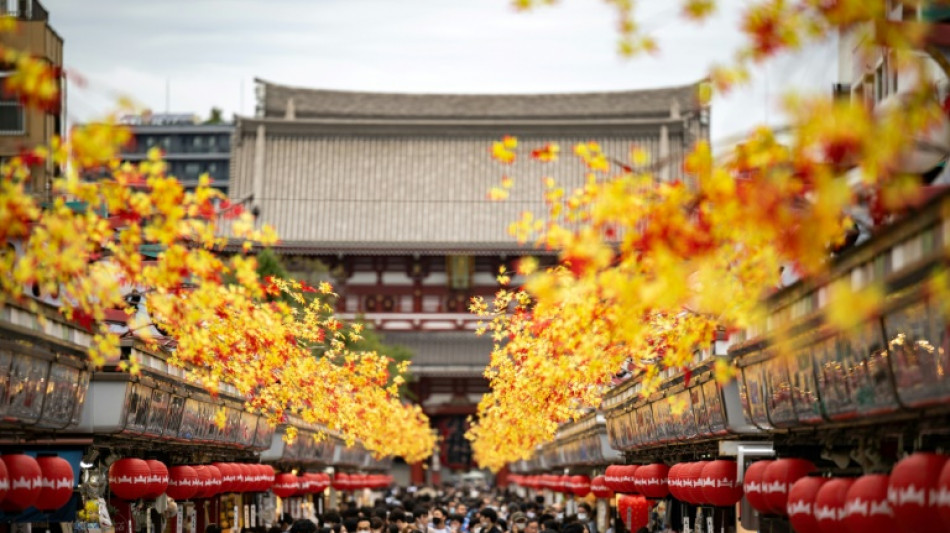
'More the merrier': Asia tourist hubs ready for China influx / Photo: Philip FONG - AFP/File
 ChatGPT interactive interface feature tested across six custom tools

 Freshways milk-price cut deepens pressure on UK dairy farms

 Labour and National remain virtually tied as New Zealand vote count advances

 The Good Daughter adapts Karin Slaughter thriller with Rose Byrne and Meghann Fahy

 Heavy-lift drone evacuates wounded Ukrainian soldier from frontline kill zone

 Morrison says West Brom recovered after pressure from successive derby losses

 Britain considers 2027 state visit for Ukraine’s Zelensky

 Anna Miltina Confronted with Racism Allegations on ProSieben Show

 German Auto Giants Face Existential Crisis as China Sales Plummet

 Cause of Death Revealed for 'Ellen' Producer Matthew Wright

 DEA Marijuana Rescheduling Hearing Closes With Government Not Meeting Its Burden Of Proof?

 Edmund Richardson Wins Baillie Gifford Prize for 'Alexander' Biography

In Tokyo's Asakusa tourist district, caricaturist Masashi Higashitani is dusting off his Chinese as he prepares for an influx of travellers after Beijing ends inbound quarantine rules.
"We used to say 'ni hao' all the time," he said with a laugh as he whipped up a portrait in minutes.
Nearly 9.6 million Chinese visited Japan in 2019, the biggest group of foreign tourists by far and a massive leap from the 450,000 who came in 2003.
Higashitani estimates around 20 percent of his customers were from China before the pandemic, and he and his employees picked up Chinese phrases from those visitors and each other.
He had to downsize and let staff go during the pandemic, so he is thrilled about the expected wave of arrivals, even though he admits some apprehension too.
"I wonder if an influx of too many of them might overwhelm our capacity. I'm also worried that we need to be more careful about anti-virus measures," he told AFP.
Travellers arriving back in China will no longer need to quarantine from Sunday, removing one of the main barriers to travel for the country's population.
The move, announced in late December, sparked a frenzy of trip planning, with searches spiking for Macau, Hong Kong, Japan, Thailand and South Korea.
Chinese tourists also made up about a third of all pre-pandemic foreign visitors to South Korea and were among the top three groups visiting Thailand and Indonesia.
- 'Not the time' -
At a crepe stand in Seoul, Son Kyung-rak said he was already making plans to deal with a flood of tourists from China.
"We're looking to hire and preparing to stock up," the 24-year-old told AFP in Seoul's popular downtown Myeongdong district.
"Chinese tourists are our main customers, so the more the merrier."
But authorities in Seoul are more cautious.
The slump in Chinese visitors "has been a blow to our tourism industry", said Yun Ji-suk, an official from South Korea's culture ministry.
"But now is not the time to be active in tourism marketing, due to the ongoing Covid situation."
China's sudden lifting of pandemic restrictions has led to a massive wave of infections, but Beijing's refusal to share information means the scale of the surge is unclear.
It has been enough to spook governments around the world, with some countries even banning arrivals from China.
Seoul is capping flights from China, and travellers from the mainland, Hong Kong and Macau will have to test negative before travel. Mainland visitors will also be tested on arrival.
Japan has announced similar rules for China, although Hong Kong and Macau travellers are exempt.
- 'Full house' -
Other Asian tourist hubs such as Indonesia have decided not to impose any restrictions.
Two million Chinese tourists visited annually before the pandemic, and restaurant owners on the resort island of Bali are hoping for a rebound.
"Before the pandemic, we had a lot of Chinese customers... At least 100 to 200 customers came daily," Kadek Sucana, who runs a seafood restaurant in the Jimbaran area, told AFP.
He is hoping for a "full house again... because Chinese tourists come in large groups".
While Beijing has loosened many of its Covid restrictions, overseas travel by tour groups remains banned.
And there is little sign that the availability of flights will quickly catch up to renewed demand.
As a result, travel destinations throughout Asia are expecting any rebound in Chinese tourists to be slow.
Indonesia is aiming for just over 250,000 Chinese tourists in 2023, a fraction of pre-pandemic figures.
Thailand, which is also not imposing new rules, is hoping for around five million Chinese tourists this year, less than half the number who came in 2019.
Tourism accounted for nearly 20 percent of Thailand's national income before the pandemic, with China its largest source of foreign tourists.
"This is an opportunity to restore our economic situation and recover from losses we suffered for nearly three years," Thai Public Health Minister Anutin Charnvirakul Anutin said Thursday.
burs-sah/pbt/cwl
A.Rodriguezv--AMWN

