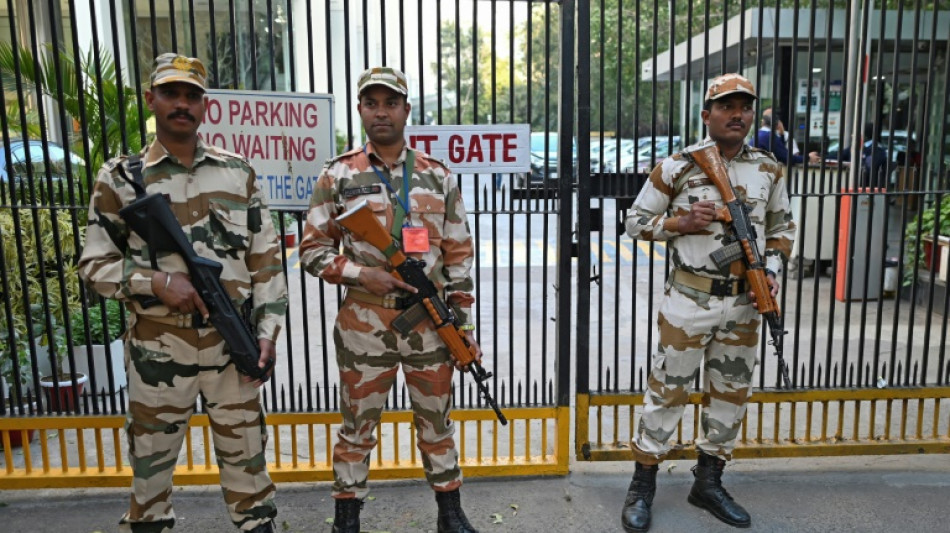
BBC tax raids put India press freedom in spotlight / Photo: Sajjad HUSSAIN - AFP/File
 CT scans reveal health and burial clues from Egypt’s Braided Lady mummy

 Oxford faces complaints over lecturer’s classroom attire

 Kyren Wilson and John Higgins reach International Championship snooker final

 New Zealand and Tonga meet for place in Rugby League World Cup final

 Reports of unsafe AI-toy responses renew calls for child-safety rules

 Juneau food network combines difficult supply routes with deep sharing traditions

 India climbs green-transition ranking after first emissions decline in 25 years

 Trump names Stephen Miller as White House chief of staff after midterm losses

 Restored Albanian tower houses anchor new rural tourism trail

 Sonia Gandhi reflects on family tragedy and reluctant political career

 Pope Leo begins three-country South American tour in Uruguay

 Khawaja says entire Australia camp knew of 2018 ball-tampering plan

 November Foraging Guide: Edible Mushrooms and Critical Safety Protocols

 Microsoft Updates Xbox PC App with 60% Faster Startup and Redesigned Interface

 Early Polar Vortex Disruption Creates Uncertain Winter Outlook for Pennsylvania

 DEA Marijuana Rescheduling Hearing Closes With Government Not Meeting Its Burden Of Proof?

Just weeks after the BBC aired a documentary examining Indian Prime Minister Narendra Modi's role in deadly 2002 sectarian riots, tax inspectors descended on the broadcaster's offices.
Modi's Hindu nationalist Bharatiya Janata Party says the two are not connected, but rights groups say the BBC raids this week show the parlous state of press freedom in the world's biggest democracy.
News outlets that publish unfavourable reporting find themselves targeted with legal action, while journalists critical of the government are harassed and even imprisoned.
The three-day lockdown of the BBC's offices in New Delhi and Mumbai is the latest of several similar "search and survey" operations against media houses.
"Unfortunately, this is becoming a trend, there is no shying away from that," Kunal Majumdar of the Committee to Protect Journalists told AFP.
At least four Indian outlets that had critically reported on the government were raided by tax officers or financial crimes investigators in the past two years, he said.
As with the BBC, those outlets said officials confiscated phones and accessed computers used by journalists.
"When you have authorities trying to go through your material, go through your work, that's intimidation," Majumdar added.
"The international community ought to wake up and start taking this matter seriously."
India has fallen 10 spots to 150th on the World Press Freedom Index, compiled by Reporters Without Borders, since Modi took office in 2014.
Journalists have long faced harassment, legal threats and intimidation for their work in India but more criminal cases are being lodged against reporters than ever, according to the Free Speech Collective.
Criminal complaints were issued against a record 67 journalists in 2020, the latest year for which figures are available, the local civil society group reported.
Ten journalists were behind bars in India at the start of the year, according to Reporters Without Borders.
Once arrested, reporters can spend months or even years waiting for the cases against them to proceed through the courts.
- 'Why be afraid?' -
The BBC documentary explored Modi's time as chief minister of Gujarat state during religious riots that killed at least 1,000 people, most of them minority Muslims.
The programme cited a British foreign ministry report claiming that Modi met senior police officers and "ordered them not to intervene" in anti-Muslim violence by right-wing Hindu groups.
The two-part series featured a BBC interview with Modi shortly after the riots, in which he was asked whether he could have handled the matter differently.
Modi responded that his main weakness was not knowing "how to handle the media".
"That's been something he has been taking care of since," Hartosh Singh Bal, the political editor of India's Caravan magazine, told AFP.
"That sums up his attitude."
The BBC documentary did not air in India but provoked a furious response from the government, which dismissed its contents as "hostile propaganda".
Authorities used information technology laws to ban the sharing of links to the programme in an effort to stop its spread on social media.
Gaurav Bhatia, a BJP spokesman, said this week's raids on the BBC offices were lawful and the timing had nothing to do with the documentary's broadcast.
"If you have been following the law of the country, if you have nothing to hide, why be afraid of an action that is according to the law," he told reporters.
- 'Misogynistic and sectarian attacks' -
Unfavourable reporting in India can prompt not only legal threats from the government, but a frightening backlash from members of the public.
"Indian journalists who are too critical of the government are subjected to all-out harassment and attack campaigns by Modi devotees," Reporters Without Borders said last year.
Washington Post columnist Rana Ayyub has been a persistent target of Modi supporters since conducting an undercover investigation that alleged government officials were implicated in the 2002 Gujarat riots.
She has been subjected to an online disinformation barrage, including doctored tweets suggesting she had defended child rapists and a report falsely announcing her arrest for money laundering.
UN-appointed experts singled out her case last year and said she had endured "relentless misogynistic and sectarian attacks".
They also said Ayyub had been targeted by Indian authorities with various forms of harassment, including the freezing of her bank accounts over tax fraud and money laundering allegations.
"I am witnessing a depravity daily that I had not witnessed before," Ayyub told AFP.
Burnt copies of a book she authored had been sent to her home in Mumbai and someone threatened to gang-rape her in front of her family, she said.
"They are emboldened," she added, "knowing that nobody will take action against them."
C.Garcia--AMWN