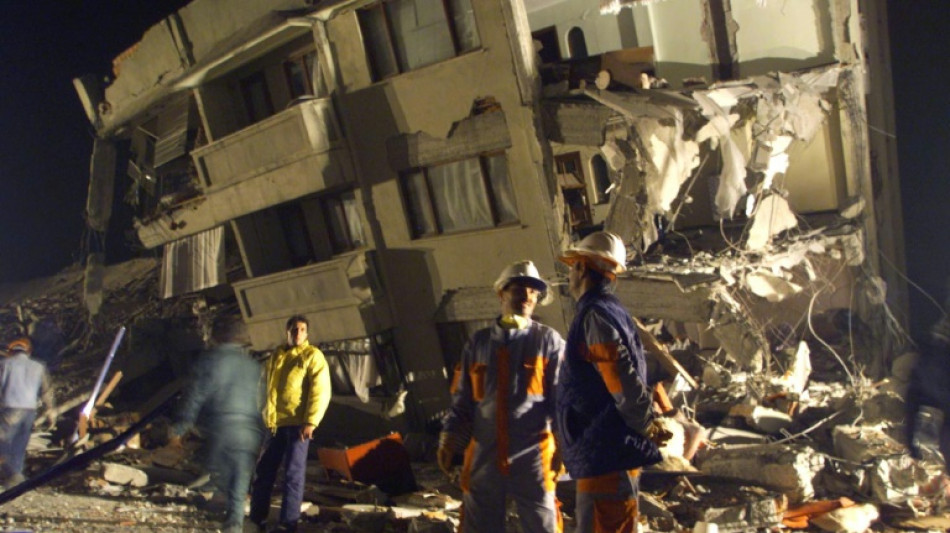
Turkey's deadly quake renews alarm for Istanbul / Photo: MANOOCHER DEGHATI - AFP
 CT scans reveal health and burial clues from Egypt’s Braided Lady mummy

 Oxford faces complaints over lecturer’s classroom attire

 Kyren Wilson and John Higgins reach International Championship snooker final

 New Zealand and Tonga meet for place in Rugby League World Cup final

 Reports of unsafe AI-toy responses renew calls for child-safety rules

 Juneau food network combines difficult supply routes with deep sharing traditions

 India climbs green-transition ranking after first emissions decline in 25 years

 Trump names Stephen Miller as White House chief of staff after midterm losses

 Restored Albanian tower houses anchor new rural tourism trail

 Sonia Gandhi reflects on family tragedy and reluctant political career

 Pope Leo begins three-country South American tour in Uruguay

 Khawaja says entire Australia camp knew of 2018 ball-tampering plan

 November Foraging Guide: Edible Mushrooms and Critical Safety Protocols

 Microsoft Updates Xbox PC App with 60% Faster Startup and Redesigned Interface

 Early Polar Vortex Disruption Creates Uncertain Winter Outlook for Pennsylvania

 DEA Marijuana Rescheduling Hearing Closes With Government Not Meeting Its Burden Of Proof?

The 7.8-magnitude earthquake that killed tens of thousands across Turkey's southeast has reignited fears of an even more catastrophic death toll if a long-feared one hits Istanbul.
Seismologists warn that a massive earthquake is likely to strike Turkey's biggest city -- officially home to 16 million people but estimated to hold up to 20 million -- by 2030.
The city lies on the northern edge of one of Turkey's main fault lines and is densely packed.
A 7.6-magnitude earthquake with an epicentre on the city's eastern outskirts killed more than 17,000 people in 1999. The number of Istanbulites has roughly doubled since then.
Independent urban scholar Murat Guney said carnage can be avoided if the government has the political will to relocate people from shoddy buildings filling the city's shanty towns.
Guney said Istanbul had an ample supply of vacant properties just recently constructed and strong enough to withstand major jolts.
Procrastination could spell doom, he said.
"A major earthquake of up to 7.5 magnitude is expected in Istanbul. Such an earthquake may cause the death of hundreds of thousands of residents while estimates about the number of buildings that will totally collapse or be severely damaged range from 50,000 to 200,000," Guney told AFP.
"Those high-risk buildings, which are mostly squatter style and not resistant to earthquakes needed immediate transformation before they collapse even following a minor earthquake."
- Sliver of good news -
The February 6 earthquake claimed the lives of more than 38,000 people in southeastern Turkey and nearly 3,700 in neighbouring Syria.
Officials say more than 55,000 buildings were either levelled or damaged beyond repair.
Its impact was felt across a part of Turkey with approximately the same population as Istanbul.
Guney said Istanbul had around 1,166,000 residential buildings.
"Of these, 817,000 buildings (70 percent) were constructed before the 1999 earthquake, when there were no construction inspections regarding resistance to earthquakes," he said.
But there was a sliver of good news: Guney said Istanbul had 150,000 earthquake-resistant properties built after 2008 that still stood empty.
"They either belong to the construction companies that are waiting for customers, or they are the second or third houses of the rich, who do not bother to rent those apartments," Guney said.
"There is even no need for more construction in Istanbul," he said.
"The number of empty buildings is sufficient to move in those who live in the high-risk buildings... However, such a political decision has never been taken by the government."
The 1999 quake prompted the government to impose a special levy that became known as the "earthquake tax".
The money was meant to help make Turkish cities earthquake-proof.
"However, that tax money was not used properly and efficiently," Guney said. "That special tax money was used to cover other government expenses."
The Turkish government has issued no public breakdown of how that money has been spent.
"So far, the majority of the high-risk buildings were not covered by an urban transformation project," Guney said.
Th.Berger--AMWN