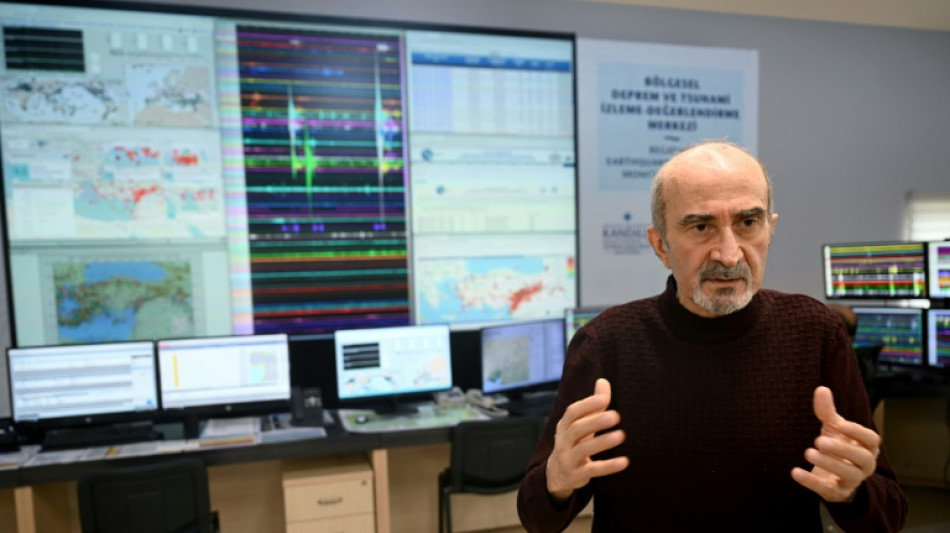
Quake-prone Istanbul not at heightened risk: expert / Photo: OZAN KOSE - AFP
 CT scans reveal health and burial clues from Egypt’s Braided Lady mummy

 Oxford faces complaints over lecturer’s classroom attire

 Kyren Wilson and John Higgins reach International Championship snooker final

 New Zealand and Tonga meet for place in Rugby League World Cup final

 Reports of unsafe AI-toy responses renew calls for child-safety rules

 Juneau food network combines difficult supply routes with deep sharing traditions

 India climbs green-transition ranking after first emissions decline in 25 years

 Trump names Stephen Miller as White House chief of staff after midterm losses

 Restored Albanian tower houses anchor new rural tourism trail

 Sonia Gandhi reflects on family tragedy and reluctant political career

 Pope Leo begins three-country South American tour in Uruguay

 Khawaja says entire Australia camp knew of 2018 ball-tampering plan

 November Foraging Guide: Edible Mushrooms and Critical Safety Protocols

 Microsoft Updates Xbox PC App with 60% Faster Startup and Redesigned Interface

 Early Polar Vortex Disruption Creates Uncertain Winter Outlook for Pennsylvania

 DEA Marijuana Rescheduling Hearing Closes With Government Not Meeting Its Burden Of Proof?

Fears of another major earthquake have been rekindled in Istanbul since the February 6 disaster that hit Turkey and Syria, but a prominent Turkish seismologist has reassured the risk "hasn't increased".
"The risk hasn't increased because we are talking about completely different systems," Dogan Kalafat, the director of the Kandilli Observatory's Earthquake-Tsunami Monitoring Center in Istanbul, told AFP.
Turkey's most populated city is situated near the North Anatolian Fault while the recent 7.8-magnitude quake that killed 43,500 people occurred along another fault in the country's southeast, Kalafat explained.
Still, the 16 million residents of Istanbul, a city that spreads over two continents and has seen skyscrapers mushroom in recent years, are wondering if they're ready for the "Big One".
"I'd like to say it, but sadly, it's a very big city with too many poorly constructed buildings," said Kalafat, who has denounced using low-quality cement and building on "soft soils".
While waiting for a large-scale quake, "we must make good use of the time. We must build earthquake-proof houses on solid soil. It's the most important precaution to take," the seismologist stressed.
At the observatory, seismologists take turns every eight hours watching a series of computer screens monitoring potential tremors.
In front of them, on a wall at least five metres (16 feet) tall, a giant screen provides real-time readings from 260 seismic stations across the country.
"Nine thousand aftershocks have taken place in Turkey since February 6," which is more than "seven or eight times normal", Kalafat said.
- Early warning -
On one of the desks, a laminated map shows the North Anatolian Fault, which crosses the Sea of Marmara, only "15 to 17 kilometres" from the southern shores of Istanbul, Kalafat said.
In 2001, two years after a 7.4-magnitude quake left 17,000 people dead in northwest Turkey, Kalafat calculated a 65 percent probability that a quake with a magnitude above 7 would occur before 2030 in the same region -- which includes Istanbul.
The risk climbed to 75 percent in 50 years and 95 percent in 90 years.
"These statistics are still relevant," said Kalafat, adding: "even with the technology of today, it is impossible to predict an earthquake."
"We can indicate, with a certain margin of error, where an earthquake can occur and what magnitude it can be, but we can't know when it will occur," he said.
The Kandilli Observatory has developed an early warning system "but Istanbul is too close to the fault line" for a system to be effective, Kalafat said.
On one of the desks, sitting between two screens, is a black telephone with two red labels with the public disaster management agency's acronym, allowing scientists to send an alert for a major earthquake.
The early warning could win "a maximum of seven or eight seconds" -- not enough time to allow inhabitants to get to safety.
In comparison, the telephonic warning system in Japan's Tohoku region, which was struck by a devastating earthquake and tsunami in March 2011, buys the public 45 seconds.
"There, you can send a message warning citizens, but we don't have this possibility here," he said.
T.Ward--AMWN