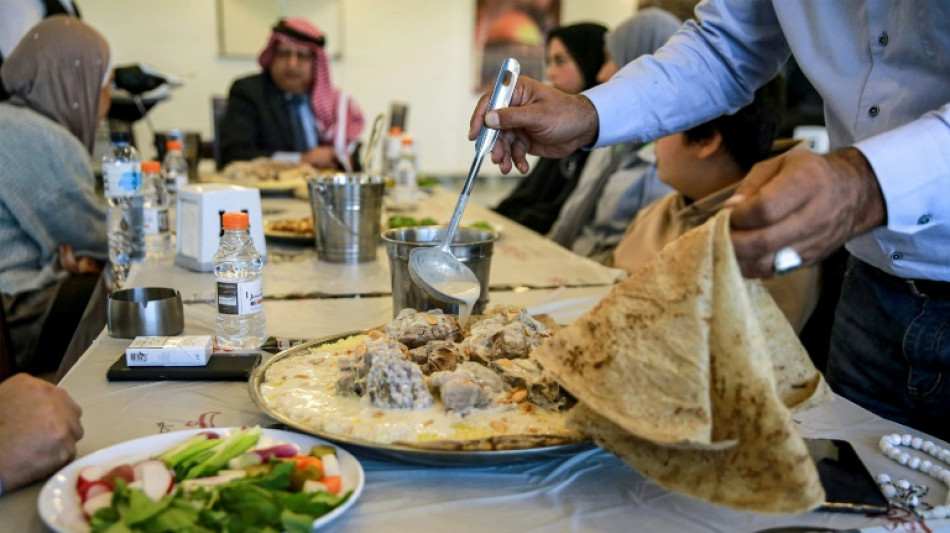
Rooted in war and symbol of peace: Jordan's national dish / Photo: Khalil MAZRAAWI - AFP
 Post-election pressures complicate US and Israeli decisions on Iran

 UN members approve talks on treaty protocol against environmental crime

 Family-run West Sussex beach café prepares for first winter season

 CT scans reveal health and burial clues from Egypt’s Braided Lady mummy

 Oxford faces complaints over lecturer’s classroom attire

 Kyren Wilson and John Higgins reach International Championship snooker final

 New Zealand and Tonga meet for place in Rugby League World Cup final

 Reports of unsafe AI-toy responses renew calls for child-safety rules

 Juneau food network combines difficult supply routes with deep sharing traditions

 India climbs green-transition ranking after first emissions decline in 25 years

 Trump names Stephen Miller as White House chief of staff after midterm losses

 Restored Albanian tower houses anchor new rural tourism trail

 Sonia Gandhi reflects on family tragedy and reluctant political career

 Pope Leo begins three-country South American tour in Uruguay

 Khawaja says entire Australia camp knew of 2018 ball-tampering plan

 November Foraging Guide: Edible Mushrooms and Critical Safety Protocols

 Microsoft Updates Xbox PC App with 60% Faster Startup and Redesigned Interface

 Early Polar Vortex Disruption Creates Uncertain Winter Outlook for Pennsylvania

 DEA Marijuana Rescheduling Hearing Closes With Government Not Meeting Its Burden Of Proof?

In Jordan, a sumptuous dish that has its roots in an ancient war has evolved over the centuries to be widely cherished as a symbol of peace and hospitality.
Mansaf -- the kingdom's national dish of lamb cooked in dried yogurt, served with rice and nuts -- is "the king of the Jordanian table", says Ashraf Al-Mubaideen, 47, who runs a traditional restaurant in Amman.
"If you want to honour your guest, there's nothing finer than mansaf," agrees his business partner Tamer al-Majali, 42, about the custom of greeting guests with huge platters piled high.
Mansaf was inscribed on UNESCO's list of intangible cultural heritage late last year, highlighting the "deep sense of identity and social cohesion" it evokes.
Long before it became a symbol of peace -- traditionally shared to mark the end of tribal feuds -- mansaf was born on the eve of battle, according to one version of history.
In the 9th century BC, King Mesha of the Moab Kingdom -- located on the eastern shore of the Dead Sea -- wanted to test his people's loyalty in a war against the Kingdom of Israel, said historian George Tareef.
"The king knew that the Torah forbade Jews from eating meat cooked with milk," and so he instructed his people to cook a rudimentary version of the non-kosher dish ahead of battle, said Tareef.
In modern-day Amman, Mubaideen and Majali's restaurant is called "Manasef Moab", a nod to the dish's ancient origins.
- 'Authenticity and heritage' -
Jordan's most popular dish -- regularly served at wedding banquets and in households for large families -- bears little resemblance to Mesha's culinary allegiance tests.
The dish underwent thousands of years of "evolution as a result of economic and agricultural conditions", according to researcher Hassan Mubaideen.
In an Amman restaurant, the 58-year-old academic -- donning a red keffiyeh scarf and tucking into a plate of mansaf -- said rice came to replace bread and cracked wheat, as a way to feed more people with less, though shows of generosity remain integral.
"There are special rituals and hospitality protocols linked to the meal -- like how you greet guests, in what order you serve them, where the head of the animal goes, and how you say goodbye," Mubaideen told AFP.
Large platters are traditionally shared between around a dozen people, using only the right hand, while the left is placed behind the back.
Customs have changed, and individual plates and utensils are now often used, as younger generations adopt the age-old tradition.
Sharing mansaf with her classmates, 14-year-old school pupil Zeina Elyan expressed pride in the symbol of "Jordan's ancient heritage" and the health benefits of the dish's whole foods.
Her teacher, Duha Saleh, 31, said she brought her students to the restaurant to teach them "the social culture" behind the dish, and the inherited values of generosity and hospitality.
"There's a pleasure to it," she said, "in how it connects us to who we are, our authenticity and our heritage."
H.E.Young--AMWN