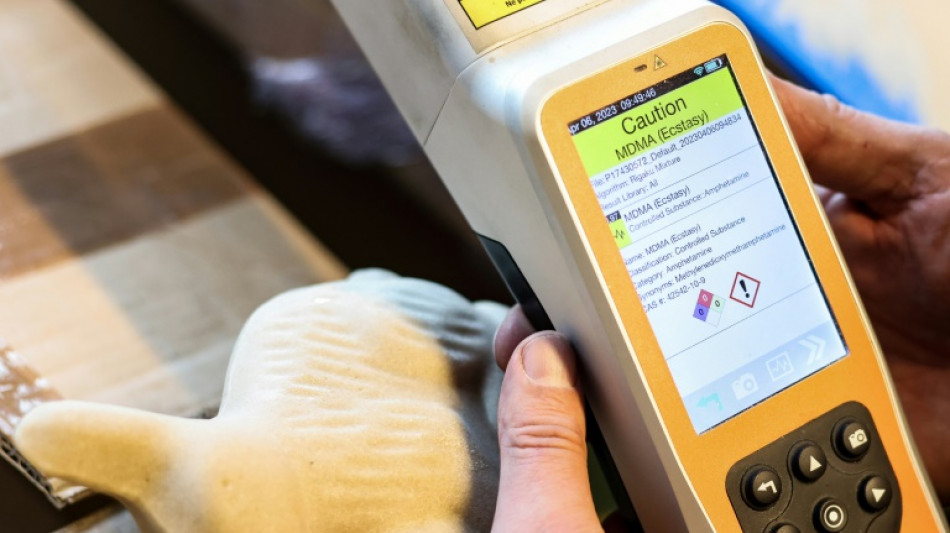
Belgian drug bunnies put the E into Easter / Photo: Kenzo TRIBOUILLARD - AFP
 Post-election pressures complicate US and Israeli decisions on Iran

 UN members approve talks on treaty protocol against environmental crime

 Family-run West Sussex beach café prepares for first winter season

 CT scans reveal health and burial clues from Egypt’s Braided Lady mummy

 Oxford faces complaints over lecturer’s classroom attire

 Kyren Wilson and John Higgins reach International Championship snooker final

 New Zealand and Tonga meet for place in Rugby League World Cup final

 Reports of unsafe AI-toy responses renew calls for child-safety rules

 Juneau food network combines difficult supply routes with deep sharing traditions

 India climbs green-transition ranking after first emissions decline in 25 years

 Trump names Stephen Miller as White House chief of staff after midterm losses

 Restored Albanian tower houses anchor new rural tourism trail

 Sonia Gandhi reflects on family tragedy and reluctant political career

 Pope Leo begins three-country South American tour in Uruguay

 Khawaja says entire Australia camp knew of 2018 ball-tampering plan

 November Foraging Guide: Edible Mushrooms and Critical Safety Protocols

 Microsoft Updates Xbox PC App with 60% Faster Startup and Redesigned Interface

 Early Polar Vortex Disruption Creates Uncertain Winter Outlook for Pennsylvania

 DEA Marijuana Rescheduling Hearing Closes With Government Not Meeting Its Burden Of Proof?

Belgian bunnies will be an Easter treat for kids around the world this weekend, but not all are moulded from the country's renowned chocolate.
A batch of rabbits seized this week by veteran customs officer Pol Meuleneire was crafted from a solid lump of MDMA, the raw material for pills of the rave drug ecstasy.
Known as the gateway into Europe for Latin American cocaine, Belgium has now also become a turntable for mail-order synthetic drugs, made in Europe and sent worldwide.
Meuleneire, who retires in a few months after 43 years in Belgium's customs service, told AFP that when he began his career he was excited to find 10 grammes of cannabis in a letter.
Now, his workspace in an office block in the freight zone at Brussels airport is overflowing with suspect packages -- and bags and jars of illegal pills and powders.
"So in 2022 we got to nearly six tonnes of drugs, seized here at the airport," explained Florence Angelici, spokeswoman for the SPF federal finance service.
"It goes all over the world. Today, people can order online on the 'dark web' in a few clicks and can decide what they want and have it delivered to their homes."
The false chocolate bunnies had been parcelled up and posted in Belgium, addressed to a buyer in Hong Kong, only to be intercepted at the Brussels airport freight terminal.
Meuleneire pressed his handheld scanner -- which uses Raman spectroscopy to identify substances by their chemical fingerprint -- against one supposed chocolate rabbit and took a reading.
The screen flashed green and the analysis was clear: "Caution: MDMA (ecstasy)".
"So you see? It's pure MDMA," the 61-year-old said. "So here we have, bumpety-bump, one or two kilogrammes of this. With one kilogramme you make six thousand ecstasy pills."
And, as Meuleneire worked his box cutter during a visit by AFP journalists, several more illicit deliveries emerged from packages received in just the past week.
A Peppa Pig branded lunchbox destined for New Zealand itself proved innocent, but the packaging it was carried in felt too heavy to be just cardboard and plastic.
Packed into a corrugated plastic parcel divider: ketamine, an anaesthetic misused as a recreational drug and one of the fastest growing illegal exports through the airport postal depot.
A child's toy chemistry set for studying the growth of crystals was found to contain a shrink-wrapped bag of crystal meth, an illegal and addictive synthetic stimulant.
- Dutch drug labs -
There is even cocaine, slid in plastic packets between double layers of cardboard packaging, making the parcel suspiciously heavy to an experienced customs officer.
Belgium's Antwerp is the main port of entry into Europe for Latin American cocaine, but some is re-exported by post to countries like Australia, where it fetches a higher street price.
Gangs in countries like Venezuela, which export plant-based narcotics like cocaine to Europe, in turn import synthetic drugs like crystal meth from European labs.
But most of the mail-order exports are of synthetic drugs made in rogue labs and covert pharma plants in Belgium and especially, according to Belgian officials, the Netherlands.
Ketamine, MDMA and methamphetamine are disguised in everyday objects or packaged in jars marked as legal vitamin supplements, then mailed from ordinary post offices in Belgium, France and Germany.
"Here, we're talking mainly about using the Belgian postal service, which might attract less attention from customs officers in the arrival countries than the Dutch one," Angelici told AFP.
"The smugglers use mules to transport the parcels and to post them from all over Belgium, and other European countries, and send them all around the world."
At the airport, a computerised platform selects packages based on known suspect features and customs officers go to work scanning them and in some cases cutting them open.
Souvenirs in Meuleneire's workspace include portraits of Jesus Christ that were held in frames stuffed with drugs, teddy bears full of pills and copper pipes packed with veterinary tranquilisers.
P.Santos--AMWN