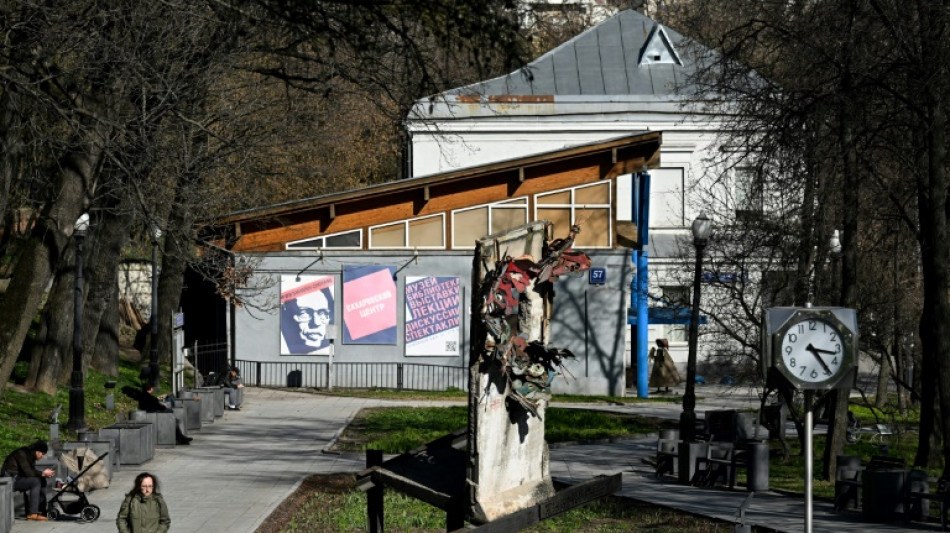
Russian rights museum shutters but refuses to be silenced / Photo: Kirill KUDRYAVTSEV - AFP
 Post-election pressures complicate US and Israeli decisions on Iran

 UN members approve talks on treaty protocol against environmental crime

 Family-run West Sussex beach café prepares for first winter season

 CT scans reveal health and burial clues from Egypt’s Braided Lady mummy

 Oxford faces complaints over lecturer’s classroom attire

 Kyren Wilson and John Higgins reach International Championship snooker final

 New Zealand and Tonga meet for place in Rugby League World Cup final

 Reports of unsafe AI-toy responses renew calls for child-safety rules

 Juneau food network combines difficult supply routes with deep sharing traditions

 India climbs green-transition ranking after first emissions decline in 25 years

 Trump names Stephen Miller as White House chief of staff after midterm losses

 Restored Albanian tower houses anchor new rural tourism trail

 Sonia Gandhi reflects on family tragedy and reluctant political career

 Pope Leo begins three-country South American tour in Uruguay

 Khawaja says entire Australia camp knew of 2018 ball-tampering plan

 November Foraging Guide: Edible Mushrooms and Critical Safety Protocols

 Microsoft Updates Xbox PC App with 60% Faster Startup and Redesigned Interface

 Early Polar Vortex Disruption Creates Uncertain Winter Outlook for Pennsylvania

 DEA Marijuana Rescheduling Hearing Closes With Government Not Meeting Its Burden Of Proof?

A museum emblematic of Russia's post-Soviet human rights movement has shut its doors in Moscow amid a clampdown on freedoms since the onset of the Kremlin's offensive in Ukraine.
The Sakharov Center, dedicated to Nobel Prize winning rights activist Andrei Sakharov, is being forced to vacate its premises by the end of the month after nearly 30 years in operation.
Despite the growing number of rights groups being muzzled, supporters say they are confident that dark times will pass and the Sakharov Center and other rights organisations will eventually return.
"I'm sure it won't be for long," said Yan Rachinsky, co-head of top rights group Memorial, which was shuttered by authorities in late 2021.
Rachinsky said he saw "no future" for modern Russia without the Sakharov Center, which features a permanent exhibition on Soviet repression.
Russia shut down Memorial just months before President Vladimir Putin sent troops to Ukraine in February 2022.
In January, a court also ordered the closure of Russia's oldest human rights organisation, the Moscow Helsinki Group.
Kremlin critics say authorities are widening a historic crackdown on dissent with most opposition figures behind bars or in exile and top rights groups shut down.
Rachinsky spoke to AFP on Sunday when the centre held its final public event.
- 'New dawn will break' -
About a hundred people showed up including representatives of Russia's embattled rights community.
"You can't kill ideas, or human communication," said political activist Yulia Galyamina.
Rights activist and poet Elena Sannikova recited a poem, saying that Russian authorities appear to have forgotten how Soviet-era repression ended.
"David will defeat Goliath, and a new dawn will break," her poem read.
Established by Sakharov's widow and rights activist Elena Bonner, the centre has leased the premises from Moscow authorities for free since the 1990s.
In 2014, Russia designated the venue a "foreign agent," a label with Stalin-era connotations. It is now being evicted due to the recent tightening of the legislation that prohibits "foreign agents" from receiving state aid.
Since its establishment in 1996, the centre hosted hundreds of debates, exhibitions and other events.
In 2015, thousands of people gathered here to pay their last respects to opposition politician Boris Nemtsov assassinated near the Kremlin walls.
Despite the eviction, the Sakharov Centre plans to build an online presence, while its archives will be stored in a warehouse and will remain accessible to researchers.
The Sakharov Center's director, Sergei Lukashevsky, who has left Russia for Germany, said that a display dedicated to Soviet-era crimes could not exist in the country in the current circumstances.
"In the conditions of today's censorship creating such an exposition would mean coming under attack very quickly," he told AFP.
Lukashevsky said that authorities planned new checks on the centre, suggesting they could result in a formal shutdown.
- 'Death of museum' -
During a visit last week, several employees packed dozens of items that made up the centre's permanent exhibit on the history of political repression and the Gulag system of prison camps into boxes.
The centre's exhibition hall, adjacent to the main building, hosted a temporary display dedicated to Bonner, Sakharov's second wife.
Svetlana Gabdullina, a 44-year-old English teacher, said her visit to the exhibition was a protest of sorts and a search for like-minded people.
"I will now start crying," she told AFP.
"Russians can be reasonable and civilised and contribute to things that are important in this world," she said, her blue eyes tearing up.
Another visitor, Alexei Frolov, who studies nuclear physics, said he took keen interest in Sakharov, who was awarded the Nobel Prize for Peace in 1975.
The 19-year-old praised the father of the hydrogen bomb as a "hero and genius", saying he remained true to his principles "until the end".
Valentin, who declined to provide his last name, said the centre's closure marked a grim new milestone.
"It is not often we witness the death of a museum," he said.
"We all hope this is not the end but even if the museum is re-born, it will be a different era."
O.M.Souza--AMWN