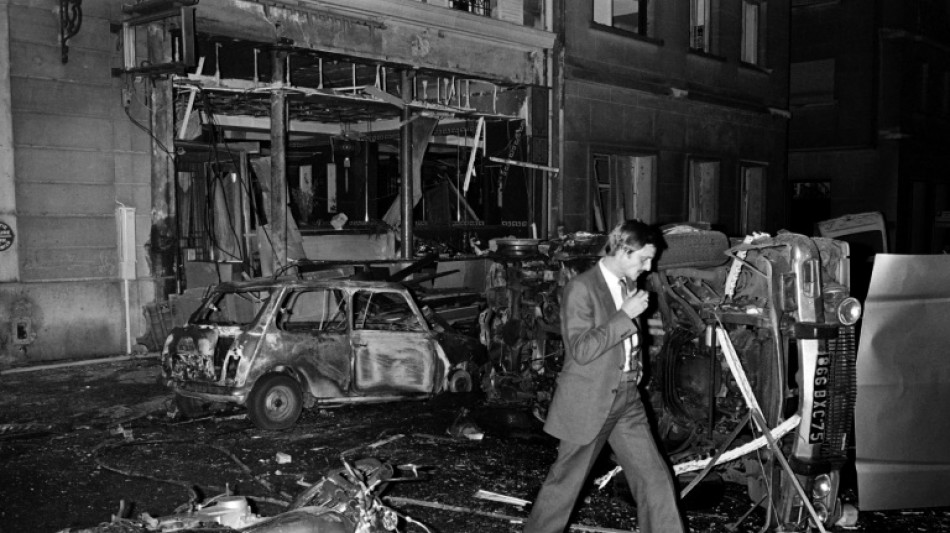
Paris court gives Canada-based professor life for 1980 synagogue bomb / Photo: Georges GOBET - AFP/File
 Post-election pressures complicate US and Israeli decisions on Iran

 UN members approve talks on treaty protocol against environmental crime

 Family-run West Sussex beach café prepares for first winter season

 CT scans reveal health and burial clues from Egypt’s Braided Lady mummy

 Oxford faces complaints over lecturer’s classroom attire

 Kyren Wilson and John Higgins reach International Championship snooker final

 New Zealand and Tonga meet for place in Rugby League World Cup final

 Reports of unsafe AI-toy responses renew calls for child-safety rules

 Juneau food network combines difficult supply routes with deep sharing traditions

 India climbs green-transition ranking after first emissions decline in 25 years

 Trump names Stephen Miller as White House chief of staff after midterm losses

 Restored Albanian tower houses anchor new rural tourism trail

 Sonia Gandhi reflects on family tragedy and reluctant political career

 Pope Leo begins three-country South American tour in Uruguay

 Khawaja says entire Australia camp knew of 2018 ball-tampering plan

 November Foraging Guide: Edible Mushrooms and Critical Safety Protocols

 Microsoft Updates Xbox PC App with 60% Faster Startup and Redesigned Interface

 Early Polar Vortex Disruption Creates Uncertain Winter Outlook for Pennsylvania

 DEA Marijuana Rescheduling Hearing Closes With Government Not Meeting Its Burden Of Proof?

A Paris court on Friday sentenced a Lebanese-Canadian sociology professor to life in prison in absentia for the 1980 bombing of a synagogue in the French capital that left four people dead.
The court followed the prosecutors' request for the maximum possible punishment against Hassan Diab, now 69 and a resident of Canada, a decision that was met with silence in court.
Some victims and their families could be seen embracing at the end of three weeks of proceedings during which the suspect's box remained empty throughout.
Prosecutors had said in their closing arguments Thursday that there was "no possible doubt" that Diab, the only suspect, was behind the attack.
In the early evening of October 3, 1980, explosives placed on a motorcycle detonated close to a synagogue on the Rue Copernic in Paris's chic 16th district, killing a student passing by on a motorbike, a driver, an Israeli journalist and a caretaker.
Forty-six others were injured in the blast.
The bombing was the first deadly attack against a Jewish target on French soil since World War II.
No organisation claimed responsibility but police suspected a splinter group of the Popular Front for the Liberation of Palestine.
French intelligence agents in 1999 accused Diab of having made the 10-kilogramme (22-pound) bomb.
They pointed to Diab's likeness with police sketches drawn at the time and handwriting analyses that they said confirmed him as the person who bought the motorbike used in the attack.
They also produced a key item of evidence against him -- a passport in his name, seized in Rome in 1981, with entry and exit stamps from Spain, where the attack plan was believed to have originated.
In 2014, Canada extradited Diab at the request of the French authorities.
However, investigating judges were unable to prove his guilt conclusively during the investigation and Diab was released, leaving France for Canada as a free man in 2018.
Three years later, a French court overturned this earlier decision and ordered that Diab should stand trial on charges of murder, attempted murder and destruction of property in connection with a terrorist enterprise.
- Denials -
Most of the evidence presented against him was based on intelligence sources, and Diab's lawyers had again argued the case should be thrown out.
"I'm in front of you to avoid a miscarriage of justice," celebrity defence lawyer William Bourdon told the court Thursday, saying that an acquittal was "the only judicial decision possible".
Diab has claimed he was sitting exams in Lebanon at the time of the attack, backed up by statements from his ex-partner and former students.
His conviction means he will now again become the subject of another arrest warrant, which risks stoking diplomatic tensions between France and Canada after his first extradition took six years.
David Pere, a lawyer for some of the people present in the synagogue at the time of the bombing, said his clients were "not motivated by vengeance nor looking for a guilty person's head to stick on a pike... they want justice to be done".
Diab has won some backing from NGOs, including Amnesty International, who said his assertion that he was in Lebanon at the time of the attack was credible.
D.Moore--AMWN