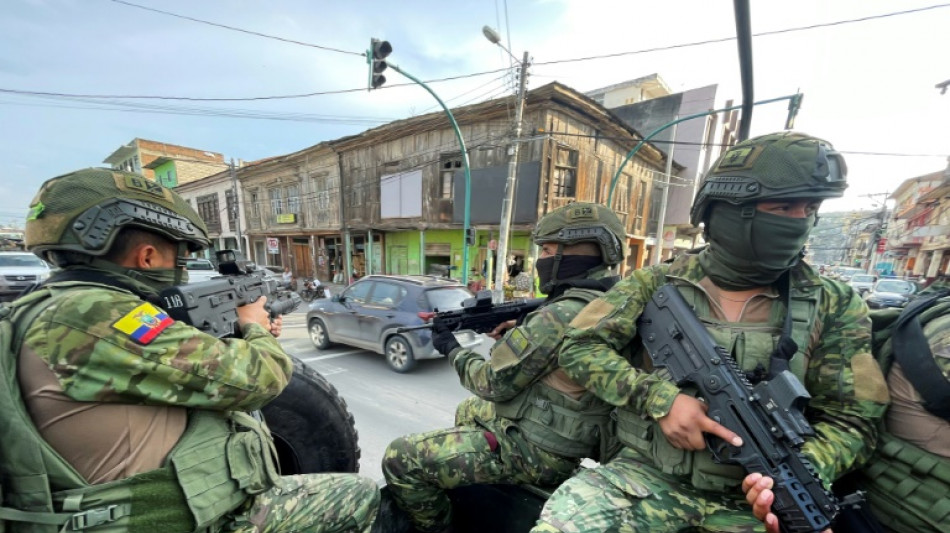
'Where are the weapons?' Life in an Ecuadoran town plagued with drug violence / Photo: Enrique Ortiz - AFP
 Post-election pressures complicate US and Israeli decisions on Iran

 UN members approve talks on treaty protocol against environmental crime

 Family-run West Sussex beach café prepares for first winter season

 CT scans reveal health and burial clues from Egypt’s Braided Lady mummy

 Oxford faces complaints over lecturer’s classroom attire

 Kyren Wilson and John Higgins reach International Championship snooker final

 New Zealand and Tonga meet for place in Rugby League World Cup final

 Reports of unsafe AI-toy responses renew calls for child-safety rules

 Juneau food network combines difficult supply routes with deep sharing traditions

 India climbs green-transition ranking after first emissions decline in 25 years

 Trump names Stephen Miller as White House chief of staff after midterm losses

 Restored Albanian tower houses anchor new rural tourism trail

 Sonia Gandhi reflects on family tragedy and reluctant political career

 Pope Leo begins three-country South American tour in Uruguay

 Khawaja says entire Australia camp knew of 2018 ball-tampering plan

 November Foraging Guide: Edible Mushrooms and Critical Safety Protocols

 Microsoft Updates Xbox PC App with 60% Faster Startup and Redesigned Interface

 Early Polar Vortex Disruption Creates Uncertain Winter Outlook for Pennsylvania

 DEA Marijuana Rescheduling Hearing Closes With Government Not Meeting Its Burden Of Proof?

A military convoy of soldiers toting rifles and submachine guns rumbles into a poor neighborhood of the Ecuadoran port town of Esmeraldas, trying to root out drug gangs.
The town in the northern part of the country, near the border with Colombia, has been living under a state of emergency for nearly two months in response to what the government calls terrorist acts by powerful drug trafficking gangs.
The trucks that make up the convoy carry more than 100 soldiers, wearing bullet-proof vests as they travel through narrow streets -- neighborhood residents eyeing them warily.
Some soldiers aim at houses with their guns while others using a battering ram knock down a metal door.
"Where are the weapons?" one hooded soldier yells at a group of young black people lying on the ground as AFP, traveling exclusively with these troops, observed the raid.
A city of 200,000, Esmeraldas, capital of the province of the same name, is considered a stronghold for crime gangs.
-Hundreds of detainees-
In this raid one suspect is handcuffed. He is believed to belong to a feared gang called the Tiguerones.
Gang members live by blending in with regular everyday people, said police colonel Julio César Vásquez.
This young detainee with long hair and a tiger tattooed on his ankle is one of more than 900 people arrested around the country since the state of emergency was declared, according to the interior ministry.
President Guillermo Lasso declared the emergency in Esmeraldas on March 3, acting because of its proximity to Colombia, the world's top producer of cocaine. A month later he extended it to other troubled regions of Ecuador and started letting people carry guns for self-defense.
"We have a common enemy: delinquency, drug trafficking and organized crime," the president said at the time.
- People are afraid -
A helicopter flies over a river looking for speedboats loaded with cocaine. In 2021 Ecuador seized a record 210 tonnes of cocaine that had been meant for shipment to Europe.
But the state of emergency has not made this town much safer. On April 11, a group of some 30 assailants killed nine fishermen in an attack that authorities said stemmed from a gang turf war.
Police say that in Esmeraldas the homicide rate is up seven percent so far this year.
Ecuador is located between Colombia and Peru, the world's two largest producers of cocaine, much of which is sent to the United States and Europe from Ecuadoran ports, principally Guayaquil.
Consequently, Ecuador has seen a recent rise in violence and murders related to drug trafficking.
Its murder rate almost doubled from 14 per 100,000 citizens in 2021 to 25 a year later.
Despite all the soldiers deployed in Esmeraldas, people are afraid. Many shops are locked shut and some hotels and big businesses have been put up for sale.
"The gangs, all the crime, we cannot work freely. You hear people say they are being extorted," said Jofre Mancillo, who runs a warehouse. "There are no guarantees to keep working."
M.Thompson--AMWN