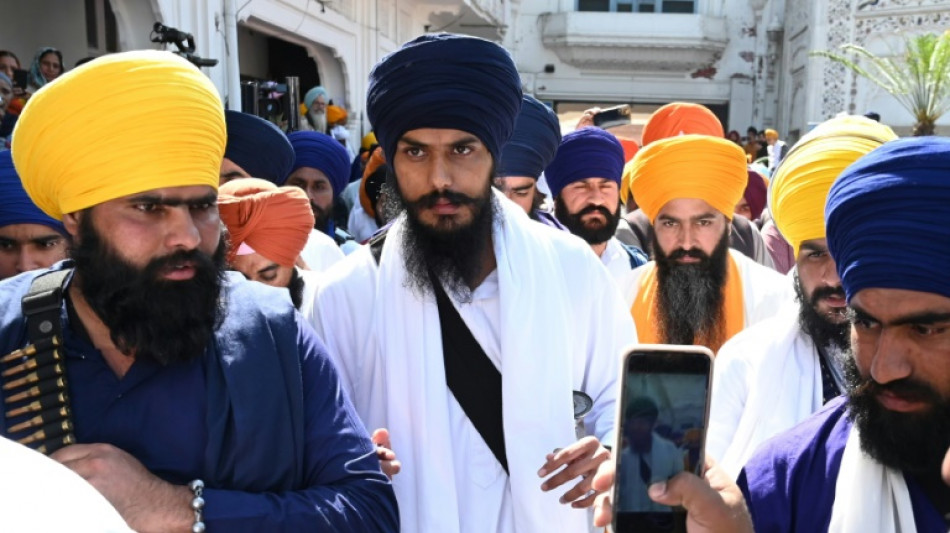
India arrests Sikh separatist after major hunt / Photo: Narinder NANU - AFP/File
 Post-election pressures complicate US and Israeli decisions on Iran

 UN members approve talks on treaty protocol against environmental crime

 Family-run West Sussex beach café prepares for first winter season

 CT scans reveal health and burial clues from Egypt’s Braided Lady mummy

 Oxford faces complaints over lecturer’s classroom attire

 Kyren Wilson and John Higgins reach International Championship snooker final

 New Zealand and Tonga meet for place in Rugby League World Cup final

 Reports of unsafe AI-toy responses renew calls for child-safety rules

 Juneau food network combines difficult supply routes with deep sharing traditions

 India climbs green-transition ranking after first emissions decline in 25 years

 Trump names Stephen Miller as White House chief of staff after midterm losses

 Restored Albanian tower houses anchor new rural tourism trail

 Sonia Gandhi reflects on family tragedy and reluctant political career

 Pope Leo begins three-country South American tour in Uruguay

 Khawaja says entire Australia camp knew of 2018 ball-tampering plan

 November Foraging Guide: Edible Mushrooms and Critical Safety Protocols

 Microsoft Updates Xbox PC App with 60% Faster Startup and Redesigned Interface

 Early Polar Vortex Disruption Creates Uncertain Winter Outlook for Pennsylvania

 DEA Marijuana Rescheduling Hearing Closes With Government Not Meeting Its Burden Of Proof?

Indian police arrested Sunday a firebrand Sikh separatist after a manhunt lasting more than a month that sparked protests and vandalism among the diaspora in Britain, Canada and the United States.
Amritpal Singh rose to fame calling for the creation of a separate Sikh homeland known as Khalistan, the struggle for which sparked deadly violence in India in the 1980s and 1990s.
Police said they arrested Singh at around 6:45 am (0115 GMT), having surrounded a village in the northern state of Punjab following intelligence that he was there in a gurdwara, or Sikh temple.
"Once he got the message that he had no escape route and he was surrounded, he was arrested," senior police official Sukhchain Singh Gill told reporters.
Singh, 30, styles himself on Jarnail Singh Bhindranwale, a figurehead of the Khalistan movement killed when the Indian army stormed the Golden Temple in Amritsar, a major Sikh site, in 1984.
He sports a similarly styled blue turban and long beard and reportedly travelled to the former Soviet republic of Georgia last year for cosmetic surgery to look more like his hero.
Singh and his supporters, armed with swords, knives and guns, raided a police station in February after one of the preacher's aides was arrested for assault and attempted kidnapping.
Authorities then tried to arrest Singh, but he dramatically escaped, reportedly on a motorbike after changing clothes at a gurdwara.
Deploying thousands of officers in the manhunt, authorities cut off mobile internet for days in the Sikh-majority northern state of 30 million people in their search.
They arrested more than 100 of his followers, transferring them to jails hundreds of miles away, and banned gatherings of more than four people in some areas.
After reported sightings in New Delhi and elsewhere, Singh released a video in late March in which he taunted the authorities and called the police operation an "attack on the Sikh community".
"I was neither afraid of arrest earlier, nor am I now. I am in high spirits. Nobody could harm me. It is the grace of God," he said.
- Overseas protests -
The operation sparked protests by Sikhs outside Indian consulates in Britain, Canada and the United States.
Demonstrators smashed windows in San Francisco, took down an Indian flag at the Indian High Commission in London and reportedly vandalised a Gandhi statue in Ontario.
India summoned top US, British and Canadian diplomats to complain and press for improved security at Indian missions in their countries.
Singh's video was posted on Twitter accounts based in Britain and Canada, which the social media company took down in India following government requests, reports said.
Twitter also blocked for Indian users the accounts of several prominent Sikh Canadians who criticised the crackdown, including MP Jagmeet Singh, as well as several journalists, according to the reports.
- Pogrom -
Punjab -- which is about 58 percent Sikh and 39 percent Hindu -- was rocked by a violent separatist movement for Khalistan in the 1980s and early 1990s in which thousands of people died.
The botched 1984 raid in Amritsar, known as Operation Blue Star, led to the assassination of India's prime minister Indira Gandhi by her Sikh security guards a few months later.
That in turn sparked a massive anti-Sikh pogrom in New Delhi and elsewhere lasting several days that left thousands more people including children shot, beaten and burned to death.
Critics accused India's then-ruling Congress of turning a blind eye to the killings with some figures from the party alleged to have played an active role in the violence.
The separatist movement later lost support, with its most vocal advocates today primarily among the Punjabi diaspora despite Indian calls on foreign governments to rein them in.
A.Mahlangu--AMWN