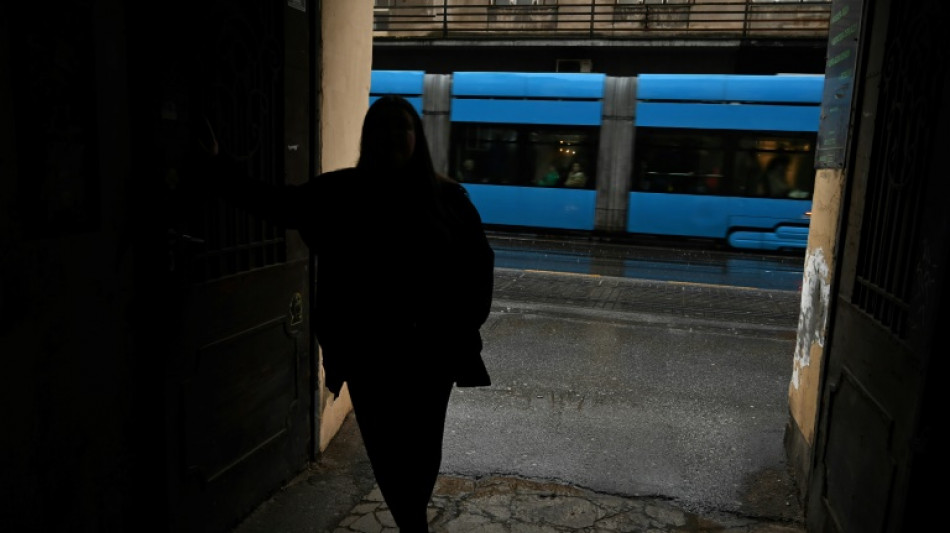
LGBTQ Croatians suffer 'alarming' mental health crisis / Photo: Denis LOVROVIC - AFP
 Post-election pressures complicate US and Israeli decisions on Iran

 UN members approve talks on treaty protocol against environmental crime

 Family-run West Sussex beach café prepares for first winter season

 CT scans reveal health and burial clues from Egypt’s Braided Lady mummy

 Oxford faces complaints over lecturer’s classroom attire

 Kyren Wilson and John Higgins reach International Championship snooker final

 New Zealand and Tonga meet for place in Rugby League World Cup final

 Reports of unsafe AI-toy responses renew calls for child-safety rules

 Juneau food network combines difficult supply routes with deep sharing traditions

 India climbs green-transition ranking after first emissions decline in 25 years

 Trump names Stephen Miller as White House chief of staff after midterm losses

 Restored Albanian tower houses anchor new rural tourism trail

 Sonia Gandhi reflects on family tragedy and reluctant political career

 Pope Leo begins three-country South American tour in Uruguay

 Khawaja says entire Australia camp knew of 2018 ball-tampering plan

 November Foraging Guide: Edible Mushrooms and Critical Safety Protocols

 Microsoft Updates Xbox PC App with 60% Faster Startup and Redesigned Interface

 Early Polar Vortex Disruption Creates Uncertain Winter Outlook for Pennsylvania

 DEA Marijuana Rescheduling Hearing Closes With Government Not Meeting Its Burden Of Proof?

By Viktor Zahtila's own count, he has been assaulted at least a dozen times for being gay in Croatia -- where attacks and rampant discrimination towards the LGBTQ community have led to an "alarming" mental health crisis.
Zahtila -- a filmmaker and pioneering gay rights activist in the country -- said most of the attacks occurred in the capital Zagreb along with a vicious beating in a tourist resort on the Adriatic coast.
"They literally battered us... It lasted for so long that at a certain moment I thought that's the end, I will not survive," he tells AFP, recalling the attack against him and his then boyfriend.
That and the subsequent violence spurred bouts of anxiety that haunted Zahtila for years.
"A macho-looking man walks towards me down the street and my heart starts pounding, I become pale, paralysed... eventually (I realise) it's just a guy who passed by, but I feel like someone punched me in the stomach."
The experience is sadly common for many in Croatia's LGBTQ community.
A study published last month -- the first of its kind in the country -- found that 25 percent of LGBTQ Croatians had been physically assaulted.
It also reported that nearly three-quarters of the LGBTQ community had experienced suicidal thoughts, with more 15 percent saying they had attempted to end their lives.
"We knew that the figures would be worrying but we're still badly surprised," said Daniel Martinovic, a spokesman for Rainbow Families, which conducted the survey.
"They are alarming," Martinovic added, saying that data suggests many in Croatia's LGBTQ community are also dealing with severe anxiety.
- Fear -
The report said that three-quarters of LGBTQ people in Croatia had experienced outright discrimination -- including in the workplace, at public institutions and in medical facilities.
"The data show clearly that in our society non-heterosexual people do not feel safe, equal, respected and protected," said psychologist Matea Popov, one of the researchers who helped compile the survey.
Most of the anxiety stemmed from the perennial fear of violence, discrimination and bullying, according to experts.
The frequency of such incidents in places such as Croatia only confirms their worst fears, according to Popov, making small tasks in everyday life potentially burdensome.
Over the past decade, the staunchly Catholic country has seen a gradual liberalisation of gay rights.
While same-sex marriage remains illegal, couples have been able to register as "life partners" since 2014 -- a status that grants them most of the same rights as heterosexual married couples.
But despite some advances, tradition in Croatia runs deep -- rooted in a history of hyper-patriarchal Balkan culture along with the influence of the Catholic church and ultra-conservative groups that regularly campaign against abortion and gay rights.
In 2013, ultra-conservatives succeeded in initiating a referendum that banned same-sex marriage.
The advocacy group Zagreb Pride said the measure paved the way for creating a "negative political and social environment" that led to an increase in hate crimes.
- 'Serious blow' -
The culture of discrimination is keenly felt by many in the country's trans community.
For Diana Avdic -- a trans woman living in Zagreb -- discrimination has been a common experience in daily life.
It was a "serious blow" when her peers at Zagreb University, where she is studying medicine, shunned her after she came out.
"I faced a lack of understanding, distancing, isolation," the 26-year-old told AFP.
"It made me feel vulnerable, exposed."
The discrimination was not only confined to her peers.
Once, during a trip to a municipal office, a clerk refused to provide her with a form to register her new name and went on to accuse her of trying to "cheat the world".
"It upset me enormously," said Avdic.
Still, unlike many LGBTQ people in Croatia, she was supported by her family, which offered much-needed respite among the deluge of bigotry.
For a 36-year-old Zagreb resident, who identifies as non-binary transgender and asked not to be named, discrimination has come not only from family but also from medical personnel.
"The psychiatrist said that as long as I have a female name and 'F' in my documents she will address me that way," he told AFP about an incident while hospitalised recently.
"It bothers me that I have to convince a doctor that I indeed exist the way I am."
Ch.Havering--AMWN