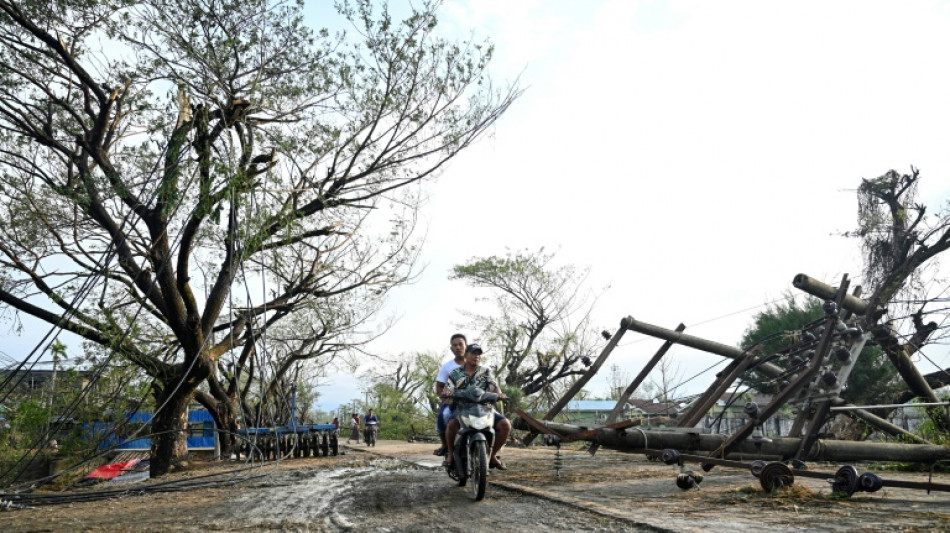
Myanmar port city cut off in Cyclone Mocha aftermath / Photo: Sai Aung MAIN - AFP
 Post-election pressures complicate US and Israeli decisions on Iran

 UN members approve talks on treaty protocol against environmental crime

 Family-run West Sussex beach café prepares for first winter season

 CT scans reveal health and burial clues from Egypt’s Braided Lady mummy

 Oxford faces complaints over lecturer’s classroom attire

 Kyren Wilson and John Higgins reach International Championship snooker final

 New Zealand and Tonga meet for place in Rugby League World Cup final

 Reports of unsafe AI-toy responses renew calls for child-safety rules

 Juneau food network combines difficult supply routes with deep sharing traditions

 India climbs green-transition ranking after first emissions decline in 25 years

 Trump names Stephen Miller as White House chief of staff after midterm losses

 Restored Albanian tower houses anchor new rural tourism trail

 Sonia Gandhi reflects on family tragedy and reluctant political career

 Pope Leo begins three-country South American tour in Uruguay

 Khawaja says entire Australia camp knew of 2018 ball-tampering plan

 November Foraging Guide: Edible Mushrooms and Critical Safety Protocols

 Microsoft Updates Xbox PC App with 60% Faster Startup and Redesigned Interface

 Early Polar Vortex Disruption Creates Uncertain Winter Outlook for Pennsylvania

 DEA Marijuana Rescheduling Hearing Closes With Government Not Meeting Its Burden Of Proof?

A major Myanmar port city remained cut off from contact on Monday after a cyclone tore through the west of the country and neighbouring Bangladesh where it spared sprawling refugee camps.
Cyclone Mocha made landfall between Cox's Bazar in Bangladesh and Myanmar's Sittwe packing winds of up to 195 kilometres (120 miles) per hour, in the biggest storm to hit the Bay of Bengal in over a decade.
By late Sunday the storm had largely passed, sparing refugee camps housing almost a million Rohingya in Bangladesh, where officials said there had been no deaths.
Communications with Sittwe, home to around 150,000 people, and which bore the brunt of the storm according to cyclone trackers, were still down on Monday.
The road to the city was littered with trees, pylons and power cables, AFP correspondents said, with vehicles full of rescuers and locals trying to reach the town and their relatives forming queues.
"We drove all the way through the cyclone yesterday and cut trees and pushed away pylons... but then the big trees blocked the road," an ambulance driver trying to reach Sittwe told AFP.
He and others were using a chainsaw to cut through branches of trees blocking the road.
The storm crashed ashore on Sunday, bringing a storm surge and high winds that toppled a communications tower in state capital Sittwe, according to images published on social media.
Junta-affiliated media reported that the storm had put hundreds of base stations that connect mobile phones to networks out of action in Rakhine state.
"I want to go home as fast as I can because we don't know the situation in Sittwe," a man from the town told AFP, requesting anonymity.
"There is no phone line, there is no internet... I'm worried for my home and belongings."
Junta chief Min Aung Hlaing had "instructed officials to make preparations for Sittwe Airport transport relief," state media reported on Monday, without giving details on when relief was expected to arrive.
- 'Extensive damage' -
The United Nations said communications problems meant it had not yet been able to assess the damage in Rakhine state, which has been ravaged by ethnic conflict for years.
"Early reports suggest the damage is extensive," the UN Office for the Coordination of Humanitarian Affairs said late on Sunday.
In Bangladesh, where officials said they evacuated 750,000 people, secretary of the disaster management ministry Kamrul Hasan told AFP that no one had died in the cyclone.
In the Rohingya camps, where about a million people live in 190,000 bamboo and tarpaulin shelters, the damage was also minimal, officials said.
"About 300 shelters were destroyed by the cyclone," deputy refugee commissioner Shamsud Douza told AFP.
The chances of landslides in the camps were also low "due to lack of rain".
"The sky has become clear."
Cyclone Mocha is the most powerful storm to hit Bangladesh since Cyclone Sidr, Azizur Rahman, the head of Bangladesh's Meteorological Department, told AFP.
Sidr hit Bangladesh's southern coast in November 2007, killing more than 3,000 people and causing billions of dollars in damage.
In recent years, better forecasting and more effective evacuation planning have dramatically reduced the death toll from such storms.
Scientists have warned that storms are becoming more powerful as the world gets warmer because of climate change.
Cyclones -- the equivalent of hurricanes in the North Atlantic or typhoons in the Northwest Pacific -- are a regular and deadly menace on the coast of the northern Indian Ocean where tens of millions of people live.
Cyclone Nargis devastated Myanmar's Irrawaddy Delta in 2008, killing at least 138,000 people.
The then-junta faced international criticism for its response to the disaster. It was accused of blocking emergency aid and initially refusing to grant access to humanitarian workers and supplies.
mma-sa-lpk-rma/pdw/sco
Y.Aukaiv--AMWN