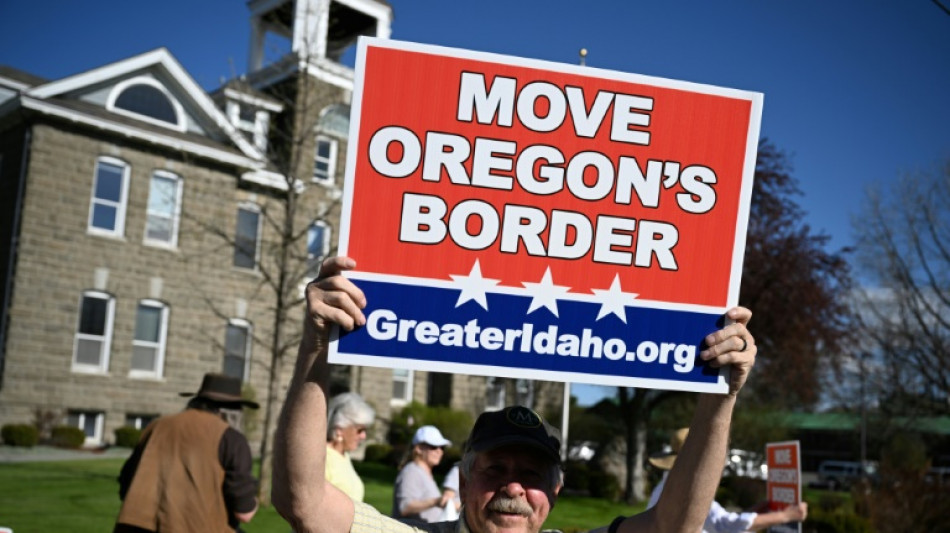
Rural America dreams of secession in eastern Oregon / Photo: Robyn Beck - AFP
 Post-election pressures complicate US and Israeli decisions on Iran

 UN members approve talks on treaty protocol against environmental crime

 Family-run West Sussex beach café prepares for first winter season

 CT scans reveal health and burial clues from Egypt’s Braided Lady mummy

 Oxford faces complaints over lecturer’s classroom attire

 Kyren Wilson and John Higgins reach International Championship snooker final

 New Zealand and Tonga meet for place in Rugby League World Cup final

 Reports of unsafe AI-toy responses renew calls for child-safety rules

 Juneau food network combines difficult supply routes with deep sharing traditions

 India climbs green-transition ranking after first emissions decline in 25 years

 Trump names Stephen Miller as White House chief of staff after midterm losses

 Restored Albanian tower houses anchor new rural tourism trail

 Sonia Gandhi reflects on family tragedy and reluctant political career

 Pope Leo begins three-country South American tour in Uruguay

 Khawaja says entire Australia camp knew of 2018 ball-tampering plan

 November Foraging Guide: Edible Mushrooms and Critical Safety Protocols

 Microsoft Updates Xbox PC App with 60% Faster Startup and Redesigned Interface

 Early Polar Vortex Disruption Creates Uncertain Winter Outlook for Pennsylvania

 DEA Marijuana Rescheduling Hearing Closes With Government Not Meeting Its Burden Of Proof?

From the sun-dappled, tree-lined village of Joseph, Debbie Price can see the distant snowy peaks of the Seven Devils, a series of mountains in the Rockies that mark Oregon's border with Idaho.
But for many eastern Oregonians like Price, that frontier no longer feels relevant.
The 64-year-old retiree is part of a local movement that wants to redraw the region's map so that they can secede to join the neighboring, more conservative state of Idaho.
"There's a lot more freedom in Idaho than there is here," said the former legal assistant, who traveled across the state border to remarry during the pandemic, at a time when weddings were banned in Oregon.
Among her list of grievances with Oregon are impending restrictions on carrying firearms, its decriminalization of the use of drugs, its pro-choice stance on abortion, and its support for LGBTQ rights.
Price blames all these on the "woke agenda" radiating out from Portland, the progressive metropolis near the northwestern state's coast.
"Maybe I'm old fashioned. I want things to stay like they are," said the devout Christian, touting Idaho's ban on abortion.
"I'm not anxious to move forward and try to be what the world is going toward these days."
While Oregon has not elected a Republican mayor in 40 years, it is very geographically divided. At the midterm elections last November, only six out of 36 counties voted Democrat.
But those six are among the most populous, and they consistently control the state's top offices.
- 'Greater Idaho' -
Out in the rural east, many voters are tired of what they describe as feeling dispossessed by the urban elite who live along the Pacific coast.
A radical solution has been brewing: to move the Idaho-Oregon border to the west and create a "Greater Idaho" encompassing half of present-day Oregon.
Of 15 counties in eastern Oregon, 11 have already voted to require local officials to discuss the plan.
On Tuesday, Wallowa County -- where Price lives -- is scheduled to vote on a similar measure.
Signs demanding to "Move Oregon's Border" sit alongside "Trump 2024" placards in the vast, rolling plains of this small corner of America, which has less than one person per square mile.
Locals decry "one-size-fits-all" laws that ignore their rural way of life.
Some complain that they can't kill wolves threatening their livestock as easily as neighboring ranchers in Idaho.
Others blame the decline of the vital local timber industry on the state's strict logging limits, which have forced many mills to close.
Many are afraid that Oregon could follow California in phasing out diesel and even gasoline-powered cars in favor of electric vehicles.
"The diesel ban is a horrible idea, and I think it would destroy our economy," said Garrett Mahon, a 41-year-old logger.
On a remote piece of land that has belonged to his family for a century, Mahon stacks giant tree trunks with an industrial machine that "you would never be able to run... on a battery," he said.
Inland Oregon's freezing winters sap the power of electrical farming and logging machinery, he explained.
- 'Culture wars' -
"I don't think we'll actually be able to not be Oregon: there's so much still involved in trying to get it done," admitted Mahon, a hunter who keeps a semi-automatic rifle in his pickup truck.
But he hopes that if his fellow rural Oregonians keep consistently voting for the project, politicians will have to "listen."
Still, the dream of a "Greater Idaho" remains highly improbable.
Changing state borders would require the approval of both Oregon and Idaho's legislatures, and then Congress in Washington, DC.
That is an extremely unlikely scenario, even in a nation with a long history of separatism -- the Civil War gave birth to West Virginia in 1863, and California has endured more than 200 attempts to divide the state from within.
In eastern Oregon, local Democrats openly mock the notion. At a recent picnic, they handed out cardboard moving boxes for those who wish to leave.
But behind the laughter, there lies some unease.
"America's democracy is in trouble... There are so many culture wars," said Devon Maxwell, a 27-year-old paralegal and member of the Democratic Party.
"What the greater Idaho movement is ultimately doing is inflaming the situation and the divides that are already in the community."
And there are signs that the idea could be taking root more widely.
In February, Idaho's House of Representatives passed a non-binding resolution to discuss the project.
This has galvanized supporters of the "divorce" such as Curt Howell, a 67-year-old farmer who believes the movement could spread far beyond Oregon.
"You could redraw the lines all over the West... living amongst like-minded people is always easier," he said.
He would personally favor a peaceful solution, but he fears that "if in Oregon, something doesn't get better in the next five to 10 years, it could become ugly."
P.Costa--AMWN