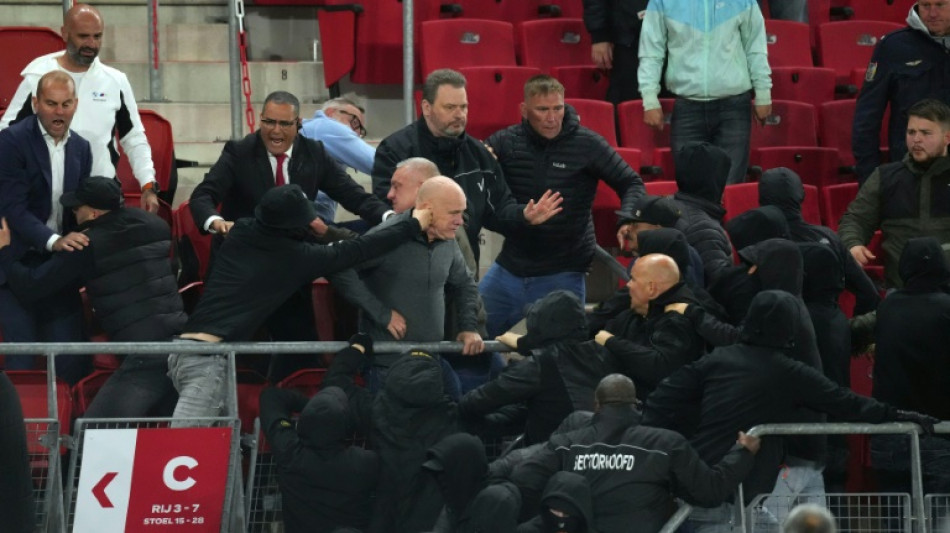
Dutch tackle surge in football violence / Photo: - - ANP/AFP
 South African election results renew debate over identity-based voting

 South African voters report smoother local election but declining IEC trust

 Dolly Parton museum and Nashville hotel open after singer’s death

 George and Amal Clooney attend New York political-comedy reading

 British buyers pay substantial premiums for period-home appearance

 Thomas Markle released to house arrest after child-abuse-image charge

 Dawn of War 4 developers chose Adeptus Mechanicus for tactical variety

 Italy face unbeaten South Africa in Turin Nations Championship match

 ChatGPT interactive interface feature tested across six custom tools

 Freshways milk-price cut deepens pressure on UK dairy farms

 Labour and National remain virtually tied as New Zealand vote count advances

 The Good Daughter adapts Karin Slaughter thriller with Rose Byrne and Meghann Fahy

 Heavy-lift drone evacuates wounded Ukrainian soldier from frontline kill zone

 Morrison says West Brom recovered after pressure from successive derby losses

 Britain considers 2027 state visit for Ukraine’s Zelensky

 Anna Miltina Confronted with Racism Allegations on ProSieben Show

 German Auto Giants Face Existential Crisis as China Sales Plummet

 Cause of Death Revealed for 'Ellen' Producer Matthew Wright
From fireworks to pitch invasions, the Netherlands is facing a surge in football hooliganism that climaxed in a shocking attack by AZ Alkmaar supporters on West Ham fans this week.
Dutch authorities were already trying to tackle the problem after more than a dozen serious incidents this year, which have shocked the country despite it being no stranger to crowd trouble.
But the problem is now an international one after black-hooded AZ fans tried to storm the area reserved for friends and family of West Ham staff following the Hammers' 1-0 win in the Europa Conference League semi finals.
West Ham manager David Moyes admitted he was concerned for the safety of his family, while stars from the Premier League team climbed over the hoardings in a bid to stop the trouble on Thursday night.
Dutch riot police were called in to deal with the unrest.
With UEFA expected to launch an investigation into events at Alkmaar, the Dutch are now under pressure to act -- but in the Netherlands as elsewhere, the problem is a tough one to stamp out.
"Football violence is a multi-headed monster that's not easy to eradicate," Dutch Justice Minister Dilan Yesilgoz said in a letter to parliament in April.
The Dutch minister was reacting after Ajax midfielder Davy Klaassen was injured on the head after a supporter from Feyenoord -- the Amsterdam side's bitter Rotterdam rivals and this year's champions -- tossed a lighter from the stands.
She called the Klaassen attack an "all-time low point" and ordered an urgent probe.
-Tougher measures -
Yet it was far from the only incident this season, sparking questions about the reasons for the violence and how to combat it.
On Sunday, a referee stopped an Eredivisie clash between Ajax and FC Groningen after less than 20 minutes when a fan ran onto the pitch followed by a barrage of smoke bombs.
Police arrested more than 150 fans earlier this month after they chanted anti-Semitic slogans on their way to a game between AZ Alkmaar and Ajax.
In February a 20-year-old PSV Eindhoven supporter was handed a 40-year ban for attacking Sevilla's Serbian goalkeeper Marko Dmitrovic.
Several other games including involving Dutch first division teams like FC Utrecht, FC Twente, Go Ahead Eagles, RKC Waalwijk and Sparta Rotterdam also had to be called off due to hooliganism.
Minister Yesilgoz said in April that the government was looking at increased measures including alcohol bans, pre-allocated seating and tougher criminal prosecutions.
The number of stadium bans handed to unruly fans over the past season, when stadiums reopened in the wake of the Covid pandemic, was "double the number handed out over the last decade," she said.
- 'Anarchy' -
Experts blamed a number of factors including pent-up fans looking for trouble after years of Covid restrictions.
Jan Brouwer, a law professor who specialises in the study of football violence at Groningen University, said an increased number of incidents reported to Dutch public prosecutors showed "that violence around football was getting more intense."
One of the reasons was a change in the hierarchy of hardcore or so-called "ultra" football hooligans, he said.
"A lot of people at the top, having had enough, have left, while a lot of young new supporters have been added at the bottom," he told public broadcaster NOS.
"There now is a type of anarchy in place and after stadium access was prohibited (during the pandemic), they are now hungry for a bit of resistance," Brouwer said.
The Dutch are also going to turn to their British counterparts to look at the so-called "English Model", minister Yesilgoz said.
This was instituted in the 1980s after English clubs were banned from Europe for more than half a decade following the deaths of 39 people following a riot before the 1985 European Cup final between Liverpool and Juventus at Heysel Stadium in Brussels.
The British model relies heavily on criminal law to punish transgressors, as well as lengthy stadium bans.
Several of the Dutch hooligans have already been punished, with the Klaassen attacker getting 60 hours' community service and Dmitrovic's assailant handed a two-month jail sentence.
L.Mason--AMWN
