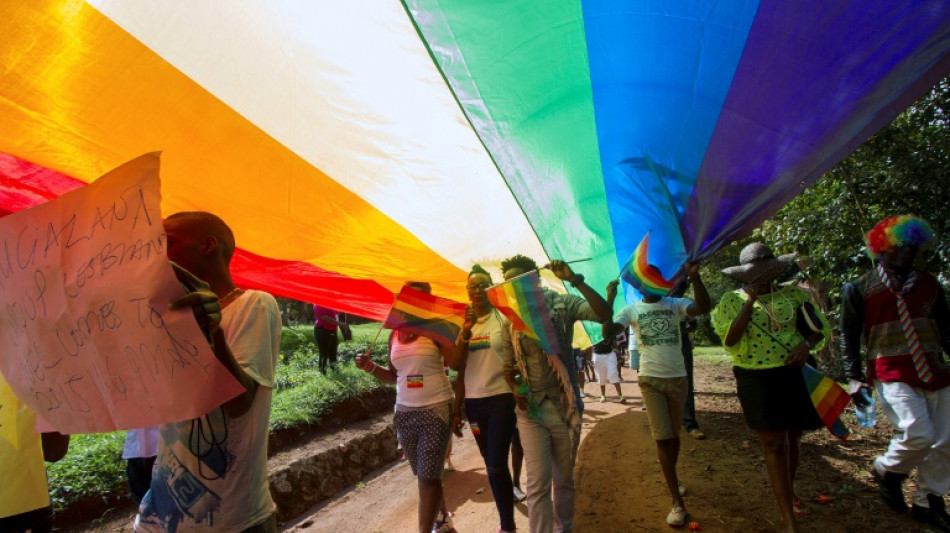
Ugandan activists call for sanctions after tough anti-gay law passed / Photo: ISAAC KASAMANI - AFP/File
 South African election results renew debate over identity-based voting

 South African voters report smoother local election but declining IEC trust

 Dolly Parton museum and Nashville hotel open after singer’s death

 George and Amal Clooney attend New York political-comedy reading

 British buyers pay substantial premiums for period-home appearance

 Thomas Markle released to house arrest after child-abuse-image charge

 Dawn of War 4 developers chose Adeptus Mechanicus for tactical variety

 Italy face unbeaten South Africa in Turin Nations Championship match

 ChatGPT interactive interface feature tested across six custom tools

 Freshways milk-price cut deepens pressure on UK dairy farms

 Labour and National remain virtually tied as New Zealand vote count advances

 The Good Daughter adapts Karin Slaughter thriller with Rose Byrne and Meghann Fahy

 Heavy-lift drone evacuates wounded Ukrainian soldier from frontline kill zone

 Morrison says West Brom recovered after pressure from successive derby losses

 Britain considers 2027 state visit for Ukraine’s Zelensky

 Anna Miltina Confronted with Racism Allegations on ProSieben Show

 German Auto Giants Face Existential Crisis as China Sales Plummet

 Cause of Death Revealed for 'Ellen' Producer Matthew Wright
Ugandan activists called on foreign donors to impose sanctions on rights abusers after President Yoweri Museveni signed an anti-gay law described as among the world's harshest.
The veteran leader defied warnings that approving the much-criticised bill against homosexuality would strain ties between Kampala and key international partners and aid donors, including Washington.
Among other harsh measures, the new law prescribes a death penalty for "aggravated homosexuality" in certain circumstances, although Uganda has not carried out capital punishment for many years.
The move has trigged outcry and calls for a tough response from Uganda's diplomatic and financial backers.
"This is a key time for stakeholders, such as the US and the EU, to move forward with sanctions against Ugandans implicated in human rights abuses," a coalition of Ugandan activist groups said in a statement late Monday.
They warned that the "dangerous and discriminatory" law would further shrink space for civil society under Museveni, whose rule has become increasingly authoritarian since he took power in 1986.
"Creating new crimes like these are a well-know way to engineer a legal basis to throw those with divergent views behind bars," said Clare Byarugaba from Chapter Four Uganda, one of the groups calling for sanctions.
She said the law would also discourage members of the LQBTQ community from seeking treatment for HIV and would "devastate the fight" against the disease in Uganda.
- 'Undermine relationships' -
Ugandan lawmakers have stood firm against western criticism over the bill since it was first introduced to parliament in March, even if it meant cuts to foreign aid or other repercussions.
US President Joe Biden on Monday said it was "a tragic violation of universal human rights" and threatened to cut aid and investment if the bill was not repealed.
Biden said he had asked his National Security Council to assess what the law means for "all aspects of US engagement with Uganda", including services providing AIDS relief and other assistance and investments.
He said the administration would also consider sanctions against Uganda and the restriction of entry into the United States for people engaging in human rights abuses or corruption there.
EU foreign policy chief Josep Borrell said the Ugandan government was obligated to uphold the rights of all its citizens and "failure to do so will undermine relationships with international partners".
In 2014, donors slashed aid to Uganda after Museveni approved a bill that sought to impose life imprisonment for homosexual relations, but was later overturned.
The Netherlands froze a seven-million-euro subsidy to Uganda's legal system, while Denmark and Norway redirected around six million euros each towards private sector initiatives, aid agencies and rights organisations.
The US -- under President Barrack Obama -- also cut aid and trading rights.
Though criticised abroad, the latest anti-gay bill has enjoyed broad support in the conservative country, where lawmakers defended the measures as a necessary bulwark against Western immorality.
Homosexuality was criminalised in Uganda under colonial laws, but there has never been a conviction for consensual same-sex activity since independence from Britain in 1962.
S.F.Warren--AMWN
