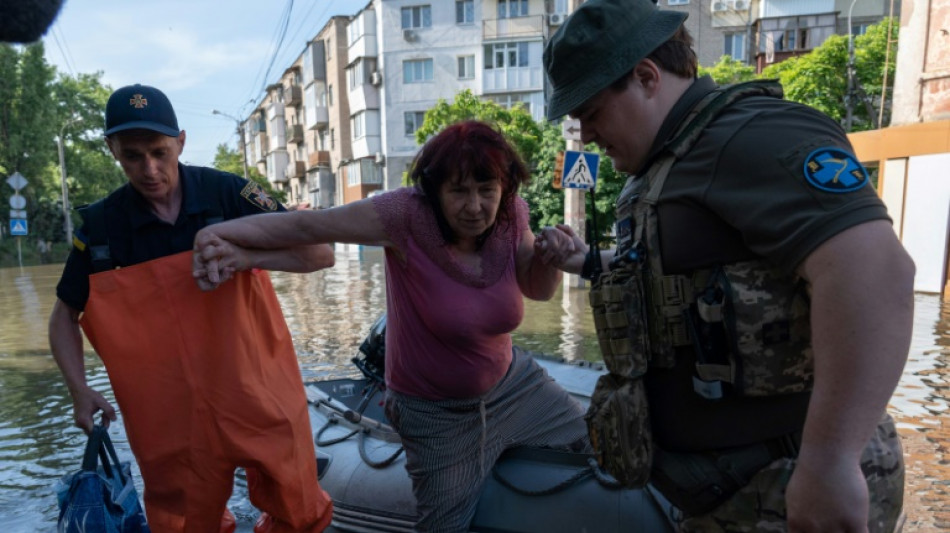
What we know about dam's destruction in Ukraine / Photo: ALEKSEY FILIPPOV - AFP
 South African election results renew debate over identity-based voting

 South African voters report smoother local election but declining IEC trust

 Dolly Parton museum and Nashville hotel open after singer’s death

 George and Amal Clooney attend New York political-comedy reading

 British buyers pay substantial premiums for period-home appearance

 Thomas Markle released to house arrest after child-abuse-image charge

 Dawn of War 4 developers chose Adeptus Mechanicus for tactical variety

 Italy face unbeaten South Africa in Turin Nations Championship match

 ChatGPT interactive interface feature tested across six custom tools

 Freshways milk-price cut deepens pressure on UK dairy farms

 Labour and National remain virtually tied as New Zealand vote count advances

 The Good Daughter adapts Karin Slaughter thriller with Rose Byrne and Meghann Fahy

 Heavy-lift drone evacuates wounded Ukrainian soldier from frontline kill zone

 Morrison says West Brom recovered after pressure from successive derby losses

 Britain considers 2027 state visit for Ukraine’s Zelensky

 Anna Miltina Confronted with Racism Allegations on ProSieben Show

 German Auto Giants Face Existential Crisis as China Sales Plummet

 Cause of Death Revealed for 'Ellen' Producer Matthew Wright
The Russian-held Kakhovka dam in southern Ukraine was ripped open after an explosion in the early hours of Tuesday, according to multiple accounts.
The damage has worsened due to the torrent of Dnipro River water unleashed by the breach, forcing thousands to flee, disrupting water supplies and sparking fears of an environmental as well as humanitarian disaster.
Here is what we know so far:
- What happened? -
The Kakhovka dam sits on the Dnipro River and is located on the front line about 60 kilometres (40 miles) east of the Ukrainian city of Kherson.
Russian forces have controlled territory on one bank of the river since the first days of their invasion last year and there are frequent exchanges of fire with Ukrainian forces stationed on the other side.
Ukrainian President Volodymyr Zelensky said the blast happened at 2:50 am local time on Tuesday (2350 GMT on Monday), causing its partial collapse.
Igor Syrota, the head of Ukraine's state-run hydropower generating company Ukrhydroenergo, said the station itself is destroyed and cannot be restored.
"The hydraulic structure is being washed away," he said, estimating that "half of the station is already under water".
British intelligence said that by noon on Tuesday, "the entire eastern portion of the dam and much of the hydro and utilities infrastructure was swept away.
"The dam's structure is likely to deteriorate further over the next few days, causing additional flooding," it said.
- What each side says -
Moscow and Kyiv have traded blame for the damage.
Kyiv said the destruction of the dam was an attempt by Moscow to hamper its long-awaited offensive. Zelensky said Russia had carried out "an internal explosion of the structures" of the plant.
After speaking with his top military commanders, Zelensky said: "The main conclusion is that the explosion was intentional, but the enemy acted chaotically, allowing their own equipment to be flooded."
Syrota of Ukrhydroenergo said that "we are more than convinced that there was an explosion inside the plant –- in particular, in the engine room.
"The plant broke in half," he said.
Ukrainian officials say Russian forces mined the dam shortly after its capture.
But Russia says the dam was partially destroyed by "multiple strikes" coming from Ukrainian forces. The Kremlin says the destruction is the result of "deliberate sabotage by the Ukrainian side".
Western powers say it is too soon to say conclusively what happened.
A Western official -- speaking on condition of anonymity -- said on Tuesday that the Western intelligence community, including the United States, was still assessing who was responsible but was leaning toward Russia.
The motive was also still being assessed, the official said, adding Russia possibly wanted to make it more difficult for Ukraine to conduct a river crossing, and to create a significant humanitarian challenge.
- Extent of destruction? -
Dozens of villages and towns have been flooded and thousands of people have been forced to flee the area.
Zelensky said that up to 80 settlements are under threat. Hundreds of thousands of people have been left without "normal access to drinking water," he said.
On Wednesday, more than 2,700 people have been evacuated from homes on both sides of the Dnipro, officials said.
More are believed to have left of their own accord.
In Kherson, the largest city nearby, water levels have risen by five metres (16 feet), officials say.
At least 150 tons of machine oil spilled into the waters of the Dnipro.
- What's next?
The UN warns that the destruction of the Kakhovka dam could spark an environmental disaster and have dire humanitarian consequences for hundreds of thousands of people.
The UN humanitarian agency OCHA said emergency humanitarian response efforts were underway to provide urgent assistance to more than 16,000 people, including water supplies.
Washington has warned there would be "likely many deaths".
The dam provided cooling water for the Zaporizhzhia nuclear power plant, Europe's largest.
The UN nuclear watchdog agency said the dam break was posing "no short-term risk" to the plant.
L.Davis--AMWN
