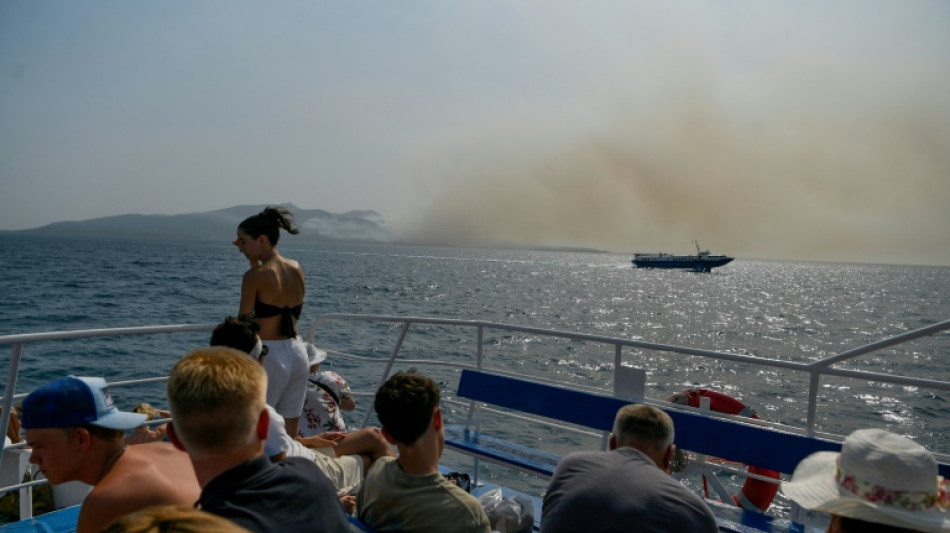
Will climate change hit Mediterranean tourism? / Photo: Armend NIMANI - AFP/File
 South African election results renew debate over identity-based voting

 South African voters report smoother local election but declining IEC trust

 Dolly Parton museum and Nashville hotel open after singer’s death

 George and Amal Clooney attend New York political-comedy reading

 British buyers pay substantial premiums for period-home appearance

 Thomas Markle released to house arrest after child-abuse-image charge

 Dawn of War 4 developers chose Adeptus Mechanicus for tactical variety

 Italy face unbeaten South Africa in Turin Nations Championship match

 ChatGPT interactive interface feature tested across six custom tools

 Freshways milk-price cut deepens pressure on UK dairy farms

 Labour and National remain virtually tied as New Zealand vote count advances

 The Good Daughter adapts Karin Slaughter thriller with Rose Byrne and Meghann Fahy

 Heavy-lift drone evacuates wounded Ukrainian soldier from frontline kill zone

 Morrison says West Brom recovered after pressure from successive derby losses

 Britain considers 2027 state visit for Ukraine’s Zelensky

 Anna Miltina Confronted with Racism Allegations on ProSieben Show

 German Auto Giants Face Existential Crisis as China Sales Plummet

 Cause of Death Revealed for 'Ellen' Producer Matthew Wright
Destructive fires, temperatures topping 40 degrees Celsius (104 degrees Fahrenheit) and tourists dodging possible catastrophe by staying home. Will climate change end up transforming tourism -- not least in the Mediterranean?
- State of play -
Regions which welcome a sizeable share of holidaymakers are also those hardest hit by climate change. In Greece, thousands of tourists have been evacuated in recent days from the islands of Rhodes and Corfu which have been ravaged by fires touched off by suffocatingly hot weather.
Rhodes' international airport has morphed into an improvised campsite flooded by disorientated tourists.
Other countries around the Mediterranean have also been hit.
In Spain, the thermometer has shot 15 degrees above normal summer season levels. Italy has also laboured under heatwaves with the island of Sardinia melting under 48 Celsius while, on Monday, Tunis endured 49C.
Tourism plays a key role in the region's economies -- the sector accounts for nearly a quarter of GDP in Greece and 12 percent in Spain.
- Economic consequences -
The soaring temperatures could turn off visitors.
For Jean-François Rial, who heads French travel firm Voyageurs du Monde, "global warming is going to render some destinations less and less visitable. The whole of the Mediterranean is concerned and yet it is the main destination of European travellers."
In Spain, "we're starting to hear tourists ask themselves" if they should be looking to spend their summer break on the Mediterranean coast, said Joantxo Llantada, professor at Madrid's IE Business School.
According to a recent note from Moody's, "heatwaves may reduce Southern Europe's attractiveness as a tourist destination in the longer term or at the very least reduce demand in summer, which will have negative economic consequences given the importance of the sector."
- No more sunworshipping? -
Not so fast, suggests Hamit Kuk, who heads the association of Turkish travel operators.
"This issue is very important for the tourism industry -- but it is not a problem if temperatures are very hot in Antalya because European tourists mostly prefer to see the sun," Kuk told AFP.
"We can look at the examples of Egypt and Dubai. In July-August there are temperatures of 45C and tourists still prefer to go there.
The president of Tunisia's hotel federation, Dora Miled, told AFP that to date "the heat has had no impact on tourism.
"If we have yet to return to 2019 activity levels ... that's above all mainly due to the high cost of air travel," said Miled.
Didier Arino, who heads the Protourisme travel consultancy in France, said: "When it comes to their holidays, people don't dream of a cool destination, they want good weather."
Even in Greece it is not certain that the fires will dissuade tourists from coming.
Kostas Chryssohoides, vice prefect of Dodecanese, an island group in the southeastern Aegean Sea that includes Rhodes, observed that "24,000 tourists arrived on Rhodes" between Sunday and Monday, fires notwithstanding. Only a handful cancelled "as a precaution", he said.
- Picking up the slack -
Should it become next to impossible to visit a destination sweltering under abnormal temperatures holidaymakers could look further afield, suggests Jean-Francois Rial, who said "northern European destinations are on the rise."
He suggested that Britain and Ireland could both gain in tourist traction.
- Alternatives -
One thing sector professionals agree on is that tourism will change. They anticipate that total visitors to the Mediterranean could rise -- but reserve in seasons outside summer, boosted by increasing demand from pensioners.
"For now we have no worries about domestic market demand, but if the global climate crisis continues to escalate, we will have to review the summer and winter seasons," said Kuk.
In Rial's view, "that could perhaps be a chance to reduce 'over-tourism'... losing some clients in summertime but gaining more in the other nine months of the year."
For Protourisme's Arino, climate change will force tourism to evolve.
"We must conceive our cities somewhat differently, our resorts, the range of activities on offer."
D.Sawyer--AMWN
