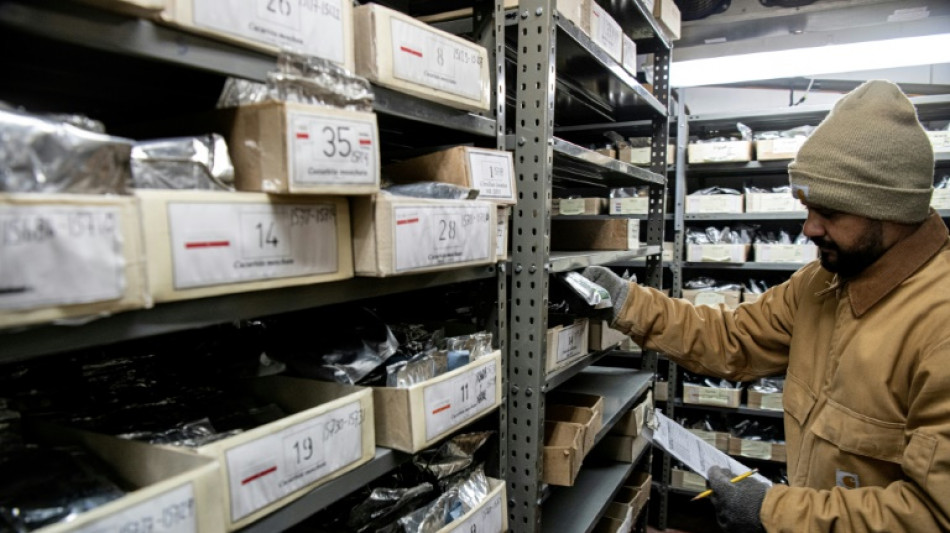
In Costa Rica, saving seeds to feed future generations / Photo: Ezequiel BECERRA - AFP
 South African election results renew debate over identity-based voting

 South African voters report smoother local election but declining IEC trust

 Dolly Parton museum and Nashville hotel open after singer’s death

 George and Amal Clooney attend New York political-comedy reading

 British buyers pay substantial premiums for period-home appearance

 Thomas Markle released to house arrest after child-abuse-image charge

 Dawn of War 4 developers chose Adeptus Mechanicus for tactical variety

 Italy face unbeaten South Africa in Turin Nations Championship match

 ChatGPT interactive interface feature tested across six custom tools

 Freshways milk-price cut deepens pressure on UK dairy farms

 Labour and National remain virtually tied as New Zealand vote count advances

 The Good Daughter adapts Karin Slaughter thriller with Rose Byrne and Meghann Fahy

 Heavy-lift drone evacuates wounded Ukrainian soldier from frontline kill zone

 Morrison says West Brom recovered after pressure from successive derby losses

 Britain considers 2027 state visit for Ukraine’s Zelensky

 Anna Miltina Confronted with Racism Allegations on ProSieben Show

 German Auto Giants Face Existential Crisis as China Sales Plummet

 Cause of Death Revealed for 'Ellen' Producer Matthew Wright
In the tropical mountains of Costa Rica, scientists guard a treasure trove of seeds collected over decades as a bulwark against food insecurity and climate change.
Some 6,200 samples from 125 species of squash, chilli, tomato and other edible plants are held at the Tropical Agricultural Research and Higher Education Center (CATIE) near the town of Turrialba.
In temperatures as low as minus 20 degrees Celsius, the seeds can be kept for up to 40 years for purposes of research, genetic engineering of plants more resistant to pests, diseases or changing weather, or to replace species that die out.
The bank "is a resource we have for use now or in the future," plant geneticist William Solano told AFP at the facility some 60 km east of the capital San Jose.
It holds seeds from 57 countries, he said, but about 90 percent are from the Central American region, collected from markets and farms or growing wild.
The CATIE stockpile, stacked on shelves in hundreds of small, silver envelopes, includes the second-largest collection of squash family seeds in the world.
Many of the seeds are not present in banks anywhere else in the world, according to the center.
- 'Genetic archive' -
"In response to climate change, we have here important materials for food security that are locally adapted" to a variety of climate conditions, ranging from humidity to extreme drought, Solano told AFP.
As ever-more extreme weather threatens food production, traditional, native seeds are essential to "give sustainability to agri-food systems," he added.
According to seed expert Ester Vargas of the University of Costa Rica, "there is variability in native seeds that gives them the ability to adapt to different conditions" in the areas of their origin.
Seed banks like the one at CATIE serve to guarantee an availability of "crops with high nutritional value" for generations to come, she added.
The UN's Food and Agriculture Organization (FAO) estimates that almost one in ten people in the world suffered hunger in 2022 -- some 735 million in total -- with increases in parts of Africa, western Asia and the Caribbean.
The FAO says seed banks help preserve "the most adapted varieties" for a given region.
"As climate change has a significant impact on agricultural production, growing local varieties, which have a high degree of genetic diversity, is highly important because these varieties have the ability to better withstand and adapt to environmental stresses and changes," a document on the organization's website states.
CATIE agronomist Daniel Fernandez said the bank also served another purpose: as a "genetic archive" of species that were replaced by more modified crops and that one day may need to be brought back.
M.Fischer--AMWN
