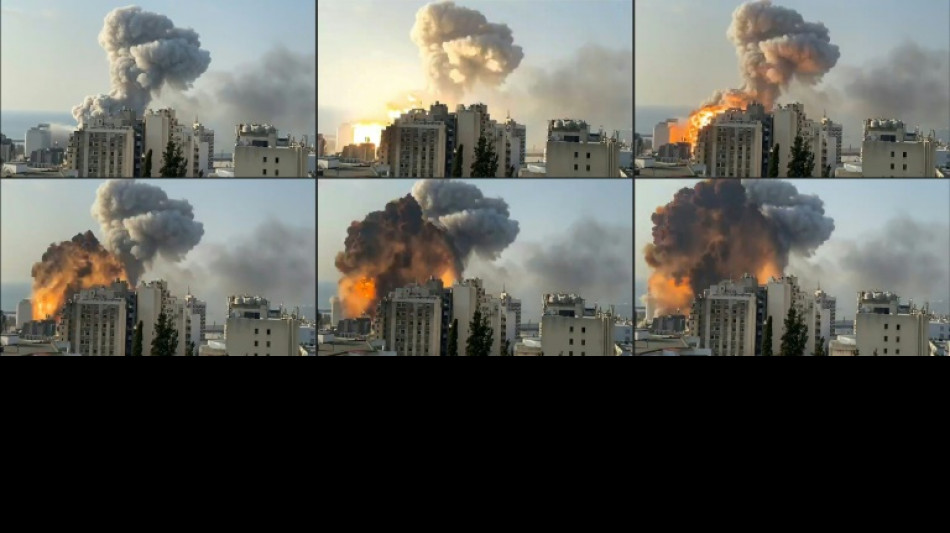
Still no answers three years after Beirut mega-explosion / Photo: Mouafac HARB - MOUAFAC HARB/AFP/File
 South African election results renew debate over identity-based voting

 South African voters report smoother local election but declining IEC trust

 Dolly Parton museum and Nashville hotel open after singer’s death

 George and Amal Clooney attend New York political-comedy reading

 British buyers pay substantial premiums for period-home appearance

 Thomas Markle released to house arrest after child-abuse-image charge

 Dawn of War 4 developers chose Adeptus Mechanicus for tactical variety

 Italy face unbeaten South Africa in Turin Nations Championship match

 ChatGPT interactive interface feature tested across six custom tools

 Freshways milk-price cut deepens pressure on UK dairy farms

 Labour and National remain virtually tied as New Zealand vote count advances

 The Good Daughter adapts Karin Slaughter thriller with Rose Byrne and Meghann Fahy

 Heavy-lift drone evacuates wounded Ukrainian soldier from frontline kill zone

 Morrison says West Brom recovered after pressure from successive derby losses

 Britain considers 2027 state visit for Ukraine’s Zelensky

 Anna Miltina Confronted with Racism Allegations on ProSieben Show

 German Auto Giants Face Existential Crisis as China Sales Plummet

 Cause of Death Revealed for 'Ellen' Producer Matthew Wright
One of history's biggest non-nuclear explosions rocked Beirut on August 4, 2020, destroying swathes of the Lebanese capital, killing more than 220 people and injuring at least 6,500.
Three years on, the probe into the traumatic disaster caused by a huge pile of poorly-stored fertiliser remains bogged down in legal and political wrangling, to the dismay of victims' families.
- The mega-blast -
The massive explosion, heard as far away as Cyprus, destroys much of Beirut port and entire districts of the city in scenes that shock the country and the world.
The blast leaves a 43-metre (141 foot) deep crater and registers as the equivalent of a magnitude 3.3 earthquake.
The disaster spreads fear and chaos, with mountains of broken glass littering roads and bloodied survivors flooding overwhelmed hospitals.
The blast was caused by a fire in a warehouse where a vast stockpile of the industrial chemical ammonium nitrate had been haphazardly stored for years.
The tragedy strikes amid a deep economic crisis, almost a year after mass demonstrations erupted against a ruling class deemed inept and corrupt as living conditions worsen.
On August 10, Prime Minister Hassan Diab resigns under a barrage of pressure over the explosion.
- Probe thwarted -
In December 2020, the lead investigator examining the blast, Fadi Sawan, charges Diab and three ex-ministers with negligence.
Two of them file a complaint, the probe is suspended, and Sawan is removed from his post by court order.
In July 2021, the new investigating magistrate, Tarek Bitar, moves to interrogate four former ministers but parliament stalls on lifting their immunity.
He is forced to suspend the probe following a series of court challenges.
- Gun battle -
In October 2021, the powerful Shiite movement Hezbollah and its ally Amal call for demonstrations to demand Bitar's dismissal.
Seven people are killed in gun battles during the rally.
At the end of 2021, Bitar resumes his investigation but less than two weeks later is forced to suspend work for a fourth time following more legal challenges.
- Silos collapse -
On August 4, 2022, several grain silos damaged in the explosion collapse in a cloud of dust, a traumatic reminder of the disaster that struck exactly two years before.
Days earlier, other parts of the silos crumbled after a fire broke out when remaining grain stocks fermented and ignited in the summer heat.
- Judicial showdown -
In January 2023, 13 months after his probe is suspended, Bitar resumes work and charges Prosecutor General Ghassan Oueidat and seven others with probable intent to murder, arson and other crimes.
Oueidat in turn charges Bitar with insubordination and "usurping power" but the investigator refuses to step down.
Oueidat also orders the release "of all those detained" over the port blast, leaving the investigation stalled and nobody yet held to account.
Victims' families and rights groups urge the United Nations to create an independent fact-finding mission.
L.Harper--AMWN
