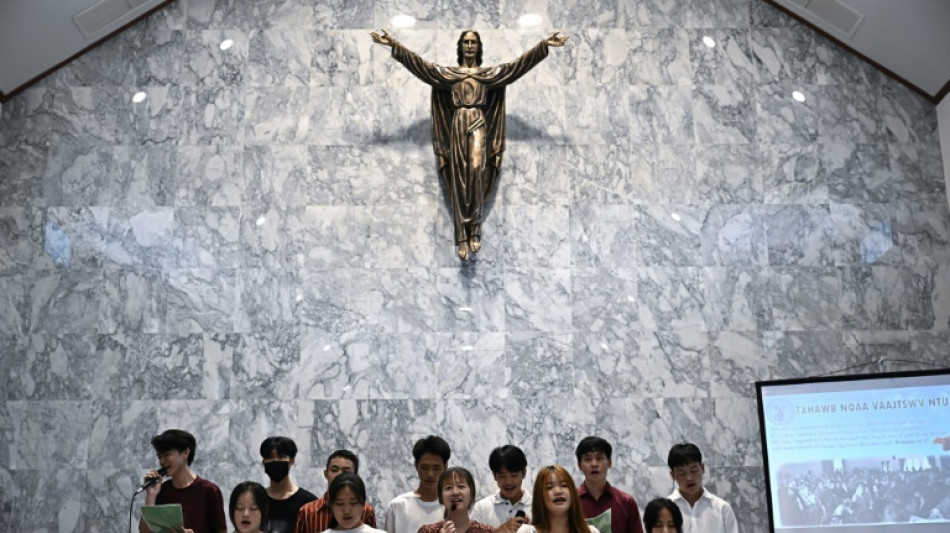
'Ripe for abuse': fears over new Thai refugee screening / Photo: Lillian SUWANRUMPHA - AFP
 South African election results renew debate over identity-based voting

 South African voters report smoother local election but declining IEC trust

 Dolly Parton museum and Nashville hotel open after singer’s death

 George and Amal Clooney attend New York political-comedy reading

 British buyers pay substantial premiums for period-home appearance

 Thomas Markle released to house arrest after child-abuse-image charge

 Dawn of War 4 developers chose Adeptus Mechanicus for tactical variety

 Italy face unbeaten South Africa in Turin Nations Championship match

 ChatGPT interactive interface feature tested across six custom tools

 Freshways milk-price cut deepens pressure on UK dairy farms

 Labour and National remain virtually tied as New Zealand vote count advances

 The Good Daughter adapts Karin Slaughter thriller with Rose Byrne and Meghann Fahy

 Heavy-lift drone evacuates wounded Ukrainian soldier from frontline kill zone

 Morrison says West Brom recovered after pressure from successive derby losses

 Britain considers 2027 state visit for Ukraine’s Zelensky

 Anna Miltina Confronted with Racism Allegations on ProSieben Show

In a church on the edge of Thai capital Bangkok, dozens of Vietnamese refugees sing at a joyful service, sharing a moment of respite from their lives in fear of arrest or deportation.
Not a signatory to the UN Refugee Convention, Thailand does not distinguish between refugees and other migrants, and thousands of people live in the country under the radar.
Later this month, a new system will come into force, which authorities say will allow them to discern between people for whom it would be too dangerous to return home, and others living in Thailand illegally.
Refugees and rights activists are wary, however, saying the system could be used unfairly, and even help expedite deportations for those deemed ineligible for asylum.
"All of us are worried and afraid as we live illegally," Vietnamese pastor Sung Seo Hoa told AFP.
A member of Vietnam's Hmong minority, the Christian pastor said he fled his country's highlands 12 years ago after coming under pressure from the communist government.
Hoa said he and others in his community lead a life of fear.
"We are afraid of police arrest, being put in jail and deported back to Vietnam. That's what we are very afraid of, 24 hours a day," he said.
Hoa does not intend to go through the new screening process.
"There are risks if we apply... they also have the right to deport us back to Vietnam. I don't think I will apply for it," he said.
- 'Fox in chicken coop' -
Under the new National Screening Mechanism, set to be introduced on September 22, Thai police will begin screening 5,000 mostly urban refugees and asylum seekers.
Applicants who are granted "protected person" status will be given temporary residence permits, as well as access to healthcare and schools -- but not the right to work.
Naiyana Thanawattho from Asylum Access Thailand, which provides legal assistance, says the scheme is "a step in a good direction" but could be "used as a screen-out process, not a screen-in".
A key area of concern is what Phil Robertson, Human Rights Watch's deputy director for Asia, called a "national security escape hatch".
"There are very broad undefined provisions connected to national security which the government could say 'for national security reasons we don't want to screen that person as a refugee and we don't need to tell you why'," Robertson said.
This could affect particular groups such as Uyghurs from China, the Rohingya Muslim minority from Myanmar, and North Koreans, he added.
The new system could be "ripe for abuse", Robertson said, as police will be heading the screening committee.
"This is like putting the fox in charge of the chicken coop."
The Thai Immigration Bureau is still working on details of the scheme -- including whether applicants will be placed in immigration detention.
"There is going to end up being a certain pay-to-play game going on. Once the system gets going people will be able to get status if they have money," Robertson said.
The screening process will include criminal background checks, which Patrick Phongsathorn of campaign group Fortify Rights said risked ensnaring Myanmar anti-coup activists who have "unfounded criminal charges against their names".
- 'Dissident swap shop' -
Thailand's track record on deporting refugees -- including 109 Uyghurs to China in 2015 -- was also a source of distrust, Phongsathorn added.
"We see there is cooperation between repressive governments in this region in terms of taking out each other's dissidents -- a swap shop if you will," he said.
In 2019 a Vietnamese journalist and government critic disappeared from a Bangkok shopping mall, resurfacing in Vietnam where he was sentenced to 10 years in prison, according to US monitoring group Freedom House.
Four Cambodian dissidents deported from Thailand in 2021 were also arrested upon return.
Asked whether applicants' information would be shared with foreign governments, the Thai Department of International Organisations said "respect for privacy and confidentiality" are core principles.
"We have a decades-long humanitarian tradition," the department said, adding that under the customary principle of non-refoulement it would not return failed applicants to their countries.
It also said applicants could appeal against a rejection within 90 days.
Under the current system, the UN refugee agency UNHCR has carried out screenings, but it is not clear how much longer that will continue.
The agency says it has been working with Thailand to "establish a fair, efficient and transparent protection mechanism in line with international standards".
P.Silva--AMWN

