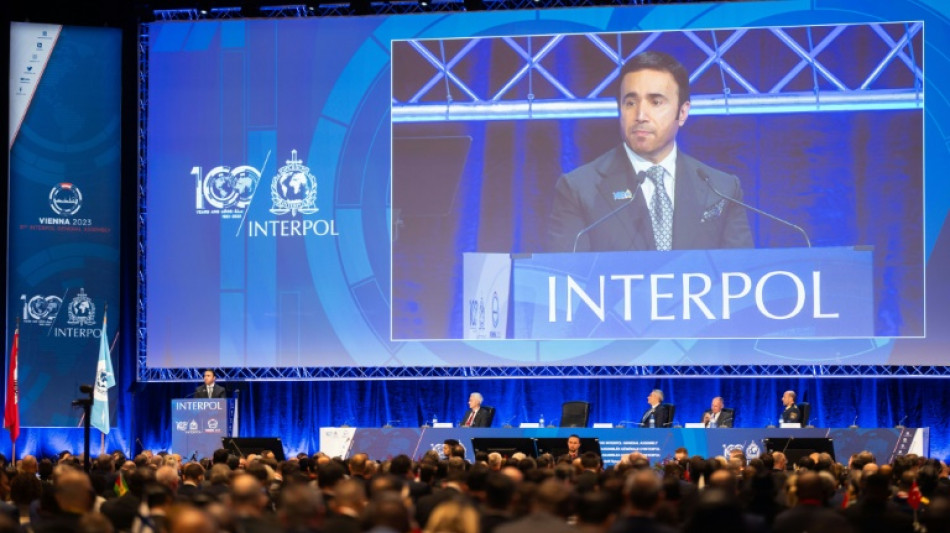
Interpol fights crime and controversial image, 100 years on / Photo: GEORG HOCHMUTH - APA/AFP
 IoT Refrigerator Hacks Disrupt Blood Labs and Supermarkets Across Europe and US

 Post-election pressures complicate US and Israeli decisions on Iran

 UN members approve talks on treaty protocol against environmental crime

 Family-run West Sussex beach café prepares for first winter season

 CT scans reveal health and burial clues from Egypt’s Braided Lady mummy

 Oxford faces complaints over lecturer’s classroom attire

 Kyren Wilson and John Higgins reach International Championship snooker final

 New Zealand and Tonga meet for place in Rugby League World Cup final

 Reports of unsafe AI-toy responses renew calls for child-safety rules

 Juneau food network combines difficult supply routes with deep sharing traditions

 India climbs green-transition ranking after first emissions decline in 25 years

 Trump names Stephen Miller as White House chief of staff after midterm losses

 Restored Albanian tower houses anchor new rural tourism trail

 Sonia Gandhi reflects on family tragedy and reluctant political career

 Pope Leo begins three-country South American tour in Uruguay

 Khawaja says entire Australia camp knew of 2018 ball-tampering plan
As Interpol marks its centenary, it faces the tricky task of nabbing criminals while ensuring that its famous red notices are not abused to snare dissidents.
This week, more than a thousand police and law enforcement leaders from around the world are attending Interpol's general assembly in Vienna, where it was founded.
"We've been growing from 20 member countries in 1923 to 196 today," Juergen Stock, Secretary General of the Lyon-based agency, told AFP.
With its famous red notices, Interpol "makes sure there is no safe haven for criminals, whether it's the physical or the online world," the 64-year-old German said.
But the organisation has had to step up controls after abuse of the notices led to criticism.
- Mafia and tattoos -
As a global hub for information sharing, Interpol helps member countries "connect the dots across continents" by identifying and locating criminals, explained Stock.
Interpol's database boasts 125 million police files, and receives about 16 million searches per day.
Bosnian Serb wartime leader Radovan Karadzic -- who was captured in 2008 after almost 13 years on the run -- and French serial killer Charles Sobhraj are among Interpol's most spectacular coups.
The global police body has also helped Italy in recent years crack down on the country's wealthiest and most powerful mafia: the 'Ndrangheta.
In May, Interpol launched an unprecedented campaign to identify 22 women believed to have been murdered in Belgium, Germany and The Netherlands.
By making previously confidential information public, Rita Roberts, who was killed in 1992, was finally identified this year after a family member recognised her tattoo.
- Tightened controls -
Notwithstanding its successes, Interpol's red notice system has been regularly accused of being misused by member states to hunt down political dissidents.
Shortly after taking office in 2014, Stock decided to tackle the problem head-on by setting up a team of about 40 experts to vet notices for wanted suspects before they are published.
"We are scanning the geopolitical situation around the world and doing these compliance checks," said Stock, stressing the system's "robust mechanism".
In 2022, just 1,465 notices were rejected or cancelled before publication, compared to a total of some 70,000 valid notices.
"If a case is predominantly political or has a military or religious component, Interpol is out and we are taking that very seriously," Stock insisted.
Moreover, he has introduced "a new refugee policy" to protect those who have been granted refugee status.
- 'Underfunded organisation' -
A handful of countries are currently under Interpol's heightened scrutiny, including Russia, which has been unable to directly send messages to other member countries since its invasion of Ukraine.
However, due to the lack of a "globally accepted definition on terrorism", mistakes can occur, acknowledged Stock.
French journalist Mathieu Martiniere, who recently published an in-depth investigation into Interpol with his German colleague Robert Schmidt, told AFP that "the situation has improved, but more than a hundred innocent people still slip through the net every year and can be extradited and then imprisoned."
A major problem Interpol faces is a "lack of human resources in an underfunded organisation."
The election of Emirati general Ahmed Naser al-Raisi -- who is being investigated in France for complicity in torture -- as Interpol's president in 2021 has also raised concerns.
The journalists' book, which was published in October, also examines when the Nazis took control of the organisation after the annexation of Adolf Hitler's native Austria.
Interpol's president at the time, Austrian Ernst Kaltenbrunner, was sentenced to death at Nuremberg and executed in 1946.
Until earlier this year, the names of Interpol's Nazi presidents were omitted from the website in order to "whitewash history", said Martiniere.
Stock said that was an unintentional oversight, which has since been rectified.
Y.Nakamura--AMWN

