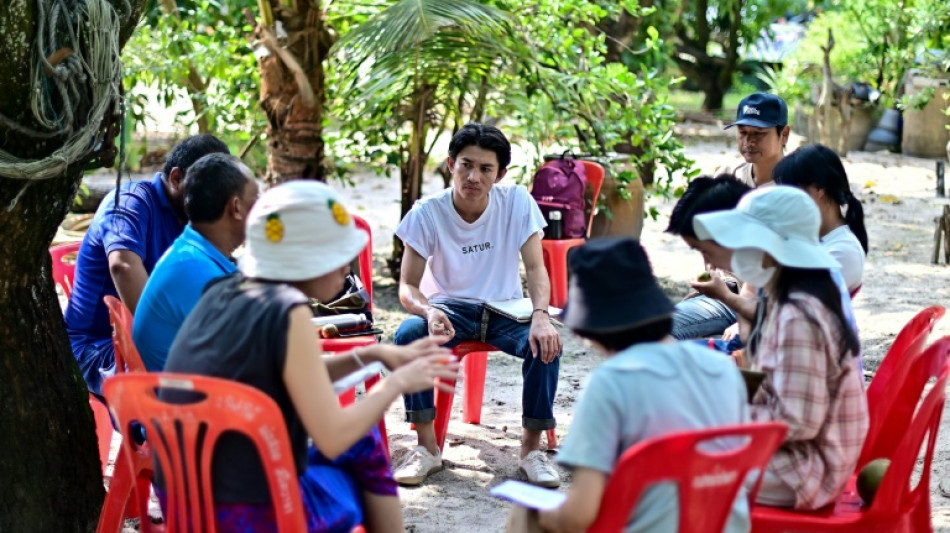
'I feel safe': the school for environmental defenders / Photo: MANAN VATSYAYANA - AFP
 IoT Refrigerator Hacks Disrupt Blood Labs and Supermarkets Across Europe and US

 Post-election pressures complicate US and Israeli decisions on Iran

 UN members approve talks on treaty protocol against environmental crime

 Family-run West Sussex beach café prepares for first winter season

 CT scans reveal health and burial clues from Egypt’s Braided Lady mummy

 Oxford faces complaints over lecturer’s classroom attire

 Kyren Wilson and John Higgins reach International Championship snooker final

 New Zealand and Tonga meet for place in Rugby League World Cup final

 Reports of unsafe AI-toy responses renew calls for child-safety rules

 Juneau food network combines difficult supply routes with deep sharing traditions

 India climbs green-transition ranking after first emissions decline in 25 years

 Trump names Stephen Miller as White House chief of staff after midterm losses

 Restored Albanian tower houses anchor new rural tourism trail

 Sonia Gandhi reflects on family tragedy and reluctant political career

 Pope Leo begins three-country South American tour in Uruguay

 Khawaja says entire Australia camp knew of 2018 ball-tampering plan
On a sun-dappled spot of sandy land along Thailand's east coast, class is in session, as a group of environmental defenders listens to local activists describe battling an industrial park.
At home, some of the 13 students gathered from around the Mekong region face harassment, jail terms, and even violence. Environmental defenders worldwide are battling intimidation and violence, with one killed every two days last year.
Under a canopy of mango leaves not far from the Gulf of Thailand, those risks seem far away and the focus is on learning from a community's fight to protect their land.
The activists are on a field trip with the EarthRights School, an unusual programme of intensive training and education for environmentalists.
It offers a practical curriculum, including campaign skills, proposal writing, and evidence gathering.
But it is also a rare opportunity for activists who often face intense pressures at home to share experiences and discuss their work freely.
"Most of them arrive very stressed and worried, either stress related to a specific danger or risk they face... or anxiety in general," said Krisztina Gyory, 53, an instructor at the school.
Discussing those fears at home can be frowned upon at best, or dangerous at worst.
But at the school, "they start relaxing after a while."
"These walls come down."
- 'A safe zone' -
The EarthRights School began in 1999 and initially focused on activists from Myanmar before expanding to accept students from the other Mekong countries: Thailand, Cambodia, Laos, Vietnam and China.
It operates discreetly from a leafy location in the country's north, accepting around a dozen students each year for a programme that ranges from several months to a full year.
Students study, live and eat together on the campus, creating tight bonds, said Kino Khanhthamaly, 27, an environmentalist working in Laos.
"We're in the same situation, we're in the same boat -- the political pressure not to do things," he told AFP.
A lawyer by training, he helps rural and indigenous communities understand their rights in the face of industrial encroachment.
"The political system is the main challenge," he said.
"Many people are afraid and concerned about security... many human rights and environmental defenders have disappeared."
But lack of education and access to information are also major factors.
In rural areas, "people don't recognise their own rights."
Win Thandar Kyaw, from Myanmar, was a student at the school in 2014 and credits it with the skills that helped her win compensation for landowners affected by property seizures.
She now works with the school and says it offers "a safe zone" for activists under enormous pressure.
"They can speak out and they can really say what they are feeling and also what they have faced, they can express themselves."
Security considerations are a key part of the curriculum and students are given lengthy checklists to consider before coming, as well as in-class instruction in digital and physical safety.
- 'Shocking and emotional' -
Nearly 2,000 activists involved in land and environmental defence were killed globally in the decade to 2022, according to monitor Global Witness.
The Philippines has long been Asia's most dangerous location, but the monitor has also highlighted a recent string of arrests in Vietnam.
"Security threats for environmental defenders is something that is very challenging," said Khin Nanda, an alumna and now school leader.
"Political activists only have to be afraid of politicians, but for the people who talk about the environment, their enemies can be the government, companies, even villagers in a community who might support a development."
Even safely ensconced in the school's bucolic surroundings, the students are not cut off from events at home.
Some are monitoring a surge in fighting in Myanmar, wondering when and whether they will be able to get back home.
Discussions in class and between students are kept confidential, but San Somanear said some of the most difficult moments of the programme had been hearing the experiences of activists from Myanmar.
"It was quite shocking, and very emotional," said the 28-year-old, who focuses on filmmaking for advocacy campaigns.
But overall, the school has provided a place to "slow down and relax", away from the pressure of worrying about security.
"I feel safe and protected here," she said.
"I will be sad to leave."
F.Pedersen--AMWN

