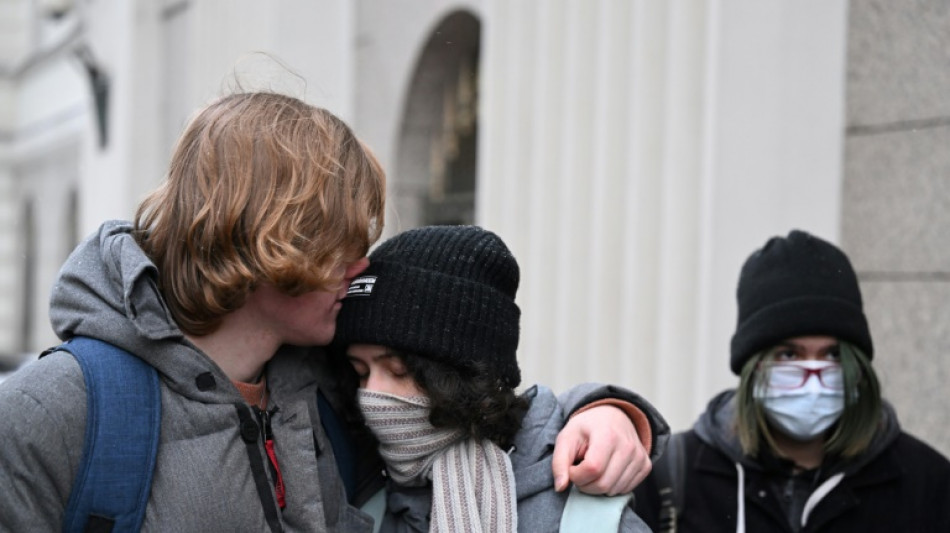
Russia bans 'international LGBT movement' for 'extremism' / Photo: NATALIA KOLESNIKOVA - AFP
 IoT Refrigerator Hacks Disrupt Blood Labs and Supermarkets Across Europe and US

 Post-election pressures complicate US and Israeli decisions on Iran

 UN members approve talks on treaty protocol against environmental crime

 Family-run West Sussex beach café prepares for first winter season

 CT scans reveal health and burial clues from Egypt’s Braided Lady mummy

 Oxford faces complaints over lecturer’s classroom attire

 Kyren Wilson and John Higgins reach International Championship snooker final

 New Zealand and Tonga meet for place in Rugby League World Cup final

 Reports of unsafe AI-toy responses renew calls for child-safety rules

 Juneau food network combines difficult supply routes with deep sharing traditions

 India climbs green-transition ranking after first emissions decline in 25 years

 Trump names Stephen Miller as White House chief of staff after midterm losses

 Restored Albanian tower houses anchor new rural tourism trail

 Sonia Gandhi reflects on family tragedy and reluctant political career

 Pope Leo begins three-country South American tour in Uruguay

 Khawaja says entire Australia camp knew of 2018 ball-tampering plan
Russia on Thursday banned the "international LGBT movement," claiming it was an extremist group in a move that cements a long crackdown on the community as the Kremlin pushes ultra-conservative social values.
The conservative turn promoted by President Vladimir Putin has accelerated since the offensive in Ukraine, often portrayed as an existential fight against Western liberal values.
The supreme court handed down the ruling in Moscow on Thursday, AFP journalists in court reported.
It did not say whether certain individuals or organisations would be affected by the ruling.
The judge ruled that "the international LGBT public movement and its subdivisions" were extremist, and issued a "ban on its activities on the territory of Russia".
The hearing took place behind closed doors and without any defence present.
The judge said the order should be executed immediately -- though some rights NGOs said there would be bureaucratic delays.
"It's causing a huge panic, because it's completely unclear who will be prosecuted under this ban," Noel Shaida, the head of communication at LGBTQ rights NGO Sphere Foundation, told AFP.
If applied to individuals, the "extremist" label means gay, lesbian, transgender or queer people living in Russia could face years in jail.
It also opens the way to the criminal prosecution of any group protecting the rights of these communities in Russia.
- 'Go underground' -
"Authorities could start opening criminal cases against public figures and activists to create a climate of fear," said Maxim Olenichev, a lawyer with Pervy Otdel, which helps victims of repression in Russia.
The ban means "complete censorship and probably difficulties in providing assistance, because we will have to go underground," Shaida, 27, said.
Most of her team has left Russia to coordinate support from relative safety abroad, as have other rights organisations since the beginning of the offensive in Ukraine.
Shaida said the ban was "quite an obvious continuation of the constant repression against LGBTQ people" in Russia.
The conservative turn in Russia accelerated after the Kremlin deployed troops to Ukraine in February last year.
Last December, Putin widened the 2013 law to criminalise any positive public mention of LGBTQ people or relationships.
In July this year lawmakers then banned medical intervention and administrative procedures that allowed people to change gender.
Authorities aim to "divert attention from the war, from the failures in the war," Shaida said.
And as the Kremlin often paints the military operation in Ukraine as a fight against liberal "decadent" values, Shaida believed Moscow passed the ban to further distance itself from the West.
Other NGOs, including transgender rights group "Center T", said they would publish safety guidelines for members of the LGBTQ community.
"One day it will be over but for now we need to try to continue to live and save ourselves," the Feminist Anti-War Resistance, which denounces Russia's military offensive in Ukraine, said on social media in response to the verdict.
G.Stevens--AMWN

