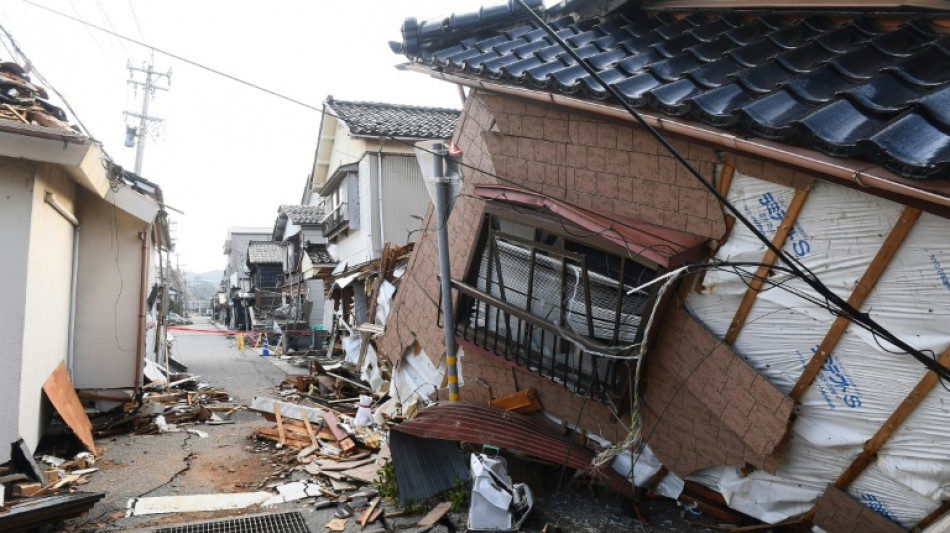
Japan says New Year quake damage could cost $17 billion / Photo: Toshifumi KITAMURA - AFP
 Aston Villa Defy History With Rare Victory at Old Trafford

 Crowds Gather at San Francisco Park for Elizabeth Holmes Lookalike Tournament

 Making Your Home Safer for Aging Parents: Accessibility Renovations That Add Value

 iPS Cell Research Accelerates Drug Discovery for ALS and Spinal Cord Injury

 Rene Eyre Revisits Autobiographical Performance 'Say A Little Prayer' in London

The cost of the damage wreaked by a huge New Year's Day earthquake that killed at least 236 people in central Japan could reach $17.6 billion, a government official said Friday.
The magnitude-7.5 earthquake and its aftershocks devastated parts of Ishikawa prefecture on the Sea of Japan coast, toppling buildings, ripping up roads and sparking a major fire.
Damage in Ishikawa and two neighbouring regions is likely to cost between 1.1 trillion yen ($7.4 billion) and 2.6 trillion yen ($17.6 billion), according to a government estimate.
A cabinet office official confirmed the figures, which were calculated using data from past major earthquakes and reported to a government economic meeting on Thursday.
But even the top estimate is much less than the 16.9 trillion yen damage caused by the 2011 earthquake and tsunami in northeastern Japan.
That disaster left around 18,500 people dead or missing and triggered a meltdown at the Fukushima atomic plant, the world's worst nuclear accident since Chernobyl.
Authorities on Thursday revealed detailed reconstruction plans for Ishikawa, where snow and badly damaged roads have complicated relief efforts in the quake's aftermath.
They include improvements to shelters for evacuees along with subsidies for rebuilding factories and ports as well as attracting tourists to the area.
Japan sits on the Pacific "Ring of Fire", an arc of intense seismic activity that stretches through Southeast Asia and across the Pacific basin.
The country is regularly hit by quakes and has strict construction regulations intended to ensure buildings can withstand strong tremors.
But many structures are older, especially in rapidly ageing communities in rural areas like those hardest hit in the New Year's quake.
Y.Kobayashi--AMWN

