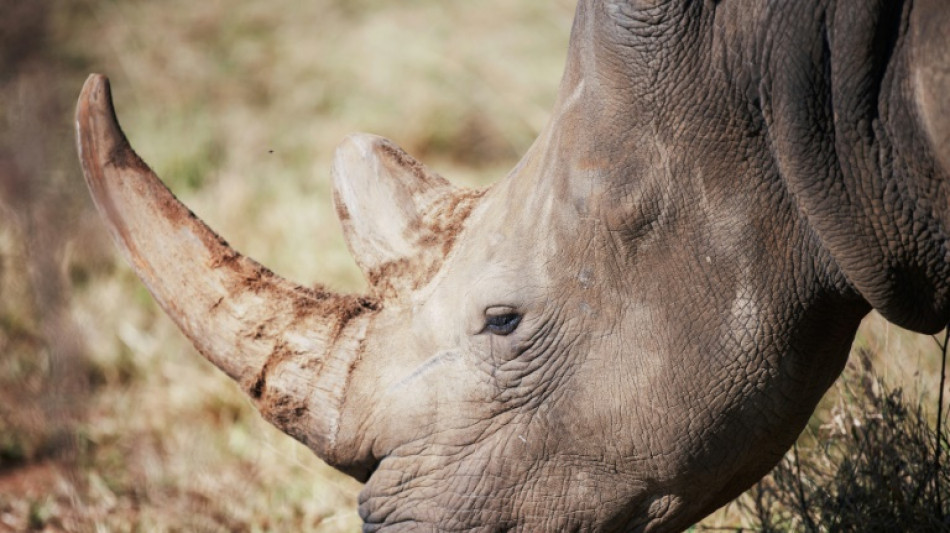
Nearly 500 rhinos killed as poaching increases in S.Africa / Photo: Luca Sola - AFP/File
 Carrick backs Dalot after hostile reception from Manchester United fans

 Aston Villa Defy History With Rare Victory at Old Trafford

 Crowds Gather at San Francisco Park for Elizabeth Holmes Lookalike Tournament

 New 401k Gold IRA Investment Guide Explains the Best Way to Invest in Gold for Retirement (2026 Update)

 InterContinental Hotels Group PLC Announces Transaction in Own Shares - November 09
Opti Digital Launches NEXA, an AI-Powered Intelligence Layer

 Tintina Mines Intersects 460m at 0.50% CuEq at the Dos Amigos Copper-Gold Project in Chile

 Ispire Technology Inc. Reports First Quarter Fiscal Year 2027 Financial Results
 CoTec Holdings Corp. Notes HyProMag USA Advances North Texas Rare Earth Magnet Facility With First Major Equipment Delivery

 iPS Cell Research Accelerates Drug Discovery for ALS and Spinal Cord Injury

Almost 500 rhinos were killed by poachers in South Africa last year, up 11 percent on 2022, despite government efforts to tackle the illicit trade in horns, ministers said Tuesday.
The country is home to a large majority of the world's rhinos and a hotspot for poaching, which is driven by demand from Asia, where horns are used in traditional medicine for their supposed therapeutic effect.
The environment ministry said 499 of the thick-skinned herbivores were killed in 2023, mostly in state-run parks.
The lion's share were poached in eastern KwaZulu-Natal province, with the Hluhluwe–Imfolozi park -- Africa's oldest reserve -- alone losing 307 animals.
"This is the highest poaching loss within this province," said Environment Minister Barbara Creecy.
"Multi-disciplinary teams continue to work tirelessly in an attempt to slow this relentless pressure".
In recent years, authorities have tightened security particularly around the Kruger National Park, a tourist magnet bordering Mozambique that has seen its rhino population fall drastically over the past 15 years.
This has resulted in lower losses there -- 78 rhinos were killed in 2023, 37 percent fewer than in 2022.
But it has also pushed poachers towards regional and private reserves like Hluhluwe–Imfolozi.
Law enforcement agencies arrested 49 suspected poachers in KwaZulu-Natal last year, Creecy said.
Across the country, 45 poachers and horn traffickers were convicted in court, she added.
Among them was a former field ranger sentenced to 10 years behind bars for killing a rhino he later claimed had charged him.
As of 2023, the national parks authority requires new employees to take a lie detector test amid concerns that some workers might be in cahoots with poachers.
Rhino horns are highly sought in black markets where the price per weight rivals that of gold and cocaine.
Nevertheless, in September last year the International Union for Conservation of Nature (IUCN) reported that thanks to conservation efforts rhino numbers had grown across Africa.
Nearly 23,300 specimens roamed the continent at the end of 2022, up 5.2 percent on 2021, IUCN said, adding the increase was the first bit of "good news" for the animals in over a decade.
About 15,000 live in South Africa, according to a separate estimate by the International Rhino Foundation.
"While these updated IUCN populations figures provide hope, these gains remain tenuous as long as the poaching crisis continues," Jeff Cooke of the World Wildlife Fund said Tuesday.
And he described the spike in killings in South Africa's KwaZulu-Natal, in particular, as "of grave concern".
O.M.Souza--AMWN