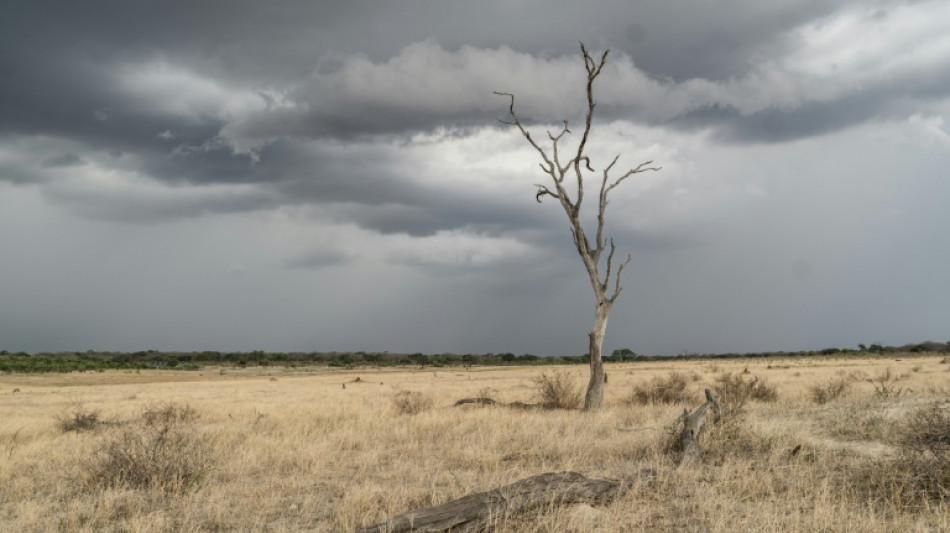
El Nino raises food security risk in southern Africa: FAO / Photo: Zinyange Auntony - AFP/File
 Carrick backs Dalot after hostile reception from Manchester United fans

 Aston Villa Defy History With Rare Victory at Old Trafford

 Crowds Gather at San Francisco Park for Elizabeth Holmes Lookalike Tournament

 New 401k Gold IRA Investment Guide Explains the Best Way to Invest in Gold for Retirement (2026 Update)

 InterContinental Hotels Group PLC Announces Transaction in Own Shares - November 09
Opti Digital Launches NEXA, an AI-Powered Intelligence Layer

 Tintina Mines Intersects 460m at 0.50% CuEq at the Dos Amigos Copper-Gold Project in Chile

 Ispire Technology Inc. Reports First Quarter Fiscal Year 2027 Financial Results
 CoTec Holdings Corp. Notes HyProMag USA Advances North Texas Rare Earth Magnet Facility With First Major Equipment Delivery

 iPS Cell Research Accelerates Drug Discovery for ALS and Spinal Cord Injury

The El Nino weather phenomenon, coupled with widespread drought, is posing an increasing risk to food security in southern Africa, a UN agency warned Friday.
Major growing areas in Malawi, Mozambique, Namibia, Zambia and Zimbabwe received only 80 percent of average rainfall during the mid-November-to-February summer period in the southern hemisphere, the Food and Agriculture Organization (FAO) said.
In a report, the FAO said "significant rainfall deficits" were recorded in February, a period when water stress has a greater impact on crop yields.
Higher than usual temperatures and an "erratic" distribution of precipitation have made the situation worse, the FAO said in the Crop Prospects and Food Situation, which is published three times a year.
South Africa, the region's largest cereal producer, also suffered from scant rain and high temperatures in January and February, likely to lead to a drop in the maize harvest compared to last year -- albeit without falling below the average of the last five years.
Cereal production in the region is expected to decline overall this year, increasing the need to resort to imports.
Access to food could be further affected by a fall in income for residents of rural areas and a possible increase in prices due to supply pressures, according to the FAO.
The situation is exacerbated by the weakness of local currencies which helps to push up the cost of living in several countries, the UN agency added.
Zambia had already at the end of last month officially described the drought there as a "national disaster," which has devastated agriculture.
El Nino is a natural weather phenomenon, corresponding to a warming of a large part of the tropical Pacific. It occurs every two to seven years and lasts between nine and 12 months.
According to the World Meteorological Organization (WMO), El Nino reached a peak in December but should still result in above-normal temperatures until May over almost all land areas.
Earlier this week the WMO said the latest El Nino was one of the five strongest ever recorded, adding its impact will continue over the coming months by fuelling heat trapped in the atmosphere by greenhouse gases.
O.Norris--AMWN