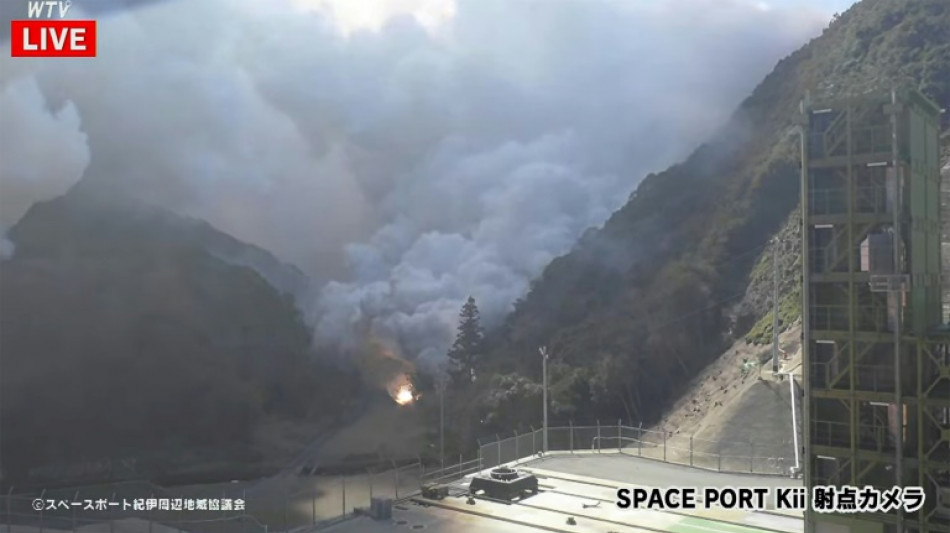
Japan space rocket explodes seconds after launch / Photo: - - AFP
 Carrick backs Dalot after hostile reception from Manchester United fans

 Aston Villa Defy History With Rare Victory at Old Trafford

 Crowds Gather at San Francisco Park for Elizabeth Holmes Lookalike Tournament

 New 401k Gold IRA Investment Guide Explains the Best Way to Invest in Gold for Retirement (2026 Update)

 InterContinental Hotels Group PLC Announces Transaction in Own Shares - November 09
Opti Digital Launches NEXA, an AI-Powered Intelligence Layer
 Tintina Mines Intersects 460m at 0.50% CuEq at the Dos Amigos Copper-Gold Project in Chile

 Ispire Technology Inc. Reports First Quarter Fiscal Year 2027 Financial Results
 CoTec Holdings Corp. Notes HyProMag USA Advances North Texas Rare Earth Magnet Facility With First Major Equipment Delivery

 iPS Cell Research Accelerates Drug Discovery for ALS and Spinal Cord Injury

A rocket made by a Japanese company exploded seconds after launch on Wednesday, in a spectacular failure for the start-up's bid to put a satellite into orbit.
Tokyo-based Space One's 18-metre (60-foot) Kairos rocket blasted off in the coastal Wakayama region of western Japan, carrying a small government test satellite.
But around five seconds later, the solid-fuel rocket erupted in fire, sending white smoke billowing around the remote mountainous area as orange flames raged on the ground, live footage showed.
"The launch of the first Kairos rocket was executed, but we took a measure to abort the flight," Space One said in a statement, adding that "details are being investigated".
Burning debris fell onto the surrounding slopes as sprinklers began spraying water in dramatic scenes watched by hundreds of spectators young and old gathered at public viewing areas including a nearby waterfront.
"I had high hopes for this, so I'm disappointed. I want to know what happened," one elderly man told public broadcaster NHK.
The fiery failure marks a blow to Japan's efforts to enter the potentially lucrative satellite-launch market.
Space One is hoping to become the nation's first private firm to put a satellite into orbit, and the plan had been for Kairos -- an ancient Greek word meaning "the right moment" -- to do so around 51 minutes after take-off.
Parts shortages and other problems had reportedly led Space One to postpone the launch of Kairos five times before Wednesday's attempt, most recently on Saturday.
- 'Didn't even imagine' -
The mayor of Kushimoto, the town of 15,000 residents in Wakayama where the failed launch took place, voiced his surprise and disappointment.
"I didn't even imagine an outcome like this," Katsumasa Tashima told reporters shortly after the explosion.
But the town "will continue to support Space One, and we want to continue to offer our help so that the first rocket will have a successful launch", he said.
Space One was established in 2018 by a team of major Japanese tech businesses, including Canon Electronics, IHI Aerospace, construction firm Shimizu and the government-owned Development Bank of Japan.
Last July, another Japanese rocket engine exploded during a test around 50 seconds after ignition.
The solid-fuel Epsilon S was an improved version of the Epsilon rocket that had failed to launch the previous October.
The malfunction came after Tokyo in March 2023 failed a second attempt to launch its next-generation H3 rocket.
The H3 has been mooted as a rival to SpaceX's Falcon 9, and could one day deliver cargo to bases on the Moon.
Last month, Japan's space agency managed a successful blast-off for the new flagship rocket.
That followed Japan's successful landing in January of an unmanned probe on the Moon -- albeit at a wonky angle -- making it just the fifth country to achieve a "soft landing" on the lunar surface.
In April last year, another Japanese start-up, ispace, tried in vain to become the first private company to land on the Moon -- losing communication with its craft after what it described as a "hard landing".
P.Martin--AMWN