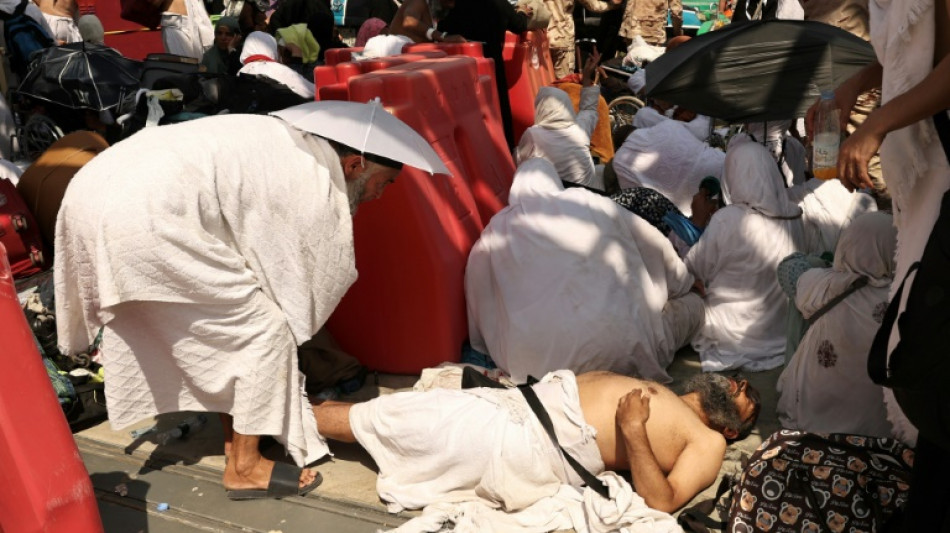
Saudi hajj pilgrims' deaths highlight how extreme heat kills / Photo: FADEL SENNA - AFP
 Belgium Signs Contract for 20 Rheinmetall Skyranger Air Defence Systems

 RBI Data Reveals Divergence in Credit Card Spending and Debit Card Cash Withdrawals

 Panthers expected to begin 2027 NRL season away from new stadium

 Sweet As app launches restaurant discovery platform

 Phoenix Restaurants Offer Thanksgiving Dinner to Go for Pickup

 Mayo school appeals for information after convent and chapel vandalism

 Virginia overwhelms Arkansas 91-72 behind balanced scoring

 Second major storm brings destructive winds and outages to British Columbia

 Godzilla Minus Zero leads North American box office with $31.6m

 Advocate calls for coordinated support for children facing trafficking

 Medicare Open Enrollment Ends Dec. 7: Review Your Coverage Options

 US Treasury order targets bank transfers linked to crypto exchange MEXC

 Nvidia CEO Controversy Sparks Fears of Tighter U.S. AI Chip Curbs for Samsung and SK hynix

 Villeneuve teases James Bond casting at Los Angeles museum gala

 Nottinghamshire launches specialist rural crime policing team

 China confirms talks over possible Xi-Putin-Trump summit

 Rail journey offers a slower route to a Berlin city break

 Arsenal control title race as Manchester United fall into bottom three

 Suspected Krakow gunman dies after attack that killed six

 Carrick backs Dalot after hostile reception from Manchester United fans

 Aston Villa Defy History With Rare Victory at Old Trafford

More than 1,000 people have died at this year's hajj pilgrimage in extreme heat in Saudi Arabia, an AFP tally showed on Thursday.
The pilgrimage involved hours of walking and praying in a country where temperatures reached 51.8 degrees Celsius (125 Fahrenheit) this week.
The World Health Organisation (WHO) has calculated that heat kills at least half a million people every year but warns that the real figure could be up to 30 times higher.
Here a scientist explains how extreme heat damages the body and how physical activity outdoors raises the risk.
- Heat effect on body -
In normal conditions, the body regulates its own temperature like a thermostat, holding it steady at about 36.8C (98.2F).
When outside heat rises, the body cools itself by raising blood-flow to vessels near the skin.
This emits heat at the surface, while perspiration also cools the outside of the body.
"To ensure the correct functioning of the cells, enzymes and vital organs, the body's temperature must stay constant, whatever the external conditions," said Pieter Vancamp, a neurobiologist at the French research institute INRAE.
- Dying of heat -
During an activity such as the hajj, where pilgrims spend hours outdoors in the sun, "the body can quickly become exhausted and can no longer find the reserves of water needed to perspire", Vancamp said.
Then the kidneys, heart and brain risk overheating and "stop working", he added.
When the body's natural thermostat is overwhelmed in this way, symptoms strike: fatigue, headaches, fever and broken sleep.
These can herald more serious effects, such as dehydration, which chokes off water to the vital organs.
The biggest risk is heatstroke, when the body's temperature exceeds 40C (104F).
"The body has its limits," said Vancamp. "When the weather is too hot or when extreme heat is combined with physical activity, for example, the body can find itself unable to self-regulate."
- Aggravating factors -
Babies, the elderly, people with health problems and outdoor workers are most at risk.
The number of sweat glands in the body decreases with age, leaving the body less able to cool itself.
"Several factors determine our reaction to heat: age, body mass, physical activity, genes," said Vancamp.
"But when the heat is too strong, even young, healthy bodies can lack the energy to keep the temperature close to 37C."
The WHO warns that hot nights pose a particular health risk.
Nighttime heat gives the body no chance to cool down, leading to a rise in heart attacks.
- More heat deaths in future? -
Worldwide, people were exposed to an average of 86 days of life-threatening temperatures in 2022, according to the Lancet Countdown report last year.
The number of people over 65 who died from heat rose by 85 percent between the periods 1991-2000 and 2013-2022, the leading medical journal added.
Climate change caused by humans burning fossil fuels is increasing heatwaves and other extreme weather events.
On the current trajectory, the world is on track to warm about 2.7C above the pre-industrial average by the end of this century, according to Climate Action Tracker.
The Lancet Countdown projected that under a 2C warming scenario, about five times as many people will die from the heat each year by 2050.
Th.Berger--AMWN


