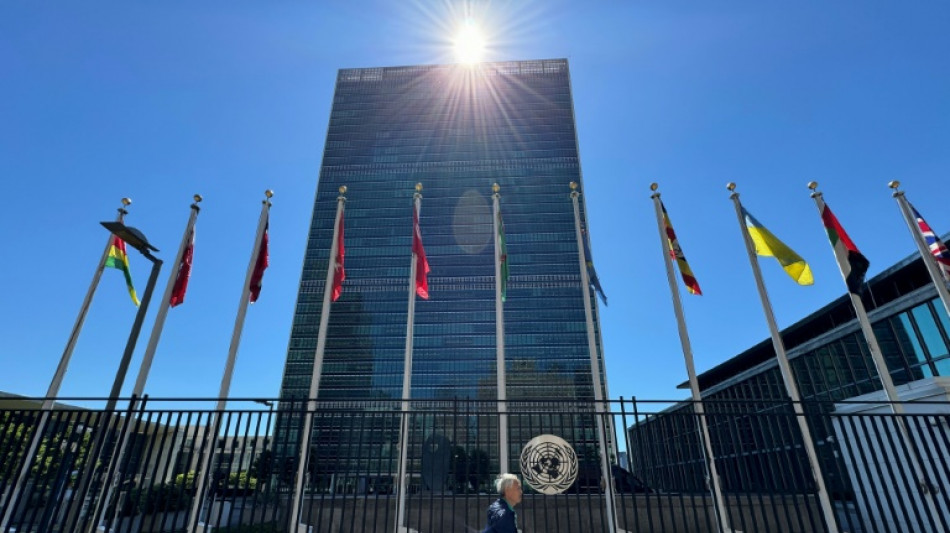
UN cybercrime text faces new scrutiny from tech firms, rights groups / Photo: Daniel SLIM - AFP/File
 Korea's Severe Asthma Patients Blocked from Biologics by Restrictive Reimbursement Rules

 Shanghai Science and Technology Museum Signs Pacts With London and Ottawa Institutions at CIIE

 First-time boat buyers advised to assess full ownership costs

 Planning and preparation can reduce stress of interstate relocation

 Two more arrested in Carrie Mullane suspected murder investigation

 MLA seeks inquiry into reported sectarian gestures on Ormeau Road

 Louise O’Reilly attacks Simon Harris over unemployment remarks

 Canadian soldier Aidan Goulding remembered at Vancouver funeral

 Tayyab Arif hits 57 on Pakistan Test debut against Sri Lanka

 Robert Trujillo discusses literacy and social justice children’s books

 Civil rights advocate William Bill Tucker dies aged 98

 Pennsylvania Democrats secure state trifecta in midterm elections

 Godzilla Minus Zero sets foreign-language box-office opening record

 Eagles record six sacks as rushing attack struggles against Giants

 Thames Water seeks to delay £12bn in debt repayments

 Newark boxing gym expands alternative education programme
 Democrats consider impeachment drive against Defence Secretary Hegseth

 Energy bill plan could use HMRC income data to target support

 Business owner earning £6,000 a month tackles £70,000 debt

 Nvidia chief faces inquiry after disclosing affair with suspected Chinese agent

 Comet returns as online electrical marketplace 14 years after collapse

UN member states meet Monday seeking to finalize an international treaty on the fight against cybercrime, a text strongly opposed by an unlikely alliance of human rights groups and big technology companies.
The "United Nations Convention Against Cybercrime" originated in 2017 when Russian diplomats sent the world body's secretary-general a letter outlining the initiative.
Two years later, and despite US and European opposition, the General Assembly created an intergovernmental committee tasked with drawing up such a treaty.
Now, the draft text will finally come up for a vote by member states at the end of a two-week session.
But after seven negotiating sessions to date, criticism has only grown.
If the revised draft includes "some welcome improvements," according to the office of the UN High Commissioner for Human Rights, concerns remain "about significant shortcomings, with many provisions failing to meet international human rights standards."
"These shortcomings are particularly problematic against the backdrop of an already expansive use of existing cybercrime laws in some jurisdictions to unduly restrict freedom of expression, target dissenting voices and arbitrarily interfere with the privacy and anonymity of communications," it said in an analysis.
The treaty, according to the draft language, would aim to "prevent and combat cybercrime more efficiently and effectively" and to strengthen international cooperation, notably regarding child pornography and money laundering.
But its detractors say the text claims sway over far too expansive a field, as reflected in its subtitle: "crimes committed through the use of an information and communications technology system."
The text could thus require governments "to facilitate investigations into things like same-sex conduct, criticizing one's government, investigative reporting, participating in protests or being a whistleblower," said Human Rights Watch executive director Tirana Hassan.
Rather than a cybercrime treaty, the text "actually resembles a global surveillance treaty that would address all crime," she told reporters, adding that it exceeds "even the most expansive possible interpretation of its mandate."
- A preference for 'no outcome' -
Debate over the draft has brought together some strange bedfellows -- rights groups are aligning with tech mammoths like Microsoft, which said in a written submission that "no outcome is better than a bad outcome."
Nick Ashton-Hart heads the Cybersecurity Tech Accord delegation to the treaty talks, representing more than 100 technology companies.
"There is a need for more cooperation by most states, especially developing states, on cybercrime," Ashton-Hart told AFP, but added: "This convention does not have to be the vehicle for that cooperation."
Better options would be either the Council of Europe's Budapest Convention on Cybercrime or the UN Convention Against Organized Transnational Crime, he said.
Unless the current draft is substantially improved, Ashton-Hart added, his organization will call on member states not to sign or ratify the treaty.
"Democratic states would expect opposition from the private sector, very aligned with the civil society world, were this to come up for ratification at the national level," Ashton-Hart said.
Russia, meanwhile, has defended its vision.
"Excessive attention to human rights provisions in the Convention is significantly detrimental to international cooperation and will in fact hinder the cooperation between law enforcement agencies of states," the Russian delegation said.
In a statement, it accused Western countries of wanting to "politicize discussions."
The Russians favor a return to the text's original 2019 title, which called for an "international convention on countering the use of information and communications technologies for criminal purposes" -- not the current "United Nations Convention Against Cybercrime."
J.Williams--AMWN


