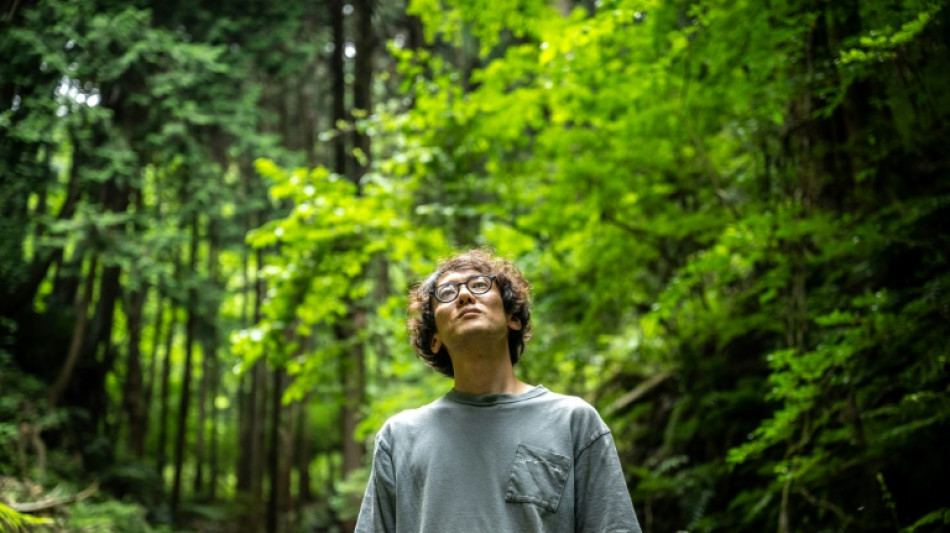
Slow down to save the planet, says Japan's rock star philosopher Saito / Photo: Philip FONG - AFP
 Korea's Severe Asthma Patients Blocked from Biologics by Restrictive Reimbursement Rules

 Shanghai Science and Technology Museum Signs Pacts With London and Ottawa Institutions at CIIE

 First-time boat buyers advised to assess full ownership costs

 Planning and preparation can reduce stress of interstate relocation

 Two more arrested in Carrie Mullane suspected murder investigation

 MLA seeks inquiry into reported sectarian gestures on Ormeau Road

 Louise O’Reilly attacks Simon Harris over unemployment remarks

 Canadian soldier Aidan Goulding remembered at Vancouver funeral

 Tayyab Arif hits 57 on Pakistan Test debut against Sri Lanka

 Robert Trujillo discusses literacy and social justice children’s books

 Civil rights advocate William Bill Tucker dies aged 98

 Pennsylvania Democrats secure state trifecta in midterm elections

 Godzilla Minus Zero sets foreign-language box-office opening record

 Eagles record six sacks as rushing attack struggles against Giants

 Thames Water seeks to delay £12bn in debt repayments

 Newark boxing gym expands alternative education programme

 Democrats consider impeachment drive against Defence Secretary Hegseth

 Energy bill plan could use HMRC income data to target support

 Business owner earning £6,000 a month tackles £70,000 debt

 Nvidia chief faces inquiry after disclosing affair with suspected Chinese agent

 Comet returns as online electrical marketplace 14 years after collapse

As Tokyo's millions put in another day's work on the coalface of capitalism, celebrity Marxist philosopher Kohei Saito and his friends are clearing rocks from a muddy mountain stream.
Saito's core argument -- that capitalism is the root cause of climate change and we need to stop chasing growth to save the planet -- has struck a chord in the world's fourth-largest economy, especially among young people.
The associate professor at the University of Tokyo has sold half a million copies of his latest book and last month spoke at music festival Fuji Rock, headlined by The Killers.
He has become a face of the global movement for "degrowth" -- a word that "kind of freaks people out", Saito told AFP as he tended to his slice of collectively owned land on the capital's western outskirts.
"Maybe it's not the best way to convince people, especially in America," said the 37-year-old, whose hit title "Slow Down: The Degrowth Manifesto" came out in English this year.
But using the term is one way to "provoke or challenge" widely accepted economic principles which are leading to environmental ruin, he said.
Saito is not a member of the Japanese Communist Party and he rejects the need for top-down, Soviet-style systems.
Instead he believes in grassroots change led by projects such as Common Forest Japan, his attempt to reconnect with nature and build a democratically run community.
"Unless the left or liberal, progressive side offers a more attractive vision of the future... right-wing populism will take advantage of this crisis," Saito said.
He is a regular TV news talk show guest, and recently made headlines for saying he was boycotting the Olympics, citing its "excessive commercialism" and "double standards" over Israel's participation and Russia's exclusion.
- 'Degrowth isn't just frugal living' -
Saito's calls for a world where fewer things are produced -- reducing carbon emissions -- and a break with overconsumption and long working hours have resonated with those disillusioned with the status quo in Japan.
The Japanese version of "Slow Down" came out in 2020, when the pandemic brought many industries to a standstill.
"I didn't expect this was something people would be interested in, because Marx is outdated" and degrowth could sound like "some kind of negative dictatorship", he said.
Yet coming of age after Japan's 1980s boom years, Saito's generation has seen decades of economic stagnation despite the pursuit of growth, he contends.
So "that kind of discussion has some attraction, especially to young people who don't fetishise the old kind of Japanese miracle any more".
New technologies such as electric cars, carbon capture or nuclear fusion cannot solve the climate problem in a system that is always seeking greater profit, Saito said.
Banning private jets and "excessive public advertisements" as well as "introducing a much more radical wealth tax" could be a starting point instead.
"But I also want to emphasise that degrowth is not simply about giving up everything and living in frugality," said Saito.
It's about challenging capitalism's sense of "scarcity" that makes people insecure about the future -- a stress they try to overcome with shopping and other intensive consumption which in turn "destroys the planet".
- 'No greedy behaviour' -
On the mountainside, the slim, round-spectacled philosopher, his wife and two children, and around 20 others climbed up the stream's banks, home to worms and wild mushrooms.
They moved stones and branches to allow the water to flow more easily, trying to reduce the risk of landslides.
Although his ideas could sound far-fetched to minds "almost dominated by the logic of capital", Saito says the forest project exemplifies a society where there is "no greedy behaviour -- because it doesn't make sense".
Growing up in Tokyo, Saito wasn't much of a hiker and his parents weren't political.
He discovered socialist thinkers like Noam Chomsky as a teenager interested in his "criticism of American imperialism". Years later, Japan's 2011 tsunami and Fukushima nuclear disaster brought home "the unsustainable relationship between humans and nature".
While pursuing his PhD in Berlin, Saito investigated Marx's take on ecology in the German's notebooks from his later years.
The idea of degrowth dates back to the 1970s, but has gained traction recently with a slew of new books including "Less Is More: How Degrowth Will Save the World" by economic anthropologist Jason Hickel.
Saito makes clear in "Slow Down" that for now his ideas only apply to the world's rich countries, which are disproportionately responsible for climate change.
Despite being a keen observer of local politics, as a philosopher, he says tricky decisions, like how much new infrastructure is too much, are not his to make.
"I'm not a good politician. Because politics is about compromise, right?"
P.Stevenson--AMWN


