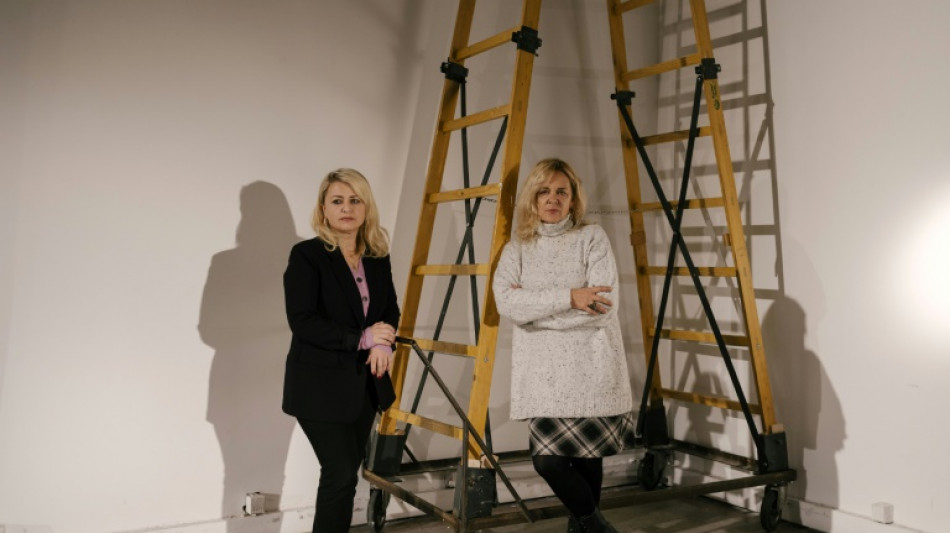
Balkans women stage ancient Greek play to condemn women's suffering in war / Photo: Vladimir Zivojinovic - AFP
 Sherilyn Smith Encourages Women to Embrace Scars as Symbols of Resilience

 Belgium Signs Contract for 20 Rheinmetall Skyranger Air Defence Systems

 Spectrocell Strengthens Product Discovery and Customer Engagement with Bioz Badges

 InterContinental Hotels Group PLC Announces Transaction in Own Shares - November 10

 RBI Data Reveals Divergence in Credit Card Spending and Debit Card Cash Withdrawals

 Panthers expected to begin 2027 NRL season away from new stadium

 Sweet As app launches restaurant discovery platform

 Phoenix Restaurants Offer Thanksgiving Dinner to Go for Pickup

 Mayo school appeals for information after convent and chapel vandalism

 Virginia overwhelms Arkansas 91-72 behind balanced scoring

 Second major storm brings destructive winds and outages to British Columbia

 Godzilla Minus Zero leads North American box office with $31.6m

 Advocate calls for coordinated support for children facing trafficking

 Medicare Open Enrollment Ends Dec. 7: Review Your Coverage Options

 US Treasury order targets bank transfers linked to crypto exchange MEXC

 Nvidia CEO Controversy Sparks Fears of Tighter U.S. AI Chip Curbs for Samsung and SK hynix

 Villeneuve teases James Bond casting at Los Angeles museum gala

 Nottinghamshire launches specialist rural crime policing team

 China confirms talks over possible Xi-Putin-Trump summit

 Rail journey offers a slower route to a Berlin city break

 Arsenal control title race as Manchester United fall into bottom three

 Suspected Krakow gunman dies after attack that killed six

 Carrick backs Dalot after hostile reception from Manchester United fans

Maja Mitic is Serbian. Zana Hoxha is Kosovar. Their adaptation of an ancient Greek tragedy highlights not so much the devastation war inflicts on women but women's capacity to heal and resist.
Euripides's "Trojan Women", first performed in 415 BC, is an acerbic condemnation of the atrocities of war. It focusses on the misery and injustices the women of Troy endure after the conflict between their people and the Greeks.
The adaptation that Hoxha and Mitic are currently staging in the Balkans has a quite distinct focus.
"In our version, we are moving forward by also taking care of each other, by finding ways to save our children," said Hoxha, who directed the play.
It demonstrates "that amidst conflict and war, amidst hatred, women are the ones that find ways to resist," she said of the play, being performed in Belgrade on Friday and Saturday night after two shows in Kosovo.
This production echoes the interminable discussions between the male politicians of Serbia and Kosovo who -- a quarter of a century after the end of the war between Belgrade and its breakaway province -- have still not concluded a lasting peace. The women negotiate on the soberly designed set.
As a Kosovar and feminist director "who still remembers war" and also the times of the former Yugoslavia, 43-year-old Hoxha said, "it was important to do this play because unfortunately it's very relevant".
- Transcending language -
In Euripides's play, the women of Troy are married by force to their worst enemies, murdered and sacrificed on the tombs of men who fell in battle.
They are the victims of the war that follows war.
The tale needed two women to tell it, stressed Hoxha's co-director Mitic, a prominent figure in Serbian theatre since the 1990s.
"The men, they make wars... The consequences are on women and the children of these women," she said.
Mitic plays Hecuba, the former queen of Troy, whose children are sacrificed, one after the other, to the follies of war.
She recites Euripides's ancient text in Serbian.
Thaltybios, who comes to tell the women of their fate, replies in Albanian.
An English translation scrolls across the back wall.
After a few minutes, listeners can no longer distinguish the different languages because the pain is universal.
"The relationship, the emotions that these actors are able to carry are more important than the language barriers," Hoxha said.
- 'Art has power' -
And whether they speak Serbian, Kosovar Albanian or English, the Trojan women make audiences reflect and make them angry.
"Even our characters are angry," Hoxha explained.
"They say like, you know, 'fuck this shit, we don't want this anymore.'
"'Why are we suffering? Why do Cassandras have to exist today? Why does Andromache have to lose her child?"
At one point in the play, Hoxha recalled, Andromache says she wants to be able to walk around freely with her husband and son and not feel threatened in the street.
That feeling remains unchanged for women today, she said.
"There are only a few places in the world where I feel completely safe to be myself."
"We are trying to change that," she added.
"I don't think that the performance alone can do that. But art has the power to bring you something which maybe you didn't even know existed."
The emphasis in Hoxha and Mitic's adaptation on the universal relevance of the protagonists' concerns extends as far as their costumes.
The characters dress in black leather and ankle boots -- a uniform that could belong to any army in the world.
Just as Hecuba could be any grieving mother on the planet.
It's a story about women and war "in any part of the world, in any century, in any culture, in any religion", said Mitic.
"This is the story that Euripides wrote centuries ago, but actually we see repetition of the same model during the war, after the war -- raping, criminals, everything.
"What we see in this play, we really see today (in) Ukraine or Gaza, or (in) Kosovo or Bosnia" or wherever conflict is occurring including Somalia and Sudan, Mitic said.
After an hour in front of a packed hall, the voices combine, hoping for another future: "Sometimes to live is to resist," they say.
S.Gregor--AMWN
