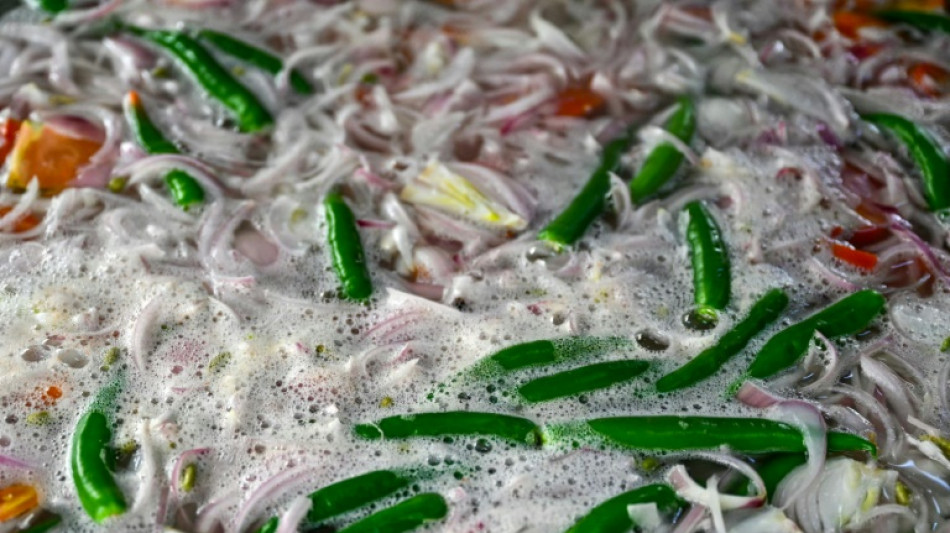
Malaysian rice porridge a 'trademark' Ramadan tradition / Photo: Mohd RASFAN - AFP
 Thukukile Zuma Resigns from ANC Johannesburg Leadership Amid Disciplinary Dispute

 CM Mohan Yadav Meets Bohra Spiritual Leader to Discuss Simhastha 2028 and Development

 Eli Crane Defeats Jonathan Nez in Tight Arizona Congressional Race

 Sherilyn Smith Encourages Women to Embrace Scars as Symbols of Resilience

 Belgium Signs Contract for 20 Rheinmetall Skyranger Air Defence Systems

As dusk fell, hundreds of Muslims at a mosque in the Malaysian capital of Kuala Lumpur feast on bowls of fragrant rice porridge known locally as "bubur lambuk", part of a Ramadan tradition dating back decades.
Slow-cooked with various spices in giant pots and stirred with oversized ladles, bubur lambuk is traditionally prepared by volunteers in mosque courtyards before being distributed to the public for iftar, the fast-breaking meal in the largely Islamic nation.
But the broth, specially prepared at Masjid India, a well-known Kuala Lumpur mosque, serves a unique version of the porridge using a recipe originating from India.
The recipe is known as Nombu Kanji, according to the mosque's imam, Muhammad Nasrul Haq Abdul Latif.
"This tradition has been passed down from generation to generation, from the 60s to the 70," he told AFP.
"So it has become a trademark. If it (Nombu Kanji) wasn't there, it wouldn't be complete."
Mosque volunteers use 140 kilogrammes (308 pounds) of rice daily to cook the porridge, which is served in bowls to prayer attendees or packed into 1,000 large plastic packets to be distributed to the public.
Each packet is enough to feed a family of four.
"From the perspective of making things easier for the people in this area, sometimes the homeless who struggle to get food, low-income workers, and office workers who sometimes don't have time to go home and cook benefit from this," he said.
"So, the preparation of iftar meals by mosques helps make their daily lives more convenient (during Ramadan)."
Mohaiyadin Sahulhameed, a local resident originally from India, said the porridge served at the mosque reminded him of home.
"Back in our village, the way we cook is using large woks, with curry leaves, mustard seeds, cinnamon, and all sorts of ingredients mixed together. When combined with rice, it creates a rich aroma, quite similar to how it's done here," he said.
The mosque's cook, Sathakkathullah Hameed, said he saw preparing the large pots of porridge daily as a religious calling.
"During this fasting month, I want to help others. Allah grants rewards, mercy, and blessings, and, God willing, He will provide sustenance," he said.
"And when people eat the porridge I cook, they say 'Bismillah,' (in the name of God) and I respond with 'Alhamdulillah' (praise be to God).”
D.Cunningha--AMWN


