
USGS Challenges Simple Narrative Linking Menhaden to Osprey Decline
 Eli Crane Defeats Jonathan Nez in Tight Arizona Congressional Race

 Sherilyn Smith Encourages Women to Embrace Scars as Symbols of Resilience

 Belgium Signs Contract for 20 Rheinmetall Skyranger Air Defence Systems

 BioTech Breakthrough Acknowledges Champions Oncology Innovation with the "Contract Research and Development Innovation Award"

 InterContinental Hotels Group PLC Announces Transaction in Own Shares - November 10

 Spectrocell Strengthens Product Discovery and Customer Engagement with Bioz Badges
 Apex Extends Trinity Zone in West Step-out Drilling With 2.52% REO Over 223.3 m and 2.49% REO Over 123.3 m at Rift

 Zomedica Announces "Third Friday at Four" Webinar on November 20, 2026: The People Behind Zomedica - Seven Guiding Principles in Action, and Q3 Financial Results
 Geek+ Unveils 24/7 Warehouse Autonomy Plan to Advance Self-Optimizing, Around-the-Clock Operation
 China Explores a New Pathway for Medical AI: Bridging R&D Innovation and Clinical Adoption
 Aztec Drills 70.1 Meters of 0.80 g/t AuEq (0.49 g/t Au and 16.85 g/t Ag) from Surface in TR26-54 at the Tombstone Project, Arizona

 Zeb Nickel Commences Diamond Drilling at the Zeb Nickel Project
 Electrovaya to Participate in Upcoming Investor Conferences
INEO Invited to 15th Annual ROTH Technology Conference in New York
 Nextech3D.ai to Report Fiscal Second Quarter 2027 Financial Results and Host Investor Webinar on November 19, 2026 at 4:30 PM ET

 Sterling Metals Announces Fully Allocated Private Placement of Units, Flow-Through Shares and Charity Flow-Through Units

 Greene Concepts Highlights Groundwater Resources and Commercial Opportunities

 Allstar Health Brands Confirms MLS NEXT Expansion Bid to Anchor a Permanent Training Structure and a Professional Pathway

 Horizon Aircraft Completes Preliminary Design Review of Cavorite X7 Hybrid eVTOL
 ATWEC Technologies, Inc. (OTCID:ATWT) Reports Third Quarter 2026 Revenue of $12.46 Million, Up 37% Year-over-Year
 Your Patients Are Asking AI About You. AimwellBio Lets Every Physician See the Answer, Free.

 Four Nines Gold Intersects 67 Metres at 1.78 g/t Gold, Reinforing Emerging Gold Corridor at Hayden Hill

 Opportunistic Trader ETF(WZRD) to Delist and Liquidate

 Critics and Listeners Agree: Eylsia Nicolas' "The Wedding Song" Nominated for GlacerFM's Best Pop Song 2026; Second Consecutive Listener's Choice Nomination Follows Widespread Critical Recognition and Growing Global Audience

 Guard Home Warranty Launches Claims 2.0: A Real US-Based Person in 16 Seconds, Claims Reimbursed Instantly
Federal agency finds complex ecological causes behind osprey trends, not single-species blame
WASHINGTON, DC / ACCESS Newswire / May 5, 2025 / A letter from the U.S. Geological Survey (USGS) sent last week to the House Natural Resources Committee indicates multiple environmental stressors - not just prey availability - are responsible for recent osprey reproduction issues in the Chesapeake Bay. The USGS' conclusions challenge narratives pushed by menhaden fishery opponents, including a widely publicized study by Dr. Bryan Watts of the Center for Conservation Biology, which linked a decline in osprey reproduction in Virginia's Mobjack Bay to reduced availability of menhaden.
Menhaden increase in osprey diets is statistically insignificant
Specifically, the USGS finds that the Watts et al. (2024) study did not demonstrate a biologically significant change in the proportion of menhaden in the osprey diet over time. The agency also noted that menhaden made up a slightly higher portion of the diet in 2021 compared to 2006-07, although the difference is statistically insignificant. "Although the proportion of Menhaden as a percentage of total diet in 2021 is numerically larger than the 2006-07 value, the two values are bounded by overlapping error bars, and are thus not different in a biologically meaningful way," the letter stated.
"The amount of food delivered to young in a nest can be influenced by many factors, including prey abundance, access to prey, … increased predation risk, parental condition, brood size, and adverse weather conditions," said the USGS letter, which was delivered on May 2. "Ecological systems such as this are complex and occur at large scales that make it difficult and sometimes not possible to measure and accurately estimate the influence of all contributing factors."
Chesapeake osprey trends also seen around the country
Following bird conservation measures including the banning of DDT, the Atlantic Coast osprey population increased by nearly 600% between 1966 and 2022. In the Chesapeake Bay, it has increased by about 1800% since 1960. While scientists have observed a leveling off of osprey populations between 2012 and 2022, populations remain high by historical standards. Furthermore, the USGS reports that this trend has been observed in numerous other locations including Florida, South Carolina, North Carolina, New Jersey, and Delaware, as well as the Pacific Coast, raising serious questions about any impact from the menhaden fishery since there is no menhaden fishery in those locations.
Overfished Striped Bass also an important food source for osprey
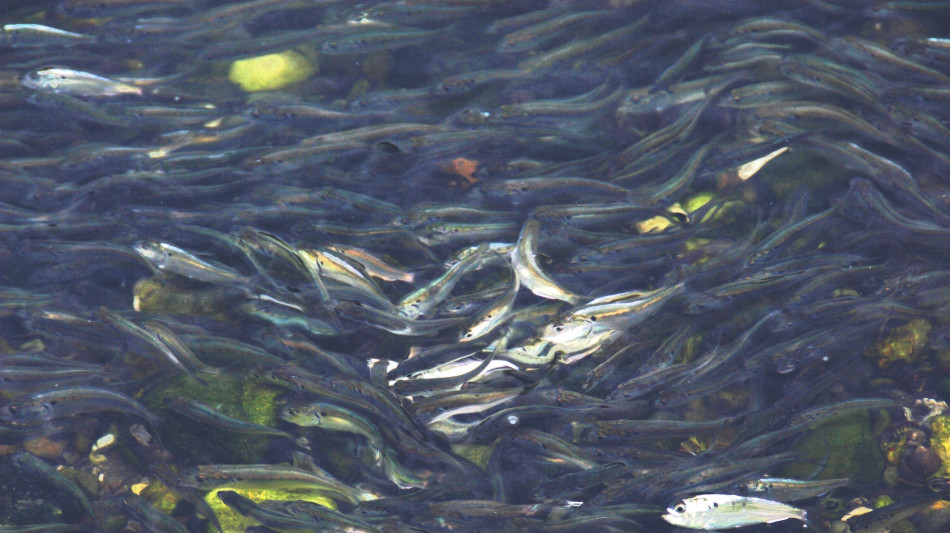
The USGS also identifies striped bass as an important food source for osprey in parts of the Chesapeake Bay and notes that the status of this stock may influence osprey reproduction. "Preliminary observations made by USGS scientists during a 2024 Osprey nesting study in the vicinity of the Choptank River suggest Menhaden and Striped Bass may be the primary prey type there," the letter states. It further explains that "the principal contributing factor to poor breeding performance was loss of young due to starvation," likely caused by "limited prey capture and/or prey delivery to nests." Additionally, the letter notes that "the USGS has included Striped Bass among the list of prey species captured and consumed by Osprey at some Chesapeake study sites," and concludes that "many of the factors that affect the status of the Striped Bass stock in the Chesapeake could also have direct or indirect effects on Osprey reproduction."
The Atlantic States Marine Fisheries Commission (ASMFC) has found that Atlantic striped bass are currently overfished, with spawning stock biomass below the sustainable threshold as of the most recent assessment. Over the past decade, recreational fishing-particularly in the Chesapeake Bay-has been the primary driver of striped bass mortality, accounting for the vast majority of total removals, including substantial losses from catch-and-release mortality¹. The ASMFC has repeatedly cited recreational release mortality as a major factor in the species' decline² and has responded with new management measures aimed at rebuilding the stock by 2029³. Conversely, the Atlantic menhaden fishery has repeatedly been found to be healthy and sustainably managed. The most recent stock assessment by the Atlantic States Marine Fisheries Commission in 2022 found menhaden is not overfished and overfishing is not occurring. The fishery has been certified sustainable by the Marine Stewardship Council, the gold standard for seafood sustainability, since 2019.
Osprey nesting sites in the Chesapeake are now at a surplus
The USGS scientists reported that the number of breeding pairs in the Chesapeake Bay increased from approximately 1,450 pairs in 1973 to around 10,000 pairs in 2020 - an increase of nearly 600 percent. "All estimates indicate that the density of breeding pairs of Osprey in the Chesapeake has grown substantially since the 1970s," the letter states. It also notes that "there are many natural structures, duck blinds, and manmade platforms suitable for nesting Osprey in the Chesapeake," and that "Osprey nesting sites in the Chesapeake are now at a surplus and unused platforms are frequently being taken over by Canada Geese." While the letter does not conclude that the population has exceeded environmental limits, it acknowledges that "as a natural population regulation process," higher osprey densities increase competition for limited resources such as food and nesting sites, and that "growth usually continues until the population reaches the maximum population size the environment can support."
VIMS also found no clear relationship with menhaden
Last fall, scientists from the Virginia Institute of Marine Science (VIMS) also found that the Watts study did not "establish a clear relationship with menhaden abundance and availability." Both the original Watts study⁴ and the VIMS rebuttal⁵ were published in the journal Frontiers in Marine Science.
The USGS findings make clear that osprey reproduction is shaped by a wide array of environmental factors - and that no single fishery can shoulder the blame. The letter shows that blaming the menhaden fishery for complex ecological trends in osprey populations oversimplifies the science and misleads the public. Moreover, the overfished status of striped bass - driven largely by recreational fishing - may also be a contributing factor.
Footnotes
¹ Atlantic States Marine Fisheries Commission. Atlantic Striped Bass Stock Assessment Update. October 2022.
² Atlantic States Marine Fisheries Commission. Amendment 7 to the Atlantic Striped Bass Interstate Fishery Management Plan. May 2022.
³ Atlantic States Marine Fisheries Commission. Addendum II to Amendment 7. January 2024.
⁴ Watts Bryan D. , Stinson Christine H. , McLean Peter K. , Glass K. Andrew , Academia Michael H. , Byrd Mitchell A. (2023). Prey provisioning and diet of Osprey in lower Chesapeake Bay: A comparative study. Frontiers in Marine Science.
https://www.frontiersin.org/articles/10.3389/fmars.2023.1284462/full
⁵ Latour Robert J. , Gartland James , Ralph Gina M. (2024). Commentary: Prey provisioning and diet of Osprey in lower Chesapeake Bay: A comparative study. Frontiers in Marine Science.
https://www.frontiersin.org/articles/10.3389/fmars.2024.1416687/full
About the Menhaden Fisheries Coalition
The Menhaden Fisheries Coalition (MFC) is a collective of menhaden fishermen, related businesses, and supporting industries. Comprised of businesses along the Atlantic and Gulf coasts, the Menhaden Fisheries Coalition conducts media and public outreach on behalf of the menhaden industry to ensure that members of the public, media, and government are informed of important issues, events, and facts about the fishery.
Media Contact:
Menhaden Fisheries Coalition
(202) 595-1212
www.menhaden.org
SOURCE: Menhaden Fisheries Coalition
View the original press release on ACCESS Newswire
X.Karnes--AMWN