
Chesapeake Bay Foundation Continues to Spread Menhaden Misinformation
 Sherilyn Smith Encourages Women to Embrace Scars as Symbols of Resilience

 Belgium Signs Contract for 20 Rheinmetall Skyranger Air Defence Systems

 Spectrocell Strengthens Product Discovery and Customer Engagement with Bioz Badges

 InterContinental Hotels Group PLC Announces Transaction in Own Shares - November 10

 RBI Data Reveals Divergence in Credit Card Spending and Debit Card Cash Withdrawals

 Panthers expected to begin 2027 NRL season away from new stadium

 Sweet As app launches restaurant discovery platform

 Phoenix Restaurants Offer Thanksgiving Dinner to Go for Pickup

 Mayo school appeals for information after convent and chapel vandalism

 Virginia overwhelms Arkansas 91-72 behind balanced scoring

 Second major storm brings destructive winds and outages to British Columbia

 Godzilla Minus Zero leads North American box office with $31.6m

 Advocate calls for coordinated support for children facing trafficking

 Medicare Open Enrollment Ends Dec. 7: Review Your Coverage Options

 US Treasury order targets bank transfers linked to crypto exchange MEXC

 Nvidia CEO Controversy Sparks Fears of Tighter U.S. AI Chip Curbs for Samsung and SK hynix

 Villeneuve teases James Bond casting at Los Angeles museum gala

 Nottinghamshire launches specialist rural crime policing team

 China confirms talks over possible Xi-Putin-Trump summit

 Rail journey offers a slower route to a Berlin city break

 Arsenal control title race as Manchester United fall into bottom three

 Suspected Krakow gunman dies after attack that killed six

 Carrick backs Dalot after hostile reception from Manchester United fans

Special interest group uses blatant falsehoods rather than facts
WASHINGTON, DC / ACCESS Newswire / June 30, 2025 / The Chesapeake Bay Foundation (CBF) issued a press release on June 25, 2025 that includes multiple false and misleading claims, omits important context, and makes unfounded accusations that misrepresent both the scientific record and the operations of the menhaden fishery.
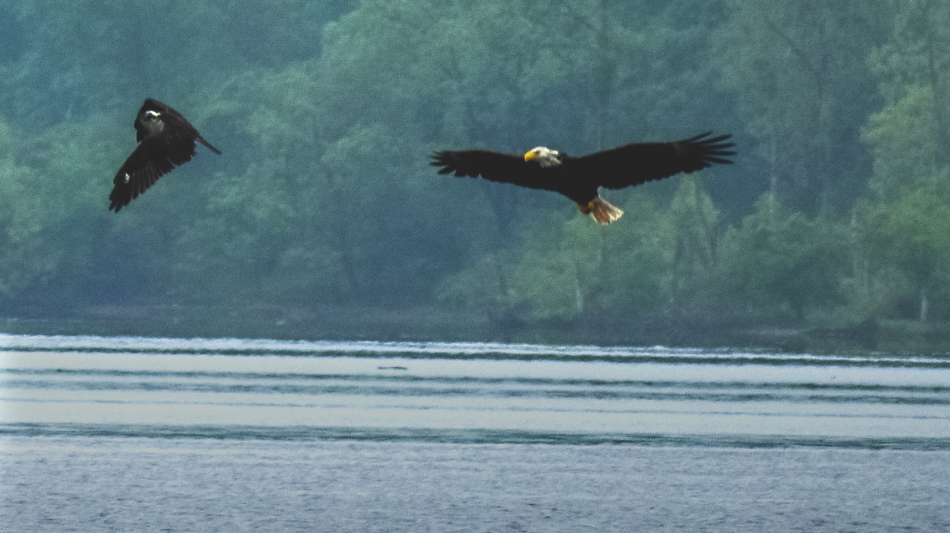
A bald eagle forces an osprey to relinquish its prey. Eagles are known to be kleptoparasitic, stealing food from other birds of prey. Photo credit: Robert Blanton
The release, written by CBF's Virginia Communications & Media Relations Manager Vanessa Remmers, responds to a May 2025 aerial survey of osprey nesting by Dr. Bryan Watts of the College of William and Mary's Center for Conservation Biology, whose own release on the survey does not mention the menhaden fishery. This response addresses and corrects the major inaccuracies.
Misleading Claims of Menhaden Fishing Activity
The press release claims:
"…the seaside of Virginia's Eastern Shore, a frequent area for industrial menhaden fishing by Omega Protein."
Correction: This is false on two counts.
Geographically inaccurate: No menhaden sets were made by Ocean Harvesters in the area of the Eastern Shore of Virginia either before or during the period of the recent osprey aerial survey conducted by Dr. Watts. For the past three years, Ocean Harvesters has not operated within one mile of the shoreline on the lower bayside as the result of a voluntary agreement with the state to address concerns of local residents, leaving a substantial buffer zone in place. On the oceanside, while there are no formal regulatory restrictions, the natural contour and depth of nearshore waters effectively limit operations, creating incidental buffers of anywhere from a quarter to one mile where fishing does not occur.
While no sets were conducted in the region during this timeframe, fishing vessels did transit the area and spotter planes have observed significant numbers of menhaden in these waters, consistent with the area's long-standing reputation as a prolific fishing ground. Accordingly, there is no factual basis for a suggestion that menhaden fishing is related to any lack of prey in this location during the period the survey was conducted.
Wrong entity: CBF incorrectly identifies the fishing company. Omega Protein does not fish. It is a processing company that manufactures nutritional products for humans, pets, and agriculture. Fishing is conducted by Ocean Harvesters, a U.S.-owned and operated company whose vessels are crewed by unionized American fishermen, members of United Food & Commercial Workers Local 400, AFL-CIO. This information has been widely distributed and is well known to CBF, yet the special interest group continues to use the scare tactic of claiming foreign vessels are operating in the Chesapeake Bay.
Osprey Reproduction: The Real Science
The release references questions surrounding prey availability, but inaccurately implies that menhaden is the only important prey species, and that this situation is unique to the Chesapeake Bay, stating:
"The Center for Conservation Biology concluded 'the most likely cause of the decline is prey availability,'" and "The U.S. Geological Survey (USGS) corroborates the osprey decline, likely attributing it to a scarcity of food."
Correction: This is a mischaracterization of the science, and it takes the words of the U.S. Geological Survey out of context.
The USGS, in a 2025 letter to Congress, did address prey issues, but noted that "Adult Osprey capture a variety of fish species, and several studies have shown that Osprey diet composition differs in various regions of the Chesapeake." They identified both menhaden and striped bass, a species that has been overfished by recreational anglers for years, as possible primary prey types, and also cited Atlantic croaker, gizzard shad, and catfish as important osprey prey species.
In their letter, USGS also noted that "the published research of Watts and colleagues does not explore all the possible causes of nestling starvation. The amount of food delivered to young in a nest can be influenced by many factors, including prey abundance, access to prey, exposure to contaminants, incidence of disease, increased predation risk, parental condition, brood size, and adverse weather conditions."
At an August 2024 meeting of the Atlantic States Marine Fisheries Commission (ASMFC), USGS scientists stated that while they observed a leveling off of osprey populations between 2012 and 2022, populations remain high by historical standards. Furthermore, USGS reported that this slight decreasing trend has been observed in numerous other locations including Florida, South Carolina, North Carolina, and Delaware, as well as the Pacific Coast-regions without menhaden fisheries-raising serious questions about the validity of blaming menhaden fishing as the sole culprit for the Chesapeake's osprey dynamics.
False Claim about Industry Blocking Science and Data Secrecy
CBF alleges:
"Had Omega Protein not consistently opposed menhaden science, Virginia would be developing better answers on ecology and fishery impacts during these challenging times."
This statement, made by Chris Moore, Virginia Executive Director of the Chesapeake Bay Foundation, is demonstrably false and a huge disappointment given Mr. Moore's established knowledge of the menhaden industry's involvement in collaborative science.
Correction: The industry has actively supported science and data collection. It has participated in over 15 research collaborations with respected institutions such as the Virginia Institute of Marine Science (VIMS) and NOAA. Notably, the industry contributed to the design of the very Bay-specific study that groups like CBF advocate for. While voicing scientific concerns about unproven methods, the industry even offered to assist in the development of a pilot study to validate new technology. That offer was rejected by other parties.
CBF also implies the fishery is lacking transparency. But the menhaden industry's confidential landings data are routinely submitted to NOAA, the ASMFC, and the Virginia Marine Resources Commission. These data are integrated directly into ecological reference points (ERP) and other models used in fishery management. Every net set since 1955 has been provided to NOAA Fisheries.
Ecological Reference Points (ERPs): An Inclusive Process
The Chesapeake Bay Foundation was directly involved in developing ecological reference points, the scientific models now used to manage the fishery with a focus on predator-prey balance. This process, coordinated by ASMFC and its Menhaden Management Board, took place between 2017 and 2020 and included multiple environmental NGOs, scientists, and agency staff.
CBF's current rhetoric ignores their own participation and the consensus-building that led to the current management framework, which continues to find that menhaden are not overfished, and overfishing is not occurring.
The release on CBF's website includes a prominent fundraising appeal and a pop-up alert encouraging contributions to be matched by The Orokawa Foundation of Towson, Maryland. The release itself reflects a pattern of advocacy-driven storytelling that omits important facts, scientific nuance, and regulatory clarity. Rather than contributing to constructive discussion, it amplifies unsupported claims, vilifying hardworking, blue-collar fishermen in the Atlantic menhaden fishery. Virginia's menhaden fishery is sustainably managed, domestically operated, unionized, and scientifically scrutinized. Public debate about menhaden management should be rooted in data, not distortion, and the Chesapeake Bay Foundation should be held accountable for misrepresenting both the science and the stakeholders.
About the Menhaden Fisheries Coalition
The Menhaden Fisheries Coalition (MFC) is a collective of menhaden fishermen, related businesses, and supporting industries. Comprised of businesses along the Atlantic and Gulf coasts, the Menhaden Fisheries Coalition conducts media and public outreach on behalf of the menhaden industry to ensure that members of the public, media, and government are informed of important issues, events, and facts about the fishery.
Press Contact
Menhaden Fisheries Coalition
(202) 595-1212
www.menhaden.org
SOURCE: Menhaden Fisheries Coalition
View the original press release on ACCESS Newswire
Y.Nakamura--AMWN
