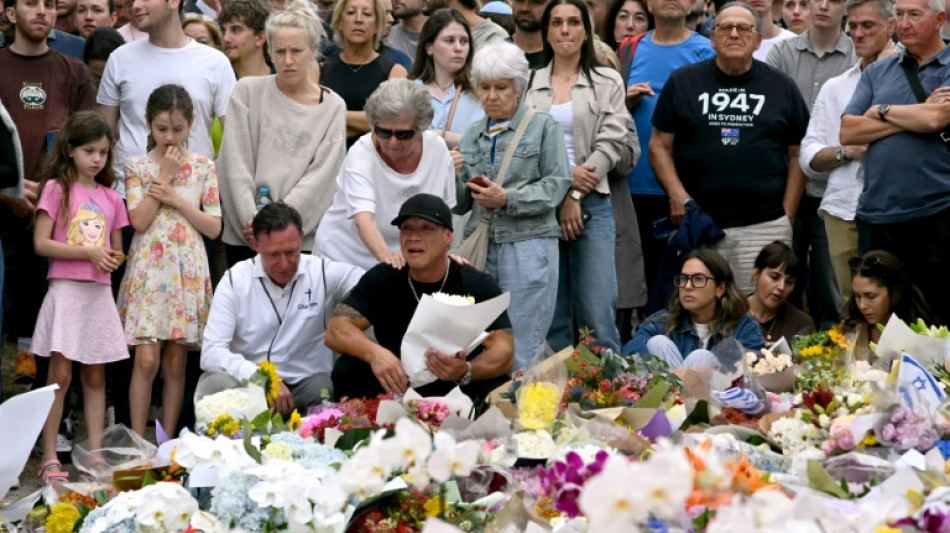
Bondi Beach suspect visited Philippines on Indian passport / Photo: Saeed KHAN - AFP
 Aston Villa Defy History With Rare Victory at Old Trafford

 Crowds Gather at San Francisco Park for Elizabeth Holmes Lookalike Tournament

 Making Your Home Safer for Aging Parents: Accessibility Renovations That Add Value

 iPS Cell Research Accelerates Drug Discovery for ALS and Spinal Cord Injury

 Rene Eyre Revisits Autobiographical Performance 'Say A Little Prayer' in London

 UAE's HCT Holds Record Graduation and Announces Major Training Expansion

 NASA Awards $10B Lunar Contract Framework to SpaceX, Blue Origin

The father and son behind one of Australia's deadliest mass shootings spent nearly all of November in the Philippines, authorities in Manila confirmed Tuesday, with the father entering on an Indian passport.
Sajid Akram and his son Naveed, who killed 15 people and wounded dozens of others at a Hanukkah celebration on Sydney's Bondi Beach, entered the country on November 1 with the southern province of Davao listed as their final destination.
The province on the southern island of Mindanao has a long history of Islamist insurgencies against central government rule.
"Sajid Akram, 50, Indian national, and Naveed Akram, 24, Australian national, arrived in the Philippines together last November 1, 2025 from Sydney, Australia," immigration spokeswoman Dana Sandoval told AFP.
"Both reported Davao as their final destination. They left the country on November 28, 2025 on a connecting flight from Davao to Manila, with Sydney as their final destination."
Australian Prime Minister Anthony Albanese said Tuesday that the two men had likely been radicalised by "Islamic State ideology".
In a statement responding to reports that the Bondi shooters had trained in the Philippines, the National Security Council said there had been no information at the time of their visit suggesting the men posed "a serious or immediate concern".
"We don't know why they went there. There was no report about them," National Security Council spokesman Cornelio Valencia told AFP over the phone.
"We're acting for our counterparts, so we will check their reports," he said, adding his agency had not yet come across anything confirming the men had trained in the archipelago nation.
"(Islamic militancy) is not such a big problem now, because we have degraded them since Marawi," Valencia added.
Pro-Islamic State Maute and Abu Sayyaf militants -- including foreign and local fighters -- held Mindanao's Marawi under siege in 2017.
The Philippine military wrested back the ruined city after a five-month battle that claimed more than 1,000 lives and displaced hundreds of thousands of people.
While insurgent activity in Mindanao has significantly abated in the years since, the Philippine army continues to hunt leaders of groups deemed to be "terrorists".
A spokesman for the army's Mindanao-based 6th Infantry Division told AFP on Tuesday that they had heard nothing in recent years about IS-linked training camps or foreigners training with local insurgents.
F.Pedersen--AMWN

