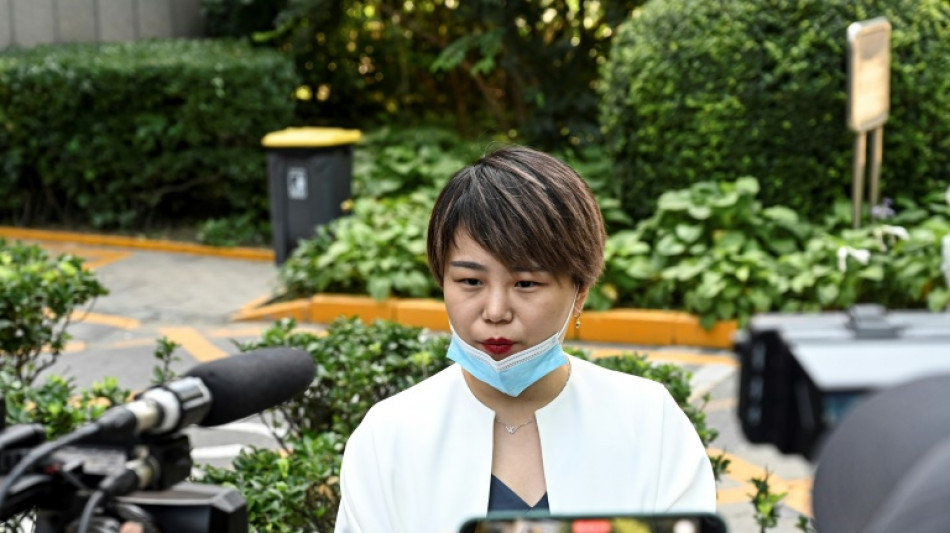
China court tosses case of single woman barred from freezing eggs / Photo: Jade GAO - AFP
 Anna Miltina Confronted with Racism Allegations on ProSieben Show

 German Auto Giants Face Existential Crisis as China Sales Plummet

 Cause of Death Revealed for 'Ellen' Producer Matthew Wright

 How to Enjoy Luxury Experiences on a Budget

 Pakistan Demands Grant-Based Climate Finance at COP31 to Avoid Debt Trap

 E Pellicci Pop-Up at Selfridges Brings Back Nostalgic School Cake

 Coronation Street's Debbie Webster Steps Down as Dementia Storyline Intensifies
A Chinese woman who was denied permission to freeze her eggs on the grounds that she was unmarried has had her case dismissed by a Beijing court.
Xu Zaozao took legal action in 2019 after a Beijing hospital refused to freeze her eggs, a procedure only available in China to married couples suffering from infertility.
Her case was widely followed in China, where women's rights have become an increasingly prominent issue, and where the birth rate has markedly slowed in recent years.
But a Beijing court ruled the hospital's refusal to freeze Xu's eggs was not illegal and "does not constitute an infringement of (her) rights", a judgment made public on Friday showed.
According to the judgment, the hospital said it "understood" Xu's complaint, but had to apply the law.
"I'm not going to let it end like this," Xu said in a video posted on the social network WeChat, promising to appeal.
"We can't say that this is a blow to the reproductive rights of single women," she added. "But it may be a small temporary setback."
Egg freezing consists of removing the oocytes before preserving them in liquid nitrogen to be used in a subsequent pregnancy.
Women across the world choose to freeze their eggs to give them a greater chance of having children later in life. But obstacles remain, with the proceedure often only available to married women.
Xu, then 30, was told by the hospital in 2018 that the procedure was only available to women who could not become pregnant naturally, and not to healthy patients.
In addition to the risks associated with egg retrieval, the hospital also noted that later pregnancies were more risky for both mother and child, and cited the difficulties faced by single mothers.
Economic development has pushed more Chinese women into the job market in recent decades, leaving many choosing to marry later in life.
Many face great pressure from parents to get married and have a child after the age of 30.
B.Finley--AMWN