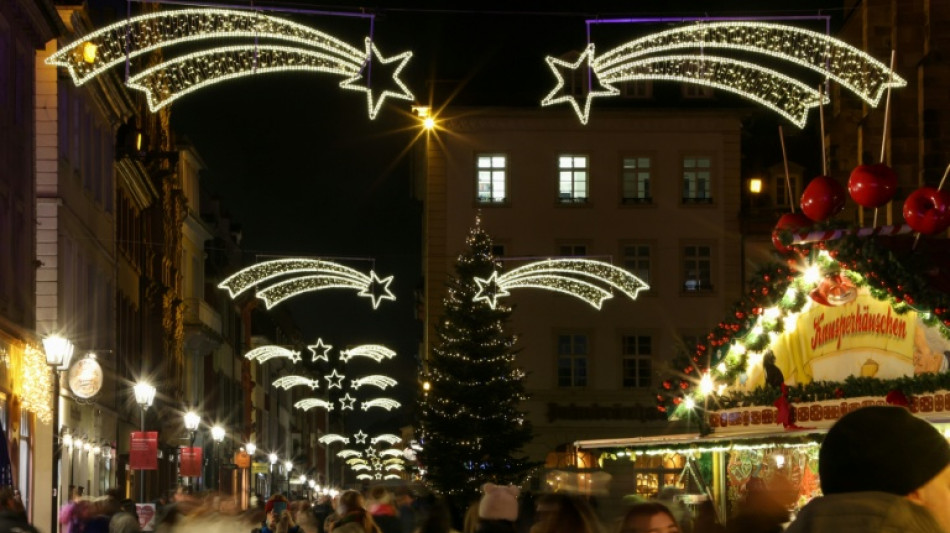
German Christmas markets hit by flood of fake news / Photo: Daniel ROLAND - AFP/File
 Aston Villa Defy History With Rare Victory at Old Trafford

 Crowds Gather at San Francisco Park for Elizabeth Holmes Lookalike Tournament

 Making Your Home Safer for Aging Parents: Accessibility Renovations That Add Value

 iPS Cell Research Accelerates Drug Discovery for ALS and Spinal Cord Injury

 Rene Eyre Revisits Autobiographical Performance 'Say A Little Prayer' in London

 UAE's HCT Holds Record Graduation and Announces Major Training Expansion

 NASA Awards $10B Lunar Contract Framework to SpaceX, Blue Origin

Security has been tightened at German Christmas markets after recent deadly attacks. But if some online videos were to be believed, they've become barbed-wire fortresses guarded by armoured personnel carriers.
A flood of disinformation has circulated on social media, with some doctored clips also giving the wrong impression that an Islamic cleric called for prayers at one of the festive events, and that markets have been stormed by Muslim men.
AFP Factcheck has taken a closer look at false claims circulating online which amplify far-right narratives about immigration and the "Islamisation" of society.
Recent images and videos showed what were claimed to be Muslim men or "Islamist immigrants" massing at Christmas markets in the cities of Hamburg and Stuttgart.
But AFP research showed that the footage was from other events: an October 2024 rally by the activist group Muslim Interaktiv, which has since been banned, and Syrians celebrating the fall of president Bashar al-Assad late last year.
Several AI-generated pictures have also shown Christmas markets with exaggerated security measures such as metre-high barbed wire fences or military-style vehicles parked around them.
- Attacks and backlash -
German Christmas markets, a centuries-old tradition, are hosted by nearly every town and city and consist of stalls with merchants selling gifts and decorations as well as sweets, sausages and hot mulled wine.
But the cosy family atmosphere of the markets has been tarnished by the shock of recent attacks.
Last year six people were killed and over 300 wounded in a car-ramming attack on the Christmas market in the eastern city of Magdeburg.
The man now on trial is a Saudi psychiatrist who adhered to conspiracy theories, held strongly anti-Islam views and repeatedly expressed his fury at German authorities.
That attack recalled a 2016 truck rampage through Berlin's Christmas market by a Tunisian man with jihadist motives that killed 13 people.
In mid-December German authorities said they had arrested five men -- an Egyptian, a Syrian and three Moroccans -- on suspicion they were involved in an Islamist plot to plough a vehicle into a Christmas market in Bavaria.
The far-right Alternative for Germany (AfD) has seized on such attacks and plots as it calls for the "remigration" of foreigners, especially to Muslim majority countries.
- 'Sow mistrust' -
Another much-shared video this month showed a man dressed in a white robe apparently delivering the Islamic call to prayer at an unspecified German Christmas market.
"This Christmas market has completely capitulated!" an Instagram user commented on the video, which was also shared on Facebook in several languages including English, Greek, Russian and Slovak.
But according to AFP research, the video dates from November 2023 and actually shows a market in the Bavarian town of Karlstadt, an event that had nothing to do with Christmas.
The Andreasmarkt has a different theme every year and in 2023 opened with a call to prayer after two local Islamic groups were asked to contribute, organisers told AFP.
A separate Christmas market was due to open in the town in early December, they said -- which is why a Christmas tree can be seen in the video.
Christmas markets are a ripe target for disinformation because of their emotional associations, said Lea Fruehwirth of Germany's Centre for Monitoring, Analysis and Strategy.
"Christmas symbolism stands for joy, a warm feeling of community and security," said Fruehwirth, a disinformation researcher at the non-profit extremism monitoring agency.
Narratives that "accuse Muslims of wanting to violently destroy this idealised image can therefore trigger a lot of emotion," she said.
The creators of such posts, she added, are likely seeking to "sow mistrust and deepen divisions in society, as is the case with Russian disinformation campaigns, for example."
L.Miller--AMWN

