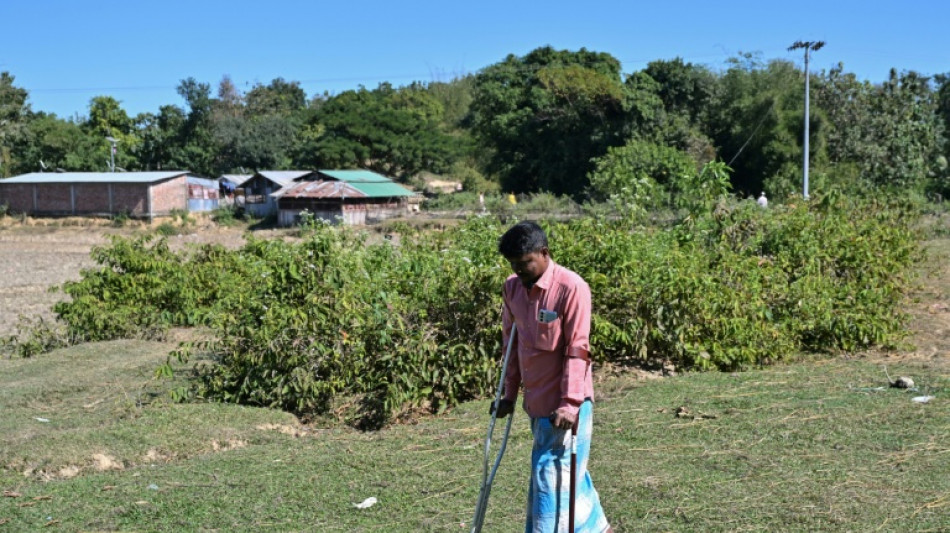
Landmines destroy limbs and lives on Bangladesh-Myanmar border / Photo: Munir UZ ZAMAN - AFP
 Netanyahu says Iran 'decimated,' Tehran targets Gulf petro-facilities

 US, Israel tactics diverge on Iran as Trump's goals still 'fuzzy'

 Brazil presidential hopeful Flavio Bolsonaro praises Bukele

 US stocks cut losses on Netanyahu war comments as energy prices soar again

 Netanyahu says Iran decimated as Tehran warns of 'zero restraint' in energy attacks

 California to rename Cesar Chavez Day after sex abuse claims
 New FIFA ruling boosts prospects for women coaches

 Trump says told Netanyahu not to attack Iran gas fields

 FIFA planning for World Cup to 'go ahead as scheduled' amid Iran uncertainty

 Mideast war exposing Europe's reliance on Gulf flights, airlines warn

 UN shipping body urges 'safe maritime corridor' in Gulf

 Trump to Japan PM: 'Why didn't you tell me about Pearl Harbor?'

 IMF raises concern over global inflation, output over Iran war

 Cunningham out for NBA Pistons with collapsed lung

 Iran attacks on gas and oil refineries heighten fears over war fallout

 Call to add Nazi camps to UNESCO list

 'Miracle': Europe reconnects with lost spacecraft

 Woltemade deployed too deep to be dangerous at Newcastle, says Nagelsmann

 EU summit fails to rally Orban behind stalled Ukraine loan

 Senegal to appeal CAF Africa Cup of Nations decision

 Record-setter Hodgkinson hopes 'fourth time lucky' at world indoors

 Karalis hits prime form to threaten Duplantis surprise

 US earns its lowest-ever score on freedom index

 What we know about the UK's deadly meningitis outbreak

 What cargo ships are passing Hormuz strait?

In the dense hill forests along Bangladesh's border with war-torn Myanmar, villagers are losing limbs to landmines, casualties of a conflict not of their making.
Ali Hossain, 40, was collecting firewood in early 2025 when a blast shattered his life.
"I went into the jungle with fellow villagers. Suddenly, there was an explosion, and my leg was blown off," he told AFP. "I screamed at the top of my voice."
Neighbours rushed to stem the spurting blood.
"They picked me up, gathered my severed leg and took me to hospital", he said.
In Ashartoli, a small settlement in Bandarban district -- the village name translates as "haven of hope" -- the weapons of a foreign war have turned forests, farms and footpaths deadly.
Bangladesh's 271-kilometre (168-mile) eastern border with Myanmar cuts through forests, much of it unmarked, as well as rivers.
It is crossed daily by villagers, as their families have done for generations, for collecting firewood or smalltime trading.
Surgeons chopped Hossain's leg off above the knee.
"My wife had to carry me on her back," he said, gesturing towards the steep hillside around his home, as he recalled the months after the blast.
A year later, Hossain walks with an artificial leg and a crutch, but he cannot return to his job on a rubber plantation.
Needing 300 taka ($2.50) a day for medicine, his two young sons now take on his former dangerous task, collecting firewood after school.
- 'My whole life' -
Similar stories echo across the border region.
"My father and forefathers collected wood from the jungle," said Mohammad Abu Taleb, 47. "I learned no other trade."
He crossed unwittingly into Myanmar.
"I stepped on a pile of dry leaves, and there was an explosion," he said, leaning on a crutch. "It took away my whole life."
His 10-year-old son has since dropped out of school to help support the family.
Taleb said trips to repair his artificial leg and attend medical checkups cost around US$80 -- an impossible burden for a family struggling to survive.
Nurul Amin, 23, lost his leg while attempting to bring a cow across the border, a memory blurred by pain.
"They carried me on their shoulders to the hospital," he recalls, saying he was more worried that his monthly income had now fallen to around $25-$30.
"That's not enough for a family," he said. "I have no other way to survive."
- 'Cruelty' -
Myanmar is the world's most dangerous country for landmine casualties, according to the International Campaign to Ban Landmines, which has detailed the "massive" and growing use of the weapons, banned by many countries.
It recorded more than 2,000 casualties in Myanmar in 2024, the latest full statistics available -- double the total reported the year before.
"The use of mines appeared to significantly increase in 2024–2025," it said in its Landmine Monitor report, highlighting "an increase in the number of mine victims, particularly near the border" with Bangladesh.
Bangladesh accuses Myanmar's military and rival armed forces of planting the mines.
Guerrilla Arakan Army fighters -- one of the many factions challenging the junta's rule -- control swathes of jungle across the border with Myanmar.
More than a million Rohingya refugees who fled Myanmar also live in Bangladesh's border regions -- caught between the warring military and separatist groups.
Bangladesh police say that at least 28 people were injured by landmines in 2025.
In November, a Bangladesh border guard was killed when a landmine tore off both his legs.
"This cruelty cannot be legitimised," said Lieutenant Colonel Kafil Uddin Kayes, a local Border Guard Bangladesh commander.
Bangladesh's border force has put up warning signs and red flags, and conducts regular mine-sweeping operations.
But villagers say warnings offer little protection when survival depends on entering forests seeded with explosives, leaving communities in Bangladesh to pay the price of war.
"The population is increasing, and people are moving closer to the border, as we have farmlands there," said 42-year-old farmer Dudu Mia.
"Planting landmines cannot be the solution. It can't go on like this."
P.Santos--AMWN