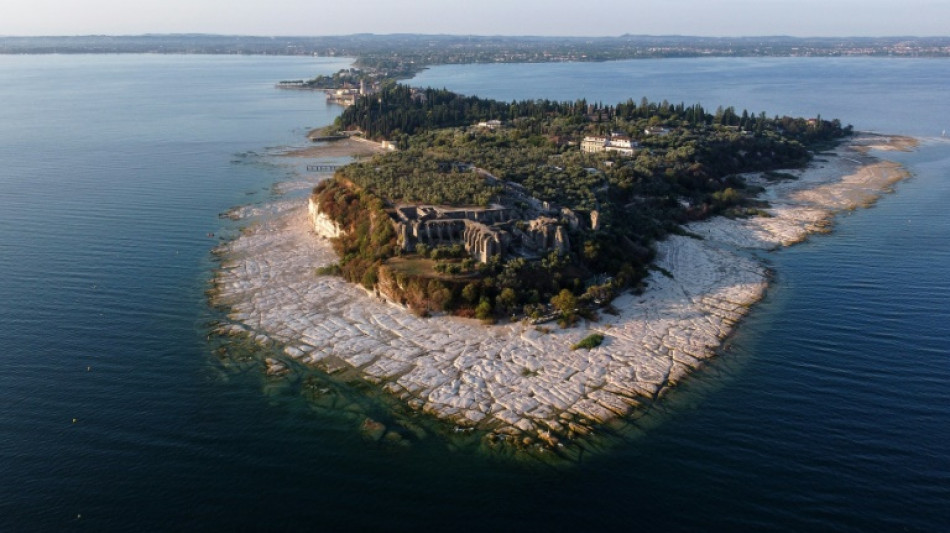
Water levels on Italy's Lake Garda drop to 15-year low / Photo: MIGUEL MEDINA - AFP
 Anna Miltina Confronted with Racism Allegations on ProSieben Show

 German Auto Giants Face Existential Crisis as China Sales Plummet

 Cause of Death Revealed for 'Ellen' Producer Matthew Wright

 How to Enjoy Luxury Experiences on a Budget

 Pakistan Demands Grant-Based Climate Finance at COP31 to Avoid Debt Trap

 E Pellicci Pop-Up at Selfridges Brings Back Nostalgic School Cake

 Coronation Street's Debbie Webster Steps Down as Dementia Storyline Intensifies
The pedalos lie far from the water's edge and the flat stone slabs around the Sirmione peninsula are exposed after drought reduced the level of Italy's Lake Garda to a 15-year low.
Italy's largest lake, a major tourist destination nestled among mountains in the north of the country, is suffering like many others from months without rain.
"We are currently at 30 centimetres (12 inches) above the (benchmark) hydrographic level," compared to an average for this time of year of between 80 and 100, said Gianluca Ginepro, head of Garda Unico, which promotes the lake.
It is the lowest since 2007, when levels dropped to 9.9 cm, according to official data.
"It's a situation to keep an eye on, even if from the point of view of using the lake -- like wind surfing, sailing -- there is no problem," Ginepro told AFP.
Tourism was holding up well, he said, although operators of trips across the lake had switched from hydrofoils to catamarans.
He also said that "the possibility of providing water for agriculture has dropped".
Farmers have also been hit by a lack of water in the River Po, which stretches across northern Italy and is suffering its worst drought for 70 years.
But the issue goes beyond Italy, with land across Europe parched by a lack of rainfall and sweltering temperatures, driven by climate change.
Several other European countries, as well as reporting record temperatures during recent heatwaves, have also reported low levels of water in rivers.
Th.Berger--AMWN

