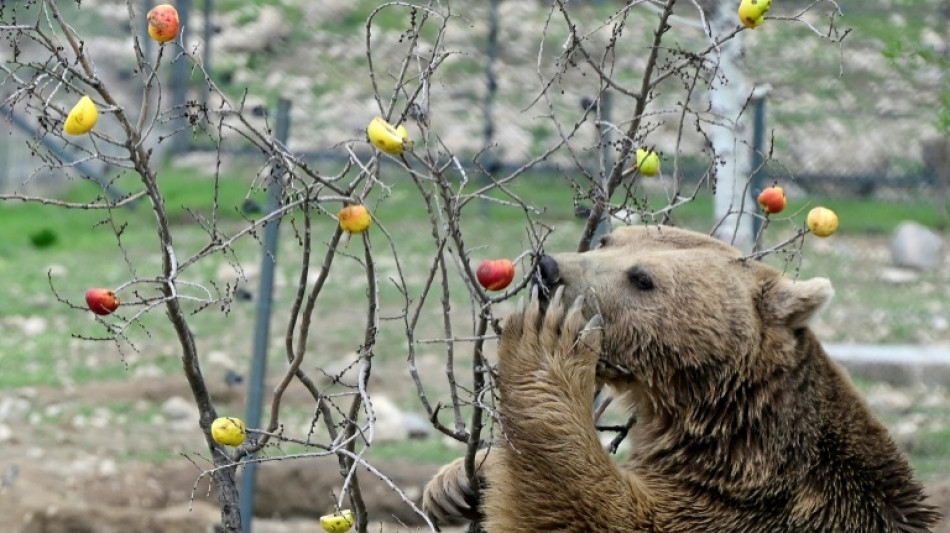
Caged and fed 'cookies': Rescuing Armenia's captive bears / Photo: KAREN MINASYAN - AFP
 India vows action after first cheetah shot dead

 'Now or Never': Ethiopia influencers push for Eritrea invasion
 Mbappe furore rages on in China, but Mao comments censored

 Billionaire Ambani's Jio jumps 21% in market debut after record India IPO
 Rays win thriller to thwart Brewers in World Series
 Reigning champ Knicks earn first win against Pistons

 Runners swap streets for shopping malls as haze chokes Singapore

 Billionaire Ambani's Jio to debut after record India IPO
 UK set for cautious budget as borrowing costs climb
 Anthropic's record IPO faces some big questions
 US Fed expected to hold rates steady ahead of key midterm elections

 Can this Latin Grammy-winner help Democrats win back Congress?
 Tuvalu has 'limited' power to halt its fossil fuel investments: NZ govt papers seen by AFP
 Palestinian activist Khalil returns to Columbia after US detention

 Trump drastically loosens oil and gas methane rules

 French Senate weighs bill to make protesters pay for unrest damage
 6 Weekend Upgrades That Increase Your Property Value

 Syria, Jordan agree to mend ties after deadly strike
 Arsenal stunned by fourth-tier Fleetwood in League Cup

 Last-gasp Sabitzer strike sends Dortmund past Bremen in German Cup

 Rights groups reject Emirati diplomat for UN top job

 Flavio Bolsonaro headed to US after Brazil election defeat: US media
 Alcaraz and Zverev win Vienna openers

 Tech firms gain ahead of Fed decision, results from AI giants

 Syria condemns deadly Jordan strikes as 'unacceptable violation'
For years, Syrian brown bears Nairi, Aram and their cub Lola were trapped in a three-metre-wide cage in Armenia's capital Yerevan, living in their own faeces and fed with sweets.
After being rescued last year, they are now thriving at a wildlife refuge in the Caucasus country's highlands, but others have not been so lucky.
As many as 20 bears are thought to remain captive in Armenia -- a post-Soviet country where oligarchs have been accused of keeping predators as status symbols.
Rescuers have found the animals in miserable conditions: holed up in hotels, backyards and petrol stations, unable to hibernate and deprived of access to natural light.
"No proper care, no veterinary check, anything," said Tsovinar Hovhannisyan, conservation manager at the Foundation for the Preservation of Wildlife and Cultural Assets (FPWC) -- an Armenian-based non-profit that spearheads the rescue efforts and operates a rehabilitation centre for the animals.
Some of the animals have been found with rotting teeth, after being fed with "cookies, Coca-Cola, and sweet stuff," she told AFP.
After realising the scale of the problem, "we were certain we need this rehabilitation and rescue centre," she added.
Armenia's strategic position between Asia and Europe has made it a hub for wildlife trafficking.
Demand for rare animals among Armenia's ultra-rich has also been a persistent issue, according to a report from the Global Organized Crime Index.
In 2015, an Armenian lawmaker faced criticism after revealing he was keeping half a dozen endangered Siberian tigers at his home.
The issue came to a head in 2016, when a private zoo owned by a businessman in the northern city of Gyumri fell into financial difficulty, leaving animals including lions and bears starving in cages.
- 'Something to brag about' -
With Armenia set to host a COP summit on biodiversity in October, rescuers are racing to free the remaining bears.
But the centre has no space to house more bears, said communications manager Ani Poghosyan.
They are trying to raise funds to expand.
"We know of several wild animals, not only bears, held by some of the key big oligarchs in Armenia," said Poghosyan.
"It is for them a status symbol. Something to brag about... especially if they're holding big predators, to show that they are more manly," she added.
Rescuing the bears is also a challenge.
In some cases an owner would offer to give up their bear, only to change their mind when the team turned up, said Poghosyan.
Rescuing Nairi, Aram and Lola was one of the most challenging operations the group has undertaken, Hovhannisyan said.
The owner was reluctant to part with the animals, telling the rescuers that they were "happy living with him".
"He was saying that we are going to kill the animals, and we don't know how to properly take care of them," said Hovhannisyan.
"We stood under the rain, more than eight hours, awaiting court for permission to get into the house and rescue the bears," she said.
When the keepers finally entered the cage, they found it caked in filth.
"That was horrible... It was stinky," she told AFP, saying she had "very bad memories from that day".
- They need to feel 'wild' -
Built into a mountainside around an hour's drive from the capital, the centre's 32 bears have large enclosures and are able to dig their own dens.
The food they are given is designed to replicate their diet in the wild, about 80 percent fruit and vegetables -- much of it grown at the refuge -- and 20 percent meat.
They are able to hibernate -- unlike in captivity -- but must have continued stimulation to keep their minds busy.
"They need to dig, they need to climb trees. They need to smell different plants. We give them live prey too," said Narine Piloyan, the centre's coordinator.
After years spent in a cage, the bears at first did not use the full enclosure -- used to living in a "small space", said Piloyan.
Despite improvements in health and wellbeing, the bears are unable to hunt, meaning they must spend the rest of their lives at the centre, said Piloyan.
The goal, she explained, is to let them be bears for the rest of their days.
"They need to feel that they are wild."
D.Moore--AMWN