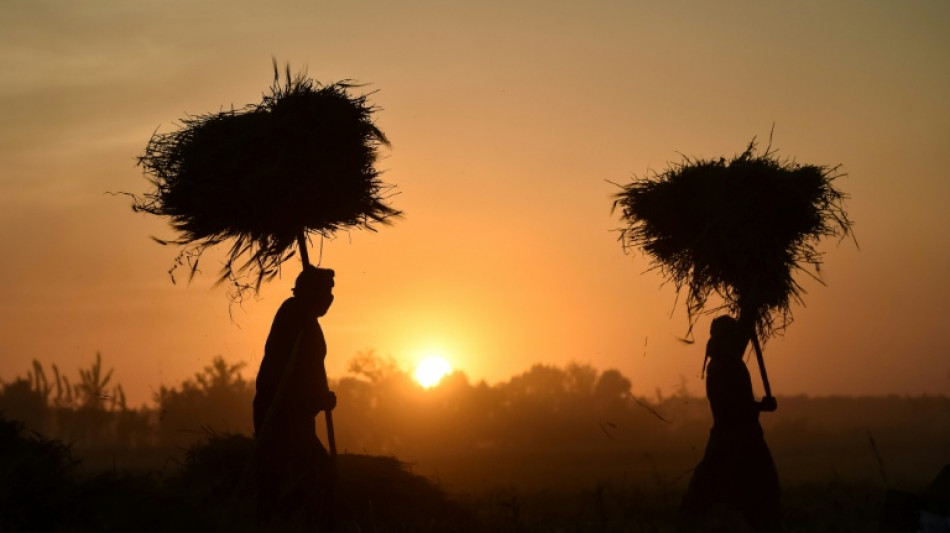
Afghanistan's water crisis worsened last year: UN report / Photo: Atif ARYAN - AFP
 Brazil markets battered, tech in focus elsewhere

 French court adjourns trial over 2020 death of delivery driver

 Serbian student movement eyes power after election triumph

 Machado ready to meet Venezuela leader after shock return

 Lula celebrates election win as Brazil markets tumble
 France's Macron accuses social media of sowing discord ahead of election
 Anthropic unveils IPO filing showing soaring sales and AI risks

 US singer Chris Brown avoids jail over London nightclub brawl

 US singer Chris Brown avoids jail over UK nightclub brawl
 Man Utd crisis deepens as Carrick faces axe

 Serbian student movement eyes power after resounding snap poll victory

 Eala breezes past world number 411 in Tokyo opener

 Swedish Centre Party leader says government coalition talks failed
 Barca's big-game defeats pose familiar questions

 Russia says open to mini Ukraine ceasefires, but no let up in war

 Bangladesh measles crisis 'warning sign' of other outbreaks: report

 'Historic victory': World leaders celebrate Lula's re-election

 Stock markets mixed ahead of tech earnings, central bank decisions

 Mother renews anti-bullying appeal a decade after son’s death

 'Historic victory': Leftist leaders in the Americas celebrate Lula's re-election
 African players in Europe: Jackson brace ends City's perfect record

 Argentine police arrest stepfather after pregnant 10-year-old reaches hospital
 Mother dies after rescuing sons from riptide in the Bahamas
 James Blunt reportedly sought extra underwear during Celebrity Traitors filming

 Trump says Canada trade deal coming 'soon'

Afghanistan's water crisis worsened in 2025, the United Nations said in a report, with drought nearly doubling compared to the year before.
Most of Afghanistan's 48.6 million people depend on agriculture, and water scarcity can have devastating consequences in a country already experiencing widespread poverty, food insecurity and conflict.
"Water access deteriorated sharply," the United Nations Development Programme (UNDP) said in the report released on Wednesday, adding that drought became "the dominant environmental stressor across nearly all regions" of Afghanistan.
Drought prevalence rose to 64 percent in 2025 from 34 percent the year before, according to the UNDP.
The most affected regions range from western Afghanistan to the northeastern province of Badakhshan, "with 92 percent of households reporting drought impacts", the report said.
"In a country that depends on agriculture, that brings food insecurity," Najibullah Yusufi, a UN expert on climate change, told AFP, adding that water issues also affect the health sector.
Between 2024 and 2025, "reports of non-functional or dried-up water points tripled, and full drinking water sufficiency fell from 59 percent to 44 percent nationally", the UNDP report showed.
Studies show that the capital Kabul could run out of ground water by as early as 2030 due to climate change and rapid urbanisation.
The Afghan National Environment Protection Agency said on Thursday that "groundwater, the main source of drinking water for most of the population, is being depleted rapidly" in major cities across the country.
More than five million Afghans have returned home from Iran and Pakistan since September 2023, according to the International Organisation for Migration.
Many of them are trying to start a new life in the capital, expecting the swelling city of more than six million to offer the best prospects of work in a country where nearly half of the population needs humanitarian assistance.
"Kabul is facing a lot of issues, population has increased, the need for water has risen, and we don't have enough rain to recharge the ground water," Yusufi said.
This year's rainfalls were better than last year, Afghanistan's disaster management authority said in April, hoping it "can strengthen the underground sources of water", and improve harvests.
Y.Nakamura--AMWN