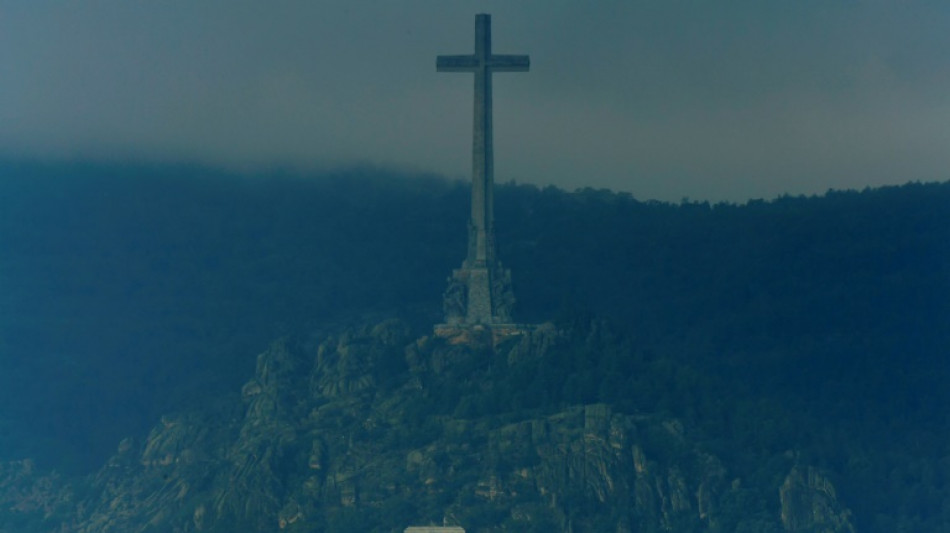
Spain to relocate remains of Franco allies to more discreet graves / Photo: JAVIER SORIANO - AFP/File
 Pope Leo begins three-country South American tour in Uruguay

 Khawaja says entire Australia camp knew of 2018 ball-tampering plan

 November Foraging Guide: Edible Mushrooms and Critical Safety Protocols

 Microsoft Updates Xbox PC App with 60% Faster Startup and Redesigned Interface

 Early Polar Vortex Disruption Creates Uncertain Winter Outlook for Pennsylvania

 Edmund Richardson Wins Baillie Gifford Prize for 'Alexander' Biography

Spain is planning to relocate the remains of two far-right figures linked to its 1936-1939 civil war who are buried in grandiose sites, a minister said Thursday.
In remarks to Cadena Ser radio, cabinet minister Felix Bolanos said new legislation passed this week would affect the grave of Jose Antonio Primo de Rivera, founder of Spain's fascist Falange party who died at the start of the civil war and is buried in an imposing state mausoleum near Madrid.
The basilica in the Valley of the Fallen is where the remains of dictator Francisco Franco were laid after his death in 1975 until they were moved to a more discreet grave by Spain's left-wing government in October 2019.
It would also affect the grave of nationalist general Gonzalo Queipo de Llano, a Franco ally who ran a military campaign in the south during the civil war and is believed to have given the green light to the shooting of Spanish poet Federico Garcia Lorca.
He is buried in Seville's iconic Macarena Basilica.
Asked if the law would mean his remains would be relocated, Bolanos said it would affect anyone involved in the coup which triggered the war and the ensuing dictatorship.
"The new law says there can be no prominent place for people who were involved in the dictatorship, or the coup d'etat," Bolanos said of flagship legislation passed this week by parliament seeking to honour victims of Francoism.
"It's not only the case with Queipo de Llano, but Jose Antonio Primo de Rivera, who is buried in front of the (basilica's) main altar... which is a prominent place," he said.
"Once the legislation comes into force, the work will begin," Bolanos said without giving further details.
"Obviously they should be given a dignified burial wherever the relatives decide, but they cannot be in any kind of prominent place because that is a way of paying homage to the protagonists of the dictatorship."
Honouring those who died or suffered violence or repression during war and decades of dictatorship that followed has been a top priority for Prime Minister Pedro Sanchez since he came to power in 2018.
M.Fischer--AMWN


