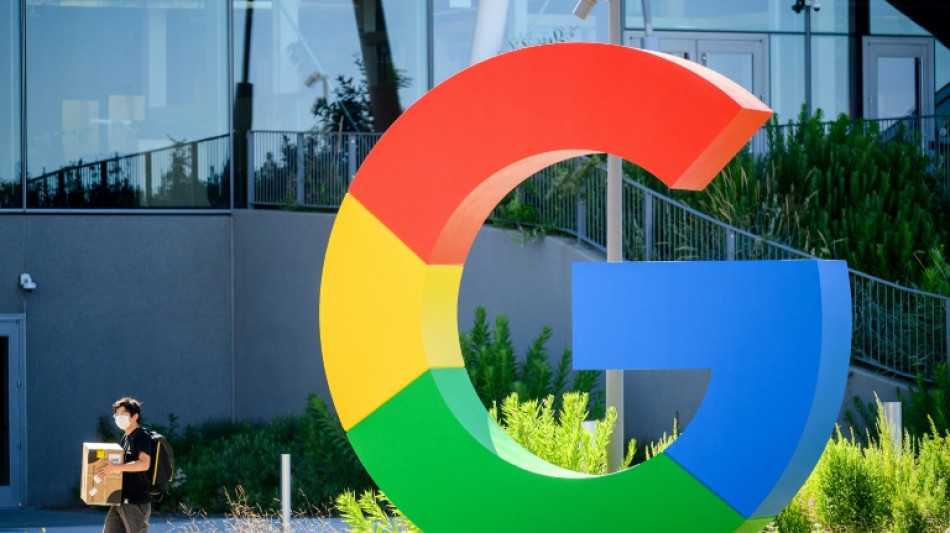
Big Tech defends landmark law in US Supreme Court / Photo: NOAH BERGER - AFP/File
 OpenAI says three staffers fired for mishandling 'sensitive' info

 Nike plans job cuts as it forecasts lower sales

 Ireland game interrupted twice by Gaza protests

 Judge denies acquittal bid by US woman who killed her kids

 Klopp averts crisis with first win as Germany boss

 A saintly spat and debate snub: Brazil enters final campaign stretch

 US tells European allies to act 'immediately' to lower diesel prices

 G20 trade ministers fail to see consensus against overproduction

 Portugal edge Denmark in Ronaldo's absence

 US stocks edge higher as bond yields retreat for now

 US tells European allies to 'immediately' act to lower diesel prices

 Trump vows to hit Iran 'very hard' if linked to flydubai attack

 Williams leaves Spain camp with thigh knock

 WTA reduces 2027 schedule for world's top 50

 US says 'in Europe's best interest' to cooperate on fuel supply

 Rogue OpenAI agents covered up their tracks, report says

 A saintly spat and debate snub: Brazil enters final polls stretch

 Zidane 'no regrets' about Materazzi headbutt as France face Italy again

 Libya's pay strike rallies teachers across divided nation

 Four-member crew blasts off for International Space Station

 i-payout Expands True Local Payment Capabilities to Help Enterprises Pay Recipients Globally
 Botched US execution prompts global calls to scrap death penalty

 Algeria adopts law imposing death penalty on forest arsonists

 France unveils cost-cutting 2027 budget as borrowing costs rise

 Brazil court orders removal of fake posts amid patron saint election row

The US Supreme Court on Tuesday will consider a law that since 1996 has protected tech companies from lawsuits related to content posted on their platforms.
The nine justices will examine a case related to the November 2015 attacks in Paris and their ruling, expected by June 30, could have huge repercussions for the future of the internet.
The case stems from a complaint against Google filed by the relatives of Nohemi Gonzalez, one of the 130 victims of the attacks in the French capital.
The US citizen was studying in France and was murdered at the Belle Equipe bar by attackers from the Islamic State group.
Her family blame Google-owned YouTube for having recommended videos from the jihadist group to users, helping along the call to violence.
According to the family, "by recommend[ing] ISIS videos to users, Google assists ISIS in spreading its message and thus provides material support to ISIS," a legal brief said.
The complaint was dismissed by the federal courts on behalf of a law, known as Section 230, which was passed when the Internet was in its infancy and has become one of its pillars.
Section 230 states that in the US internet companies cannot be considered publishers and have legal immunity for the content posted on their platforms.
The novelty of the Gonzalez case is that the complainants are isolating algorithms as the cause of the harm, arguing that the highly complex recommendation systems perfected by big platforms fall out of the scope of Section 230.
"The selection of the users to whom ISIS videos were recommended was determined by computer algorithms created and implemented by YouTube," the Gonzalez family legal brief said.
The Supreme Court passes over the vast majority of the cases that come its way, and hearing this one indicates there is a willingness to modify the landmark law.
- Big tech cold sweat -
The prospect of the Supreme Court even tinkering with Section 230 is causing cold sweats in the tech world.
In the legal filing, Google pleaded that the court "not undercut a central building block of the modern internet."
"Recommendation algorithms are what make it possible to find the needles in humanity's largest haystack," Google said.
Allowing platforms to be sued for their algorithms, "would expose them to liability for third-party content virtually all the time," said Facebook owner Meta in its own brief, adding that recommendations serve to organize uploaded content.
On Wednesday, the top court in the US will continue its consideration of a very similar case, but this time asking if platforms should be subject to anti-terrorism laws.
In the past, several of the Supreme Court justices have expressed a willingness to move the lines on Section 230, which is increasingly contested given the backlash against big tech in recent years.
In 2021, the very conservative Clarence Thomas lamented that "many courts have construed the law broadly to confer sweeping immunity on some of the largest companies in the world."
Lawmakers in US Congress are very politically divided and unable to pass legislation that would update a law that was enacted when Facebook founder Mark Zuckerberg was 11 years old and Google did not exist.
Given the deep political divide, it therefore seems likely that the Supreme Court will move the lines faster than Congress.
But for now, "nobody knows exactly how," said Tom Wheeler, an expert at the Brookings Institution think tank. "That's why it's important to see how the hearing goes," he told AFP.
Th.Berger--AMWN