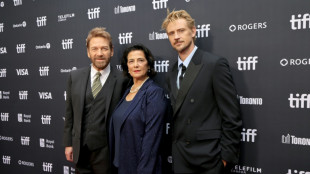
How a German war film disarmed Oscar voters despite woes at home / Photo: JUSTIN TALLIS - AFP/File
 Asian stocks drop as oil spike fans rate hike bets, eyes on US jobs

 Viral anti-vax posts weaponise Philippine inoculation fears

 Saudi coalition accuses Houthis of drone attack on Medina
 Effective Altruism: the philosophy behind Silicon Valley's AI fears
 Chinese judoka accused of biting as home hope wins Asian Games gold

 Four-member crew docks at International Space Station

 Portugal win without Ronaldo as Klopp's Germany get first victory

 Wemby: 'Very sad' to see players endorse betting firms

 Manchester City Women scrape draw with Real Madrid
 India, Australia and Pakistan in same World Cup group
 Daryz's hopes of repeat Arc win boosted by draw
 Steelers ship disgruntled defender Porter to Cowboys

 Klopp gets first win as Germany boss

 Bolivia's attorney general arrested on drugs, money laundering charges

 Raiders host Chiefs in battle of unbeaten division rivals
 Lowest Fee Bitcoin ATMs Announces Launch of More Than 400 ATMs Nationwide

 G20 against 'weaponization' of food trade: French minister

 Female US inmate in critical condition after botched execution

 Spotlight on UK-UAE ties amid Manchester City scandal
 Ethiopia and Eritrea break diplomatic ties over conflict

 Downing Street says Manchester City not 'above the rules'
 Hadjar wants to 'fight for the title' from next season
 Bolivia's attorney general arrested for alleged drug trafficking, money laundering

 German sugar tax sparks new government row

 Musk returns to US government for Pentagon war study

When "All Quiet on the Western Front" first premiered back in September, there was little to suggest it was about to wage an all-out campaign for Oscar votes.
The German-language World War I film comes from Netflix, which had a roster of far more expensive "prestige" movies primed for Academy Award pushes, from Oscar-winning director Alejandro Gonzalez Inarritu's "Bardo" to the star-studded "Glass Onion: A Knives Out Mystery."
But while those have largely fallen by the wayside, with one nomination each, "All Quiet" has emerged from the crowded trenches of awards season hopefuls as an Oscars frontrunner, with nine nods, including for much-coveted best picture honors.
"It really feels like a wave of joy and luck that has come over us," director Edward Berger told AFP, days before his film won seven prizes at Britain's BAFTAs, including best film.
"We're very grateful for that... it's a German war movie!"
Indeed, Berger's film is the third screen adaptation of Erich Maria Remarque's seminal novel about naive young German soldiers confronted with the horrors of war -- but the first shot in the author's native language.
Had he been asked, the director "would have immediately said no" to making another English-language version.
Luckily, the decision to flip the script was helped by Netflix's wildly successful expansion into new global markets with recent subtitled hits such as South Korean series "Squid Game" and Oscar-winning film "Roma."
The movie's eventual $20 million price tag was comparatively small change for the streaming giant, but a huge sum in the German film industry.
"We wouldn't have gotten the type of budget that you need to make this film five years ago," said Berger.
The film's best picture Oscar nomination is the first for any German-language movie.
- Creative license -
Ironically, the film has been far better received outside of the German-speaking world than it has at home, where many reviewers savaged it.
In particular, critics slammed Berger's decision to depart from Remarque's text, which -- with 50 million copies sold worldwide, and the legacy of being banned by the Nazis -- holds hallowed status in Germany today.
Unlike the novel, the film portrays tense armistice peace talks with French generals. It also omits a section in which one of its war-hardened heroes visits home but cannot readjust to civilian life.
"I don't follow it very closely... that's part of the journalist's job -- to observe, criticize," shrugged Berger.
"I felt licensed to make those changes" because "why make it the same?" he added.
To encapsulate the "physical difference" between the film's reception at home and overseas, Berger pointed to one especially harrowing scene towards the end of the movie.
A key character is fatally bayoneted through the back -- a moment which Berger intended to be heartbreaking and brutal, but not necessarily unexpected, given the novel's fame and the war's unfathomable death toll.
Yet at the film's world premiere in Toronto last year, "there was a loud gasp in the audience," he recalled.
"I was so surprised, because I didn't plan on this... In Germany, that didn't happen," said Berger.
"As Germans, we expect -- in a German movie about war -- you cannot have a hero. You cannot have people be successful in the mission. You almost cannot have a soldier survive," he said.
By contrast, "in America, you're used to the hero. You want them to come out positively, and you cling on to the hope that your hero is going to change the world."
- 'Shame and responsibility and guilt' -
In any case, Berger did not sign up out of any sense of patriotic duty. The film and the original anti-war novel are both stridently against jingoism of any stripe.
"We wanted to make a very German movie -- but we are not making it for the country," he said.
"I'm not a patriot. Germans have a difficult relationship with patriotism, or pride or honor, about their history or country. So I'm not in that business."
Instead, filming in German offered "an outer stamp of authenticity" and a deeper sense of the "shame and responsibility and guilt" many Germans feel about history, said Berger.
Whatever happens at the Oscars ceremony on March 12, "All Quiet" clearly left an indelible impact on voters at the US-based Academy of Motion Picture Arts and Sciences.
It is seen as a shoo-in for the best international feature statuette, a strong possibility for best picture, and its nine Oscar nominations are one short of the all-time record for a foreign-language movie.
"Were we surprised? Of course," said Berger. "I mean, you can't count on something like that."
L.Miller--AMWN