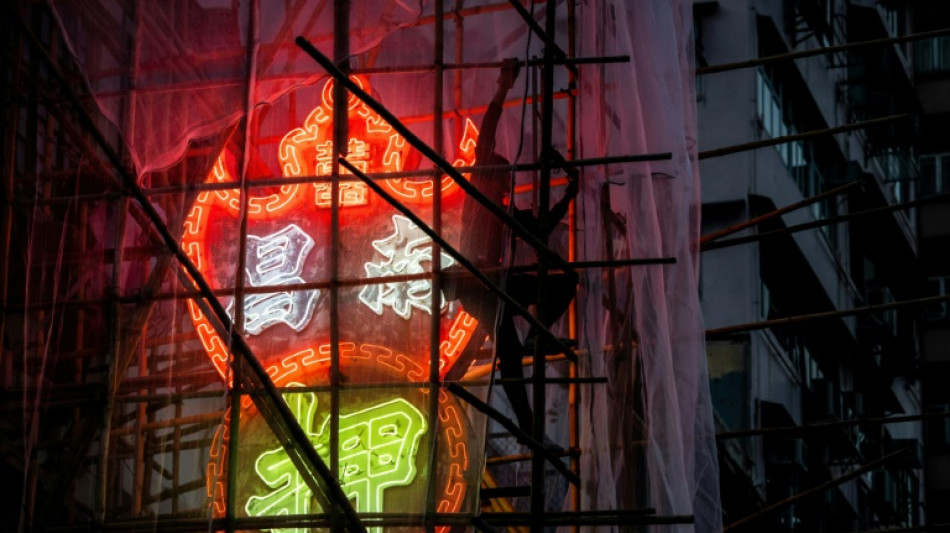
Hong Kong's bamboo scaffolders preserve ancient technique / Photo: ISAAC LAWRENCE - AFP
 Swedish Social Democrats leader to make new bid to form government

 North Korea calls Seoul 'despicable' after DMZ apology demand

 Taiwan boxer Lin wins gold as virtual taekwondo makes Games debut

 Man City face appeal deadline after explosive financial verdict

 Pole vault superstar Duplantis to skip indoor season
 Sri Lanka drop Asalanka from T20 against Pakistan

 Disney president says layoffs 'extremely painful' but necessary

 Indian flydubai pilot opened cockpit door to save passengers
 Alex Marquez clocks record lap at MotoGP Japan practice

 Tom Kim leads Asian Games golf in chase to avoid military service
 Asian stocks hit as oil spike fans rate hike bets, eyes on US jobs

 'We're losing our scientists': west Africa's STEM struggle

 World powers gather in Pacific to chart climate battle

 Return of swarming moth spectacle has Australia in a flutter

 Browns snuff out Rodgers fightback to beat Steelers 27-24

 Braves power past Phillies to set up Dodgers showdown
 Asian stocks drop as oil spike fans rate hike bets, eyes on US jobs

 Viral anti-vax posts weaponise Philippine inoculation fears
 Saudi coalition accuses Houthis of drone attack on Medina

 Effective Altruism: the philosophy behind Silicon Valley's AI fears

 Chinese judoka accused of biting as home hope wins Asian Games gold

 Four-member crew docks at International Space Station

 Gabriel Resources Announces US$3.4 Million Private Placement

 Nike plans job cuts as it forecasts lower sales

 Ireland game interrupted twice by Gaza protests

Mo Jia Yu wraps his legs around a pole to balance high above the ground and secure a joint, a skill he must master to become a bamboo scaffolder in Hong Kong.
The metropolis is one of the world's last remaining cities to use bamboo scaffolding in modern construction and building repair.
Scaffolders perched on bamboo frames several storeys high are a common sight, and are nicknamed "spiders" by Hong Kongers for their agility over the web-like latticework.
Mo is among dozens of students who enrol each year at the city's Construction Industry Council (CIC) to learn the traditionalmethod.
"You have to have a daring heart," said Mo, who has been at the school for nearly three months.
"You have to be aware of safety because you are working high up in the air."
Students learn how to firmly saddle the bamboo frame so that they can free up their hands to work on the scaffolds, which are held together with simple knots tied using nylon strips.
"This basic knot is something we learn first... we practise for an entire week to get it right," said another student, Ho Cheuk Wai.
"Then, the instructors will teach us how to put on the safety harness, and step-by-step we learn how to build all the way to the top."
Scaffolding using bamboo dates back centuries and was once a widespread practice across China and elsewhere in Asia.
Most cities in the region have phased it out to favour materials such as steel and aluminium.
In Hong Kong, intricate bamboo webs are still part of the cityscape, latticed around both old residential flats and glitzy skyscrapers.
- 'Courage and skill' -
Scaffolding is regulated by strict safety guidelines but is still viewed as a dangerous profession since the work is often done at dizzying heights.
"You need courage as well as skill to survive," said Wallace Chang, a professor at Hong Kong University's architecture department.
"This deters people from going into the industry."
Despite the perils involved in the craft, Chang hopes Hong Kong will preserve it as part of its cultural heritage.
Its popularity in the city is due to both price and efficiency.
Bamboo is readily available across the border in southern Chinese provinces. A pole costs around HK$15 (US$2) compared with HK$280 (US$35) for one made of metal.
Lightweight bamboo is also easier to transport through a cramped urban centre.
It is flexible, allowing builders to cut poles to desired lengths for different construction sites.
"Bamboo scaffolds are very suited to the odd and tight spaces in Hong Kong," explained instructor Kin Kee Wo, who has worked in the construction industry for nearly 30 years.
"It can be built in the most unthinkable places, in the most beautiful ways."
A.Rodriguezv--AMWN