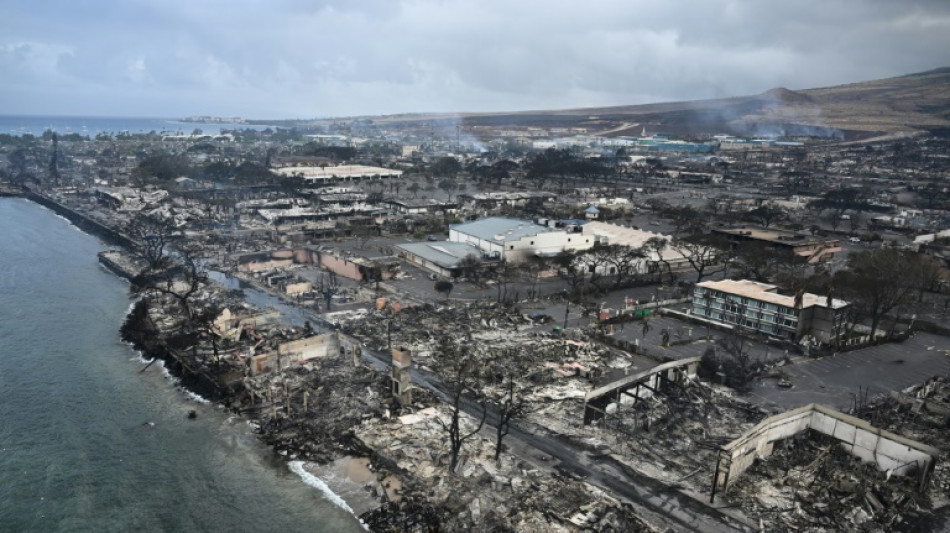
Conspiracy theories falsely link wildfires to 'smart cities' / Photo: Patrick T. Fallon - AFP/File
 Japan Olympic chief says 'lot more' athletes at Games than expected
 Asian carmakers besting US rivals at home, China poised to strike

 Widgets & Web Offers All-Inclusive Investor Relations Websites for Public Companies, IPOs and SPACs

 Adams named new US captain to 2030 World Cup

 China a better influence in Latin America than US: poll

 Judge pauses construction of border project in Texas national park

 Belgium's De Bruyne fires double to sink Turkey, France held by Italy
 US jobs data boosts stocks as oil prices dip

 US Supreme Court to hear high-stakes climate case
 Trump expected to name intel chief Clayton as AI czar: reports
 Argentina unveils passports-for-investment scheme

 Brazil election debate chaos sparks censorship row
 England's Carse charged by cricket body over nightclub incident
 Amazon vows $1 bn for data center towns, decries 'myths'

 Oil prices drop on G7 fuel release, US jobs data boosts stocks

 G7 agrees deal to ease global energy supply concerns

 Spain's government dealt blow as lawmakers reject housing bills
 Food, medicine shortages deepen in Russian-occupied Oleshky
 Man City whistleblower Rui Pinto facing 'dire consequences' - lawyers
 Russia 'tearing Kyiv apart', mayor says, as strikes paralyse traffic
 Taiwan boxer Lin wins Games gold as Japan edge North Korea on penalties

 Japan tame North Korea to win Games gold after shootout drama
 US posts weak job growth data in September

 Ethiopia's conflict: the regional dimension

 Life expectancy almost back to pre-Covid levels, says WHO

Disinformation about deadly wildfires in the United States and Canada has run rampant across social media, with posts falsely blaming coordinated arson, lasers -- and plans to develop "smart cities."
Allegations that the fires are a deliberate policy to clear areas for urban redesign deploy screenshots of government websites or headlines about everything from traffic monitoring to conferences about new technology.
"So what are the odds that we have two fires in two places within a week's time, and both of these places have initiatives to become smart-intelligent cities?" says a woman in a TikTok video, pointing to Lahaina, Hawaii and West Kelowna, British Columbia -- both of which were ravaged by wildfires in August.
Some of the videos fact-checked by AFP are no longer available on TikTok, but copies continue to circulate on Facebook, Instagram and X, formerly known as Twitter.
Kelowna did publish an "intelligent city" strategy in 2020, but there is no evidence that ground is being cleared on purpose -- a theory that has amassed millions of views in clips shared across platforms.
"I cannot conceive why a government would intentionally burn down a city to increase its use of smart city technologies," said Harvey Miller, director of the Center for Urban and Regional Analysis at The Ohio State University.
"There is no reason to destroy infrastructure to rebuild it smarter."
The conspiracy theories come amid widespread distrust in digitizing urban areas. A 2022 Axios-Momentive poll found only half of Americans are comfortable with the prospect of living in a smart city.
Kristina Dahl, principal climate scientist at the Union of Concerned Scientists, said claims that fires are being used to force changes on communities were "utterly baseless."
"It is really horrific to think that anyone would intentionally burn a community to the ground so that they could install technology," she added.
- Real world impact -
Similar conspiracy theories have circulated online after other disasters in North America, including Hurricane Idalia in Florida and a February train derailment in Ohio.
In Canada, plans for smart cities are often linked to supposed climate lockdowns or the elimination of cash.
Sometimes the rumors make their way to the real world.
David Mitchell, the mayor of Bridgewater, Nova Scotia, told AFP in May that a disinformation campaign targeted his city's participation in Canada's Smart Cities Challenge.
Posts falsely claimed the project would restrict residents' movement, leaving seniors worried they would be unable to visit their grandchildren.
In fact, Mitchell said the project was focused on retrofitting homes to be more energy-efficient and bringing more public transportation online.
"That's where this is going from being simply an annoyance of people spreading lies, to really concerning for me and other communities across the country because people are legitimately scared," he said.
While conspiracy theories are damaging, Ohio State's Miller said that privacy in modern cities is a concern.
"You cannot monitor a city at high resolution in real-time without creating the possibility of identifying individuals and their patterns of activities," he said.
Experts say transparency is key, pointing to a project that Google abandoned in Toronto in part because it failed to assuage concerns over how data would be used.
Lee McKnight, an associate professor at Syracuse University's School of Information Studies, said cities must ensure their plans are "privacy, security and rights-inclusive."
Andrew Smyth, chair of the Smart Cities Center at Columbia University's Data Science Institute, agreed.
His team, which tests concepts in Harlem in New York City, as well as in New Jersey and Florida, is focused on "privacy-preserving" technology.
"I'm not aware of nefarious motives in the smart city movement," he said. "There's no real reason why cities would seek to control -- they are looking to gain efficiencies."
Ch.Kahalev--AMWN